
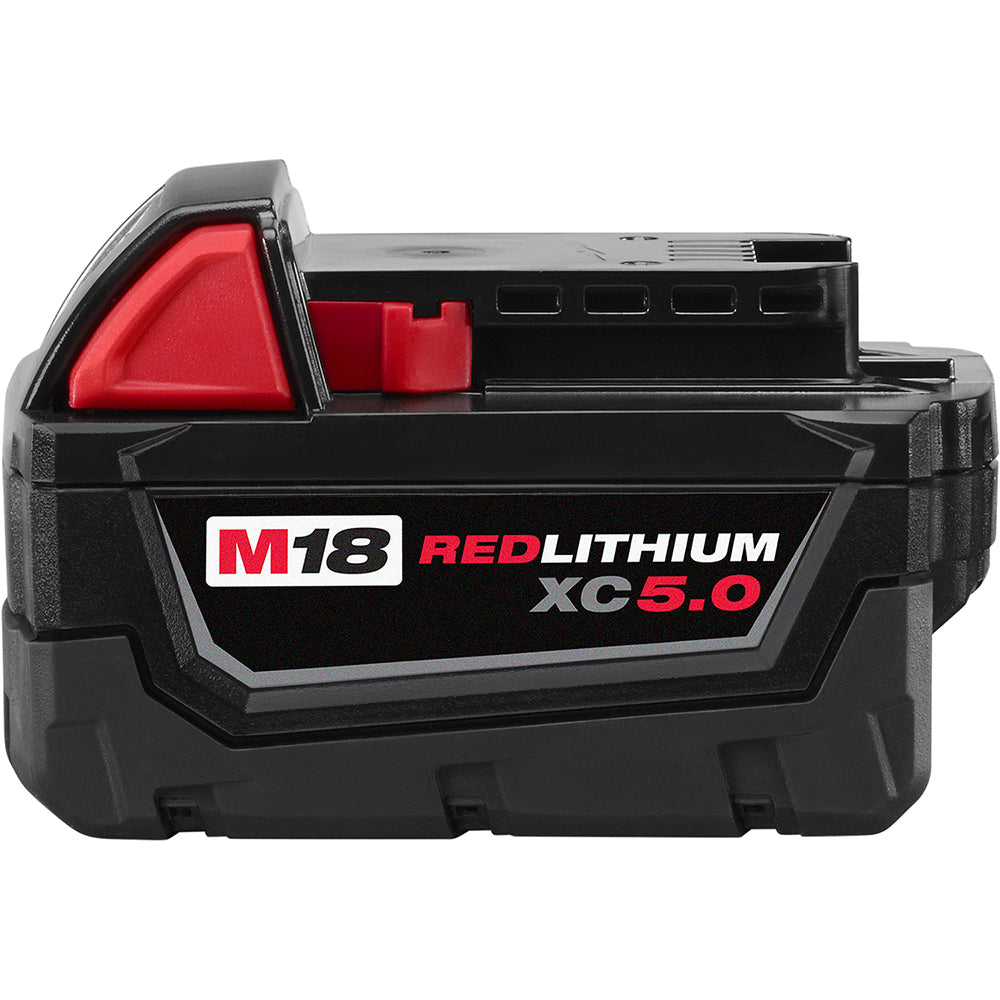
Milwaukee M18 to DeWalt Battery Adapter: Does It Actually Work?
Milwaukee M18 to DeWalt battery adapters are real — third-party options are widely available online. They mechanically bridge an M18 battery into a DeWalt 20V slot. For low-draw accessories — LED job lights, small fans, jobsite radios — they generally work fine. For power tools under real load, expect cut-outs, overheating, or newer DeWalt XR and ATOMIC tools refusing to start at all because of a BMS communication mismatch. And if your actual goal is USB device charging or AC power from your M18 battery on the job, you don't need a cross-brand adapter — there's a native M18 solution that works better.
What the Adapter Actually Does (and Doesn't)
The Mechanical Bridge
M18 and DeWalt 20V MAX use different proprietary connector shapes. The adapter physically remaps the terminal positions so an M18 battery can seat in a DeWalt tool's battery slot. That's the whole job.
The voltage difference is smaller than it looks. Milwaukee M18 batteries run at 18V nominal. DeWalt's "20V MAX" label refers to the no-load peak voltage; under working load, a DeWalt pack also runs at roughly 18V nominal. Voltage is not where the problem is.
The BMS Handshake — Why Some DeWalt Tools Won't Turn On at All
This is what every Amazon listing and Reddit thread buries or skips entirely — and it explains why you'll find wildly conflicting reports about these adapters.
Milwaukee M18 batteries use a digital Battery Management System (BMS) that communicates with M18 tools before allowing current to flow. A third-party adapter is a passive connector remap — no protocol translation, no signal generation. When you slot an M18 battery into a DeWalt tool via adapter, the DeWalt tool receives no recognizable battery signal.
No DeWalt tool line — 20V MAX, XR, or ATOMIC — enforces a digital BMS handshake; all battery-to-tool communication is purely analog via resistor-coded ID pin. Simpler and older tools tend to accept whatever the adapter delivers; higher-spec models with more stringent analog pin requirements will not power on.
"Worked great on my light" and "dead on my drill" are both accurate — those are just different tools with different BMS requirements.
No Official Cross-Brand Adapter Exists
Milwaukee doesn't make a DeWalt adapter. DeWalt doesn't make one for Milwaukee. Every adapter on the market is third-party, with no manufacturer testing, no OEM backing, and no support if something fails.
When the M18-to-DeWalt Adapter Works — and When It Fails
| Use Case | Adapter Works? |
|---|---|
| LED job lights, work lights | Generally yes |
| Small fans | Generally yes |
| Jobsite radios | Generally yes |
| USB charging via DeWalt tool port | Generally yes |
| Circular saws | Risky — avoid under load |
| Angle grinders | Avoid |
| Hammer drills, rotary hammers | Avoid |
Low-Draw Accessories — Acceptable

An LED light or jobsite radio pulls well under 10A continuous. The Milwaukee BMS protects itself and cuts power on overcurrent — but at these load levels it rarely trips. The adapter works.
Expect shorter runtime than a native DeWalt battery. The M18 BMS may cut power conservatively when it can't confirm it's seated in an M18 tool. That's fine for a work light; worth knowing if you're running something on a strict schedule.
High-Draw Power Tools — Avoid

Circular saws, angle grinders, and hammer drills under hard load pull far more current than low-draw accessories — both tool categories drawing substantial peak amperage under real working conditions. The adapter's terminals aren't built to sustain that current reliably. Heat builds at the contact points, intermittent connections develop, and the BMS trips mid-cut. That's a constant-reset problem at best and a safety concern at worst.
Add the analog pin verification failure on newer DeWalt XR brushless tools, and for those it's not even a runtime question — the tool won't start.
Warranty Risk on Both the Battery and Tool
Both Milwaukee and DeWalt restrict warranty coverage to use within their intended battery platform. A third-party adapter gives either brand legitimate grounds to deny a claim on a battery or tool failure. Don't take the word of an adapter seller on this. Check your tool manual or the manufacturer's current warranty page — milwaukeetool.com/warranty or dewalt.com/warranty — before deciding the tradeoff is worth it.
What You Probably Actually Need (No Adapter Required)
Most people searching for an M18-to-DeWalt adapter are solving one of two problems: charging a device on the job, or running a small AC load off a battery pack. Neither one requires a cross-brand adapter.
USB device charging: The M18 USB charger plugs directly into any M18 battery and delivers 65W of charging power. Enough for a phone, tablet, or earbuds. No adapter, no BMS bypass, no warranty risk. For more on using your battery pack as a portable power source, see our power tool battery guide.
AC power on the job: The M18 power inverter gives you a 120V outlet, two USB ports, and an LED light directly from any M18 battery — 150W continuous, no extension cord needed. Enough for a laptop charger, a small corded tool, or a jobsite speaker. If you're weighing that against a dedicated charger, our charger vs. inverter comparison breaks down that decision clearly. And if you want to know how long your specific pack will last, battery runtime guide has the runtime math.
Both accessories stay fully within the M18 ecosystem — BMS intact, warranty intact, no adapter in the mix.
One contrast worth making: some third-party M18 adapters are manufacturer-recognized and designed for a specific purpose, like the M18 heated jacket battery adapter for heated apparel. Cross-brand tool adapters aren't in that category — no OEM endorsement, no tested current limits.
FAQ
Do Milwaukee M18 and DeWalt 20V batteries have the same voltage?
Close. Both use 18V nominal lithium-ion cells. DeWalt's "20V MAX" label is the no-load peak voltage; under working load it drops to ~18V — same as Milwaukee M18 nominal. Voltage-wise they're close. The real mismatches are in connector shape, BMS communication, and current ratings.
Is there an official adapter to use Milwaukee M18 batteries in DeWalt tools?
No. Milwaukee doesn't make one; DeWalt doesn't make one. Every adapter on Amazon or eBay is third-party with no manufacturer support or testing behind it.
Will using a battery adapter void my warranty?
Almost certainly. Both manufacturers restrict warranty coverage to their own platform. Using a third-party adapter gives either brand grounds to deny a claim on a failure — battery or tool. Check your manual or the manufacturer's current warranty page to confirm the current terms.
Why won't my DeWalt tool turn on with the Milwaukee battery adapter?
DeWalt 20V MAX XR brushless tools enforce battery thermistor (TH) and cell-voltage (C3) pin checks before operation. A Milwaukee M18 battery through a third-party adapter can't satisfy those checks, so the tool stays off. Third-party 20V MAX tools and older pre-brushless DeWalt models don't enforce those checks and will typically run.
Can I use a DeWalt battery in Milwaukee M18 tools with an adapter?
Yes — third-party adapters are sold in both directions. The same limitations apply: low-draw accessories may work; high-draw power tools carry real risk; no OEM version exists either way.
How much do Milwaukee M18 to DeWalt adapters cost?
Single adapters typically run $13–$30; two-packs or models with built-in USB charging ports often reach $35 or more.
Is it better to just buy a second battery in my platform?
For power tools, yes — a second Milwaukee M18 battery is a cleaner investment than an adapter. For device charging or small AC power on the job, a purpose-built M18 accessory handles it directly without any of the adapter failure modes.
If you own M18 tools and want to run devices off that battery, the adapter path has real gaps — especially with newer DeWalt gear. A native M18 accessory covers the same ground without the compatibility gamble, and your battery's BMS stays in the loop the whole time. See the full M18 accessory lineup at Milwaukee M18 accessories.