
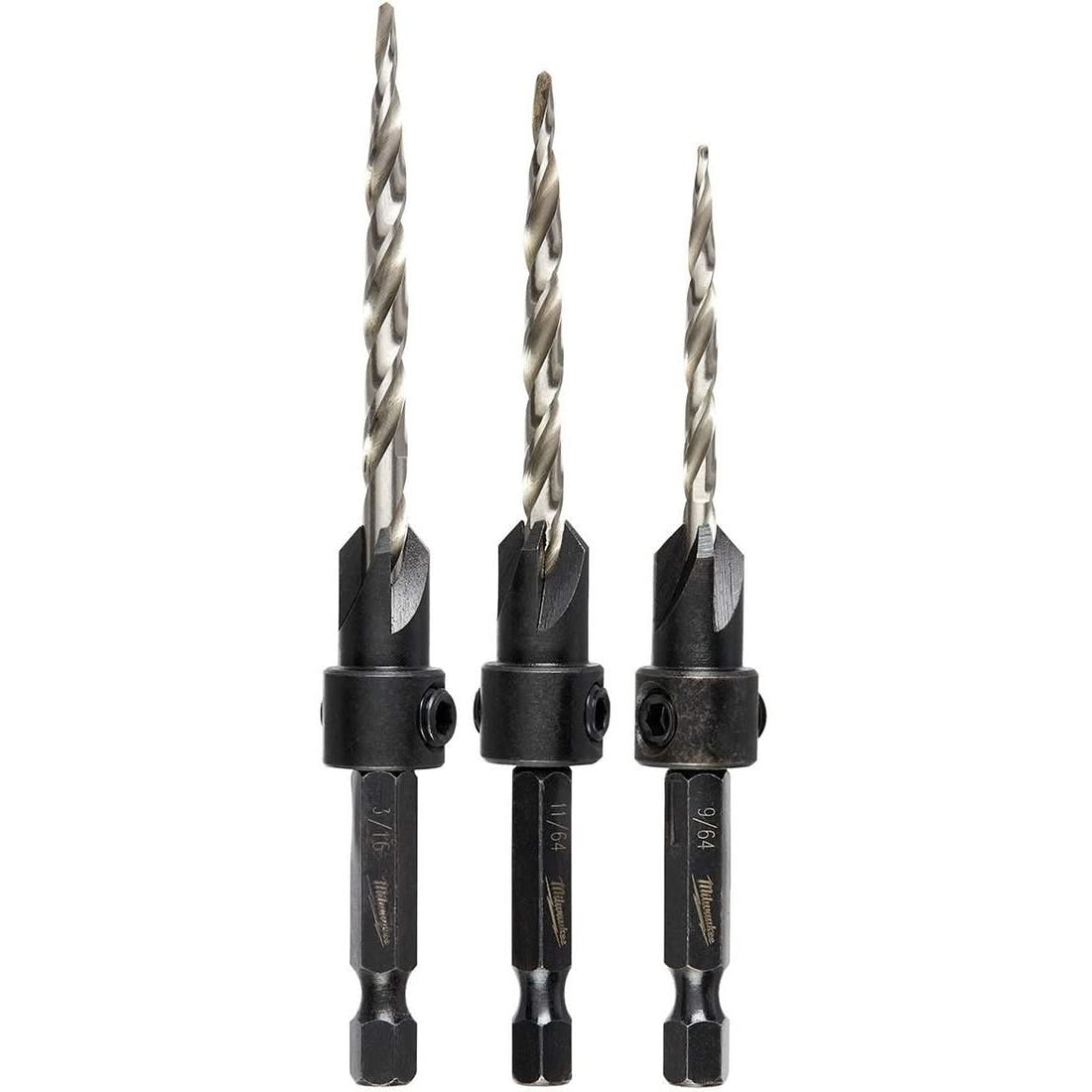
Impact Driver Countersink Bits for Deck Screws: What Works (and What Snaps)
Any impact-rated countersink bit with a ¼" hex shank works in a Milwaukee M12, M18, or DeWalt 20V MAX impact driver. Platform doesn't matter — all three use the same ¼" hex chuck. For deck screws specifically, you need an 82° countersink angle; that's the angle that matches the underside of most North American deck screw heads. Use a standard (non-impact-rated) bit and it'll snap. Use a 90° bit and the screw head will sit slightly proud. Get both specs right and you're set.
Why Not Every Countersink Bit Works in an Impact Driver
Impact-Rated vs. Standard — What the Torsion Zone Actually Does
A standard countersink bit is built for drill-press or drill/driver speeds — consistent rotation, no shock. The tip geometry is rigid and brittle. That's fine in a drill. It's a problem in an impact driver.
An impact driver doesn't just spin. It delivers rotational torque in rapid hammer strikes — hundreds of impacts per minute. That pulse-and-release action fractures a standard countersink bit at the tip or shank, often on the first seating under load. It's not a function of brand or battery voltage. Any impact driver will do it.
Impact-rated bits are built with a torsion zone — a section of the shank engineered to flex with rotational shock rather than transmit it straight to the tip. That's the difference between a bit that survives 300 countersinks on a deck job and one that snaps by the 15th screw. For more on why impact-rated construction matters, see why impact-rated bits matter.
The ¼" Hex Shank Requirement
This isn't a preference — it's a fit issue. Impact drivers use a quick-release ¼" hex chuck. Round-shank bits (common in drill-press countersink sets) won't seat in that chuck. Period.
Every bit you put in an impact driver needs a ¼" hex shank. That's the whole compatibility story at the shank level. Full background on shank types is available in our hex vs. round shank guide.
The Angle That Matters — 82° for Deck Screws
How to Read the Label
Countersink bits come in two common angles: 82° and 90°. On packaging you'll see it written as "82°," "82° countersink," or something like "#8 × 82°" or "82° × 3⁄8 in." — that last format means 82° angle, 3⁄8" cutting diameter.
If the angle isn't printed clearly, look at what the set is marketed for. Sets labeled "woodworking," "cabinetry," or "furniture" are almost always 90°. Sets labeled "deck screws," "construction," or "structural screws" should be 82°. The major deck screw brands — GRK, FastenMaster, and Spax among them — specify this angle in their product documentation, so it's worth a quick check against the manufacturer's spec for the exact screw you're using.
When 90° Is Used — and Why It's Wrong Here
The 90° angle is standard for European hardware and cabinet screws. It cuts a wider, shallower recess. For those applications, it's correct. For deck screws, it isn't.
GRK, FastenMaster, Spax, and Deckmate deck screws are designed with an 82° head angle. Drive one into a 90° countersink and the geometry doesn't match — the head sits 1–2mm proud of the surface. On a deck, that's a trip hazard. On a railing, it's a snag point. Verify the angle on the package before you open it.
One-Step vs. Two-Step — Combination Pilot/Countersink Bits for Deck Work
What a Combination Bit Does
A combination pilot/countersink bit drills the pilot hole and cuts the countersink recess in a single pass. For softwood decking — pressure-treated pine, cedar, redwood — this is the efficient move. Size the bit to your screw: a #8 combination bit for a #8 deck screw, which is the most common size at 0.164" shank diameter. Many combination bits include an adjustable depth collar so you can dial in consistent countersink depth across a full deck run without second-guessing every hole.
When Two Separate Bits Make More Sense
Hardwood decking — ipe, teak, cumaru, garapa — is a different situation. These woods are dense enough that pilot hole diameter has to be precise to prevent splitting. The pilot portion on most combination bits is sized for softwood clearance. In hardwoods, that often leaves too little room.
The better approach for hardwoods: pilot drill first at 1/8", then countersink separately. For #8 screws into softwood, the recommended pilot diameter varies by brand and screw type — check the screw manufacturer's pilot drill chart for the correct size. It's one extra step in hardwood, but it's how you avoid splitting a $40-per-linear-foot board.
Composite Decking Caution
Composite decking (Trex, TimberTech, Fiberon) is harder on the surface than in the core. Apply full impact driver torque to a countersink bit on composite and you can blow out the material around the hole — leaving a ragged, oversized void instead of a clean recess.
Two options: dial the impact driver to its lowest torque setting before the bit seats, or switch to a standard drill for the countersinking step and use the impact driver only for driving screws. Most composite deck manufacturers recommend a drill for countersinking.
Impact-Rated Countersink Bit Sets That Actually Work
| Brand | Model Line | Shank | Angle | Impact-Rated? | Best For |
|---|---|---|---|---|---|
| Milwaukee | Shockwave countersink set | ¼" hex | 82° | Yes | Deck and construction work; designed for M12/M18 and any ¼" hex chuck |
| DeWalt | Impact Ready countersink set | ¼" hex | 82° | Yes | 20V MAX users; fits any ¼" hex impact driver |
| Irwin | Impact Performance countersink set | ¼" hex | 82° | Yes | Budget-friendly option; solid for softwood deck work |
| Snappy Tools | Combination countersink set | ¼" hex | 82° | Yes | Adjustable depth stops; good for consistent depth on large deck runs |
Confirm current model numbers and included pilot sizes against brand sites before ordering — these sets get updated regularly. For Milwaukee, check the current Shockwave countersink lineup at milwaukee.com; for DeWalt, verify the current Impact Ready countersink set at dewalt.com.
Tool Army doesn't carry countersink bit sets in the current catalog. For platform-matched accessories, browse our Milwaukee collection or DeWalt collection. For a full head-to-head on Shockwave vs. Maxfit across the impact bit lineup, see our Shockwave vs. Maxfit comparison.
Does the Impact Driver Brand Matter? (M12 vs. M18 vs. 20V MAX)
No. Milwaukee M12, M18, and DeWalt 20V MAX impact drivers all use a ¼" hex quick-release chuck. Any impact-rated ¼" hex bit fits all three without an adapter.
One honest distinction worth knowing: peak torque varies across these platforms. The M12 FUEL delivers significantly less torque than the M18 FUEL or the DeWalt 20V MAX XR — roughly half, with the higher-platform drivers reaching up to 1,300 in-lb peak. That lower torque is actually a mild advantage for countersinking softwood — less chance of blowing through. The M18 and 20V MAX give you more headroom for driving into dense material or hardwood pilot drilling. But the bits themselves are identical across all three platforms.
For the full impact bit hub, see our complete impact bit guide.
Frequently Asked Questions
Can you use a countersink bit in an impact driver?
Yes — but only if it's explicitly impact-rated with a ¼" hex shank. Standard countersink bits come with smooth round shanks for drill use and will snap under the rotational shock of an impact driver. Look for "impact ready," "impact rated," or "Shockwave" on the package. If the bit came in a drill-press accessory set, it's the wrong tool for an impact driver.
What angle countersink bit do I need for deck screws?
82°. Most North American deck screws — GRK, FastenMaster, Spax, Deckmate — are designed with an 82° head angle. A 90° countersink (common in woodworking and cabinet sets) will leave the screw head sitting slightly proud of the surface.
Do I need to pilot drill before driving deck screws?
Into softwood decking (pressure-treated pine, cedar, redwood), a combination pilot/countersink bit handles both steps in one pass and works fine. Into hardwoods (ipe, teak, cumaru), always pilot drill first at the correct diameter — these woods split without a proper pilot hole, and a combination bit alone won't prevent it.
What size countersink bit do I need for deck screws?
Match the bit to the screw shank. For a #8 deck screw — the most common size — use a #8 countersink bit or a combination bit labeled for #8 screws. Check the screw manufacturer's pilot drill chart for the exact pilot diameter, since recommendations vary slightly by brand and screw type.
Will Milwaukee Shockwave bits work in a DeWalt impact driver?
Yes. Milwaukee M12/M18 and DeWalt 20V MAX impact drivers both use a ¼" hex chuck. Any ¼" hex shank impact-rated bit — Shockwave, Maxfit, or otherwise — fits either driver without an adapter. See our impact bit selection guide for broader guidance on impact bit selection.
What's the difference between a countersink and a counterbore for deck screws?
A countersink creates a tapered recess so a flat or bugle-head screw sits flush with the wood surface — that's what deck screws need. A counterbore creates a flat-bottomed cylindrical hole for bolt heads or wood plugs. For standard deck screws, you want a countersink.
When you're making 200-plus countersinks on a deck run, you'll swap between the countersink bit and the driver bit constantly. A magnetic bit holder keeps both at the gun — no hunting the deck boards for the bit you just set down. More on how it works across Milwaukee and DeWalt platforms in our platform compatibility guide.
For the rest of your Milwaukee platform accessories, check our Milwaukee collection for what fits your tools. DeWalt 20V MAX users, start at our DeWalt collection.