
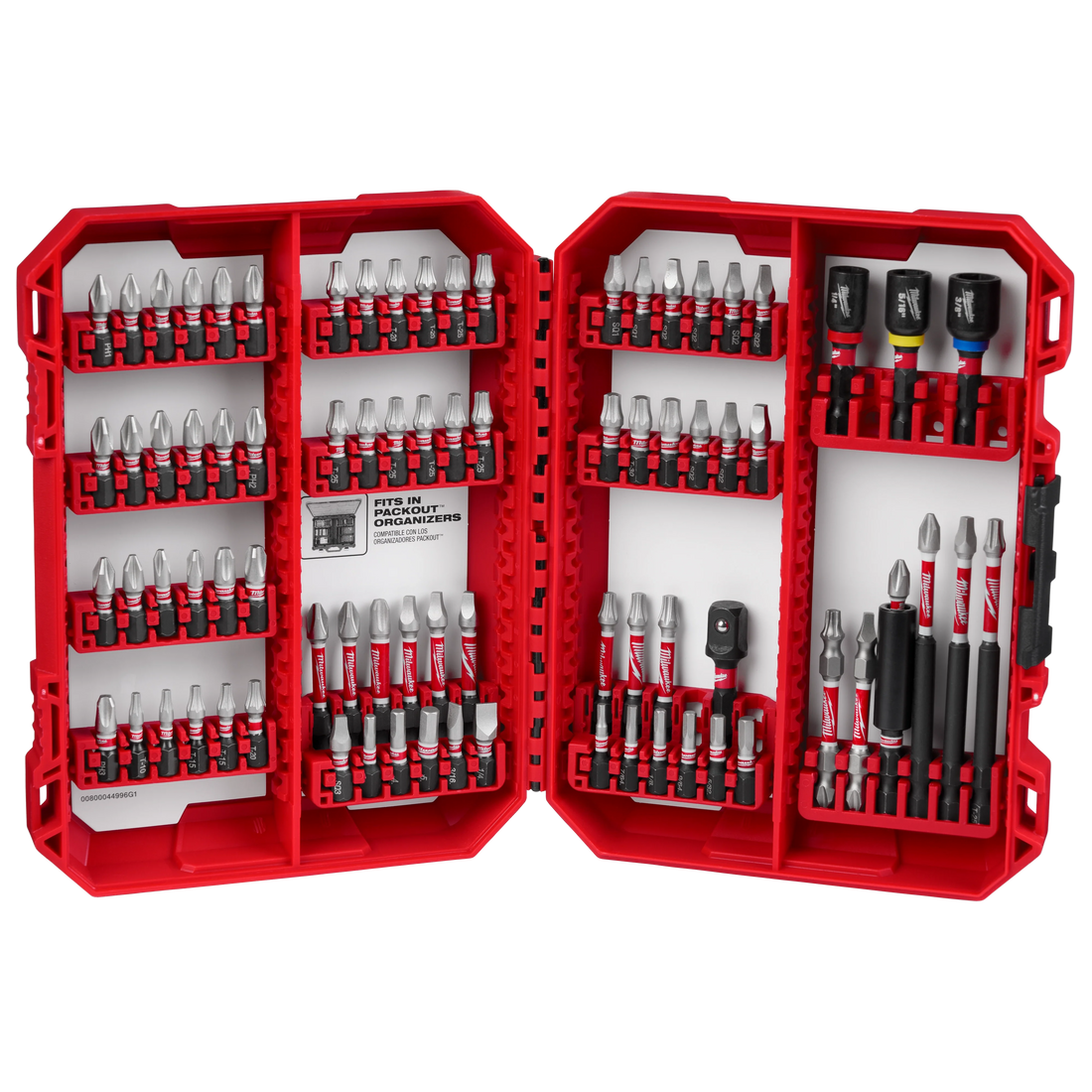
Milwaukee SHOCKWAVE vs DeWalt MAXFIT Impact Bits: Which One Should You Actually Buy?
Short answer: both impact bit lines fit any 1/4" hex impact driver — Milwaukee M12/M18, DeWalt 20V Max, Makita, Ryobi, doesn't matter. Driver brand has nothing to do with bit brand. Pick by fastener, not by tool color. Buy Milwaukee SHOCKWAVE if you drive mostly #2 Phillips (deck screws, framing, drywall) — the tip is spec'd to true PH2 geometry and cams out less under high torque. Buy DeWalt MAXFIT if you're constantly switching between Phillips and Square/Robertson (cabinets, trim, mixed finish work) — the wider tip handles both. That's the whole decision. Everything below is the why.
Do MAXFIT Bits Fit a Milwaukee Impact Driver — and SHOCKWAVE in a DeWalt?
Yes and yes. This is the question most buyers get wrong before they ever compare the tips.
The 1/4" Hex Shank Standard
Every major impact driver on the market — Milwaukee M12, M18, DeWalt 20V Max, Makita 18V LXT, Ryobi, Bosch — uses a 1/4" hex chuck. Both SHOCKWAVE and MAXFIT are 1/4" hex shank bits. Drop either into either driver. It works. The shank is an industry-wide standard, not brand lock-in.
If you run Milwaukee tools and see MAXFIT on clearance, buy them. If your DeWalt-running partner has a SHOCKWAVE set, borrow it without a second thought. Driver logo on the handle is irrelevant.
The Only Real Compatibility Gotcha
Length and format matter for your *holder*, not your driver:
- 1" insert bits — the short ones used in magnetic bit holders — fit any holder with a 1/4" hex socket. Universal.
- 2", 3", and 6" driver bits — fit standard impact chucks directly. Universal.
- Double-ended power bits — same 1/4" hex shank; some right-angle adapters expect a smooth reduced shank on one end, so check your adapter before ordering.
For insert bits — the most common format in production screw driving — what actually holds the bit matters as much as the bit itself. More on that below.
SHOCKWAVE Spec Breakdown — What "Shock Zone" and Alloy76 Steel Actually Mean
Milwaukee's SHOCKWAVE Impact Duty line is built from Custom Alloy76™ Steel. That proprietary steel formulation is tuned for repeated torque-spike loading — the hammering an impact driver delivers on every fastener.
Tip Geometry, the Flex Zone, and the Life Claim
Shock Zone: SHOCKWAVE bits have a narrowed cross-section a few millimeters behind the tip. That flex zone absorbs the rotational shock from the driver's hammering mechanism before it can reach the tip. The tip is less likely to shear from a torque spike; tip wear comes from cam-out friction instead of snapping.
The PH2 tip: SHOCKWAVE PH2 tips are ground to true Phillips #2 geometry — the profile that mates precisely with a Phillips screw recess. Precise fit equals less cam-out under high torque.
The life claim: Milwaukee states SHOCKWAVE delivers up to 50X bit life. Keep the comparator in mind: they're benchmarking against generic, non-impact-rated bits — not against MAXFIT. Nobody has published a controlled head-to-head, and neither brand has.
Where SHOCKWAVE Wins
- Deck builds (high-torque PH2 into treated lumber, volume driving)
- Framing and sheathing (same conditions — PH2 into hardwood or engineered lumber)
- Drywall (power bit format, fast PH2 sinking at lower torque with high RPM)
- Any job that is almost entirely #2 Phillips screws
MAXFIT Spec Breakdown — the "One Bit Fits Phillips and Square" Trade-Off

MAXFIT solves a different problem: the job where you're driving PH2 screws one minute and #2 Square/Robertson (SQ2/R2) screws the next. Cabinet installs. Trim work. Finish carpentry with mixed-fastener hardware kits.
Wider Tip Geometry: What It Gains, What It Gives Up
The MAXFIT tip is ground to a slightly wider profile that seats into both a #2 Phillips recess and a #2 Square/Robertson recess. On a Robertson screw, it seats clean and drives true. On a Phillips screw, it works — but the fit is marginally less precise than a dedicated PH2 tip.
That marginal looseness matters when torque goes up. Driving 3" structural screws into PT lumber at full trigger on an M18, you'll cam out MAXFIT tips faster than SHOCKWAVE because the tip doesn't mate as tightly to the Phillips recess. On cabinet screws, hinge hardware, and finish work at lower torque, you'll never notice the difference — the trade-off is effectively invisible there.
Where MAXFIT Wins
- Kitchen and bath cabinet installs (PH2 and SQ2 hardware throughout — saves constant bit swapping)
- Trim and millwork (mixed fasteners, lower torque, flip between Phillips and Robertson without pulling the bit)
- Auto trim panels and interior work where Robertson fasteners dominate
- Any mixed-fastener job where the productivity gain of one bit outweighs the slight tip slop
MAXFIT vs. DeWalt FlexTorq — How They're Actually Different
These two get conflated constantly, and it matters. DeWalt sells MAXFIT and FlexTorq as distinct product families — no current bit carries both brand names.
- MAXFIT = tip geometry. The wider tip that seats PH2 and SQ2. Has nothing to do with the shank.
- FlexTorq = shank technology. A torsion zone behind the tip (same concept as SHOCKWAVE's Shock Zone) that absorbs torque spikes before they shear the tip.
They're separate features, and DeWalt offers them only as separate lines. If you want the mixed-fastener versatility *and* the torsion protection, you'd need to pick the line that better fits your job — they don't currently overlap. If you drive mostly PH2 at high volume and want DeWalt's equivalent of SHOCKWAVE's torsion approach, FlexTorq (not MAXFIT) is the closer comparison.
Head-to-Head: Durability, Cam-Out, and Fastener Fit
| Feature | Milwaukee SHOCKWAVE | DeWalt MAXFIT |
|---|---|---|
| Steel | Custom Alloy76™ Steel | Impact-rated steel (alloy not published) |
| Tip geometry | True PH2 | Wider: PH2 + SQ2/R2 |
| Torsion zone | Shock Zone (standard) | Not standard; FlexTorq shank adds it |
| Fits Milwaukee driver? | Yes | Yes |
| Fits DeWalt driver? | Yes | Yes |
| High-torque PH2 cam-out risk | Lower | Slightly higher |
| Mixed-fastener versatility | PH2 only | PH2 + SQ2/R2 |
Verdict by scenario:
- Pure PH2, high torque (deck, framing, drywall) → SHOCKWAVE
- Mixed PH2 + SQ2 (cabinet, trim, finish) → MAXFIT
- High volume PH2 but prefer DeWalt branding → look at FlexTorq, not MAXFIT
Both brands compare their life claims against generic, unrated standard bits — not against each other. Take those numbers as "better than a hardware store pack," not as a brand shootout.
What Actually Breaks a Bit
Bits fail three ways: cam-out grinds the tip flat gradually; torque spikes shear the tip clean off; and using a non-impact-rated bit in an impact driver destroys it fast (they're not designed for hammering). Both SHOCKWAVE and MAXFIT address torque spikes with their flex zones — that's the real difference versus standard bits, not tip material alone.
Full failure-mode breakdown: why impact driver bits break
The Move Most Guides Skip: Pair Either Bit With the Right Holder
Here's where most comparisons leave money on the table — or on the deck boards, in bits of stripped screw head.
A standard quick-release impact chuck holds the 1/4" hex securely under normal conditions. But at high torque or with worn chucks, there's play. That play means the bit wobbles slightly on the screw during the drive cycle — and wobble equals cam-out. It doesn't matter how good the tip geometry is if the bit is rattling in its seat.
Why a Locking Magnetic Holder Cuts Cam-Out More Than a Tip Upgrade
A locking magnetic bit holder engages the retention notch (the circumferential groove machined into impact insert bits) and holds the bit so it can't back out or wobble. The magnetic face also centers the screw on the tip before the drive starts. The result: the screw seats squarely, the tip stays engaged, and you get the full benefit of SHOCKWAVE's or MAXFIT's tip geometry instead of fighting the holder.
A decent magnetic bit holder with a locking collar will outperform a premium bit in a worn or non-locking chuck. It's not close. The bit brand is a smaller variable than most gear content lets on.
We carry a magnetic bit holder built for both Milwaukee and DeWalt 1/4" hex systems. Same holder, either driver. Grab it with whichever bit line you choose.
See also: magnetic bit holder compatibility
Job-by-Job: Quick Recommendation
| Job | Buy this | Why |
|---|---|---|
| Deck build | SHOCKWAVE PH2 | High torque, pure Phillips — tip precision keeps cam-out down |
| Kitchen cabinet install | MAXFIT | Mixes PH2 and SQ2 hardware; saves constant swapping |
| Framing / sheathing | SHOCKWAVE PH2 | Same logic as decks; power bit format for volume |
| Drywall | SHOCKWAVE PH2 power bit | Volume driving; precise tip sinks faster, fewer stripped heads |
| Auto trim panels | MAXFIT | Robertson-heavy fasteners; MAXFIT seats clean |
| Long structural screws (#10, LedgerLOK, etc.) | Neither — use Torx | PH2 and SQ2 both cam out on structural screws; T25/T30 is the right call |
Frequently Asked Questions: SHOCKWAVE vs MAXFIT Impact Bits
Do DeWalt MAXFIT bits fit a Milwaukee impact driver?
Yes. MAXFIT uses the industry-standard 1/4" hex shank, which fits any 1/4" hex impact driver — Milwaukee M12, M18, DeWalt 20V Max, Makita, Ryobi, Bosch. Driver brand is completely irrelevant.
Do Milwaukee SHOCKWAVE bits fit a DeWalt impact driver?
Yes, same reason. SHOCKWAVE bits are 1/4" hex shank and drop into any driver with a 1/4" hex chuck. Your DCF887 doesn't know or care that the bit is red.
Which lasts longer — SHOCKWAVE or MAXFIT?
On pure #2 Phillips (deck, framing, drywall), SHOCKWAVE typically outlasts MAXFIT because the tip fits the Phillips recess more precisely — less cam-out means less tip wear. On mixed-fastener work, MAXFIT wins on practical grounds because you're not swapping bits every third screw. Both brands' "up to X life" claims compare their premium bits to generic, non-impact-rated bits — not to each other.
What is DeWalt MAXFIT?
DeWalt's premium impact-rated driver-bit line. The defining feature is a wider tip profile that nests into both #2 Phillips and #2 Square/Robertson screws — one bit handles two fastener types. Useful for mixed-fastener jobs; a marginal trade-off on pure high-torque PH2 applications.
What does "SHOCKWAVE Impact Duty" mean?
Milwaukee's name for their premium impact-rated bit line. Built with a proprietary steel formulation and a "Shock Zone" — a narrowed flex section behind the tip that absorbs the torque spikes an impact driver generates on every fastener. The tip takes less direct shock, so it wears from friction instead of snapping. For how that driver-bit relationship plays out with a hydraulic impact, the mechanics are complex.
What's the difference between MAXFIT and FlexTorq?
They describe different things. MAXFIT = tip geometry (wider profile that fits PH2 + SQ2). FlexTorq = shank technology (torsion zone that absorbs torque spikes, similar in concept to SHOCKWAVE's Shock Zone). DeWalt sells bits with both features on the same shank, and also sells each separately. If you want torsion protection without the dual-tip trade-off, FlexTorq alone is the right pick.
Are premium impact bits worth the price over standard bits?
For pros and serious DIYers running volume screws regularly, yes. A 5-pack that lasts a full deck build is cheaper than buying two or three cheap packs on the same job. For occasional home use — assembling furniture, hanging shelves — a basic impact-rated bit from either brand handles it fine. Save the premium line for high-volume driving where the tip wear actually shows up.
What actually breaks impact driver bits?
Three things: cam-out grinds the tip flat over time; torque spikes shear the tip off cleanly; and running a non-impact-rated bit in an impact driver destroys it fast. Full breakdown: impact driver bit failure.
Bit brand is a small lever. Matching tip geometry to fastener type and running a good magnetic holder are the big ones. Both SHOCKWAVE and MAXFIT are real upgrades from generic bits — just pick the right one for your most common job.
Browse the full Milwaukee accessory lineup or the DeWalt lineup. And the magnetic bit holder fits both platforms — it's the upgrade that makes whichever bits you pick actually perform.
More from the impact bit cluster:
- best impact driver bits — full bit roundup across formats and brands
- hex shank vs round shank drill bits — why the 1/4" hex shank is universal and when round shank causes problems
- impact driver bit failure — the physics of cam-out, torque spikes, and tip failure