
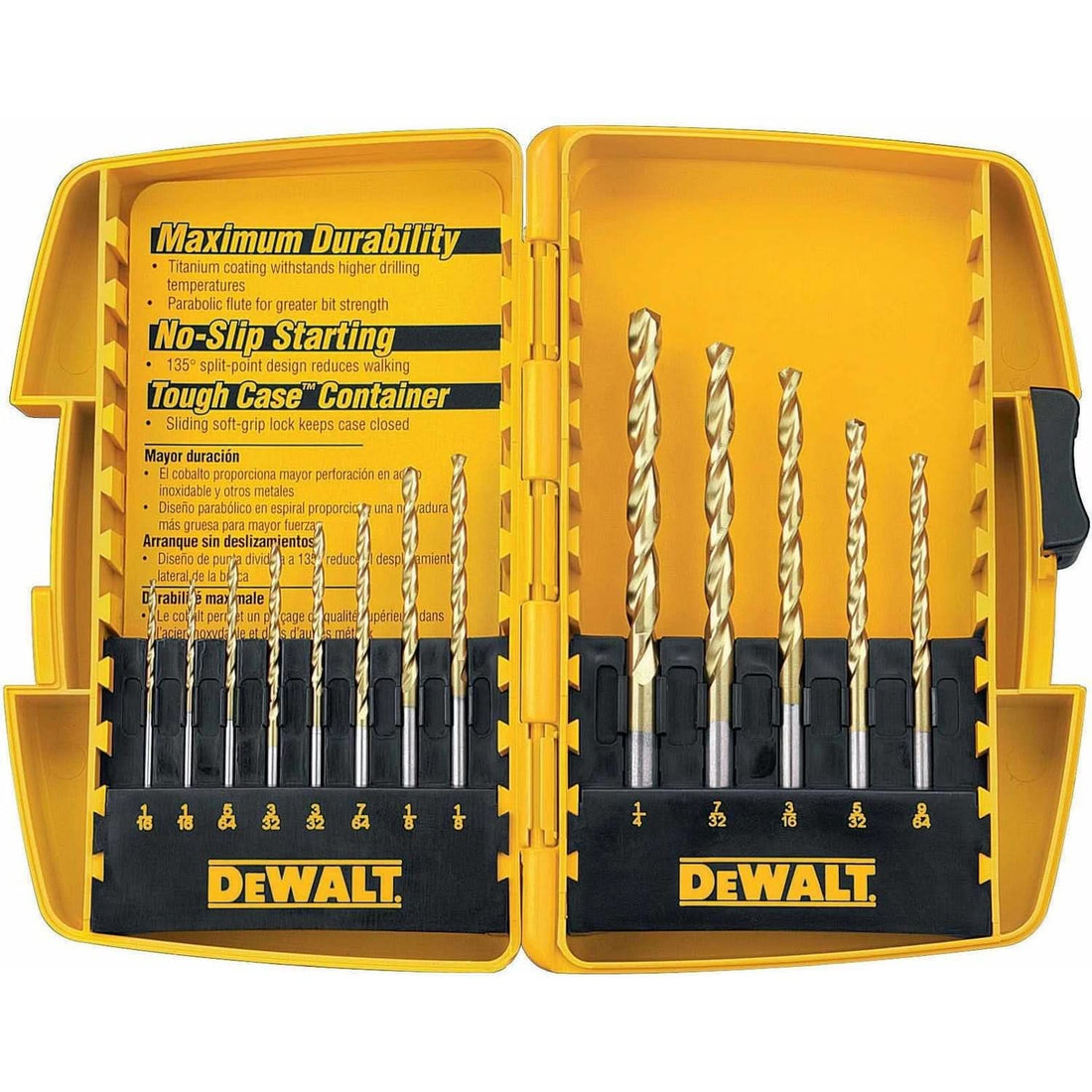
Cobalt vs Titanium Drill Bits: Which One You Actually Need
Cobalt drill bits — M35 or M42, high-speed steel alloyed with 5% cobalt (M35) or 8% cobalt (M42) throughout the body — belong in stainless steel, hardened steel, and cast iron. Titanium-coated drill bits — HSS with a Titanium Nitride (TiN) skin — handle wood, plastic, aluminum, and mild steel.
Here's the part most guides leave out: cobalt is alloyed *all the way through*. Heat it, grind it, run it hard — the hardness stays. A titanium bit has a coating just 2–5 µm thick. The moment that skin wears off, you're running plain HSS. Fine in wood. Useless in stainless.
Drilling one hole in pine? Buy titanium-coated. Drilling stainless hardware all week? Buy cobalt.
Cobalt vs Titanium: The 30-Second Decision
| Material | Reach For | Skip |
|---|---|---|
| Wood / plywood | TiN-coated or black oxide | Cobalt (overkill, waste of money) |
| Plastic | TiN-coated | Cobalt |
| Aluminum | TiN-coated or plain HSS | — |
| Mild steel | TiN-coated | — |
| Stainless steel | Cobalt M35 minimum | TiN-coated (coating wears off fast) |
| Hardened steel | Cobalt M42 | TiN-coated |
| Cast iron | Cobalt | TiN-coated |
| Masonry / concrete | Carbide or SDS bit | Both of these |
What "Cobalt" and "Titanium" Actually Mean
Retailers use both words loosely. Here's what you're actually buying.
Cobalt Bits — M35 and M42

Cobalt bits are high-speed steel with cobalt alloyed into the base metal — not a coating, not a finish, not a surface treatment. Two grades you'll encounter:
- M35: 5% cobalt, hardness 65–67 HRC — the standard cobalt step-up from plain HSS. Good for occasional stainless and harder steel work.
- M42: 8% cobalt, 68–70 HRC — harder, more heat-resistant, slightly more brittle. The right call if you're drilling stainless or hardened steel regularly.
That gold-bronze color on a cobalt bit? That's the cobalt alloy itself. Because the alloy runs all the way through, you can sharpen these on a bench grinder and still have a hard cutting edge. You remove material — not hardness.
Titanium Bits — TiN-Coated HSS
Titanium-coated bits start life as HSS bits. A Titanium Nitride (TiN) coating goes on via physical vapor deposition (PVD). The coating is 1–4 µm thick — thinner than a human hair. The TiN surface itself is impressively hard at 2,300 HV Vickers (~80–85 HRC), which is why they market these aggressively. But hard doesn't mean thick. Once that micron-thin skin wears through, you're drilling with plain HSS.
The bright gold color is the coating. Do not try to sharpen these — grinding removes the only hard part.
Which Drill Bit for Which Material?
Wood and plastic: Black-oxide or TiN-coated bits are the right call. Plain HSS cuts wood without issue; the TiN coating reduces friction and the heat that comes with it. Spending cobalt money on pine or PVC is money thrown away.
Aluminum: TiN-coated handles it well. Aluminum can gall against bare HSS; the coating reduces that. Keep your RPM moderate and don't let the bit dwell — build-up on the flutes is aluminum's main problem.
Mild steel: TiN-coated is fine for most jobs. Electrical boxes, angle iron, unistrut — the coating survives normal shop or field use on mild steel. Nothing here demands cobalt.
Stainless steel: Cobalt, period. Stainless is work-hardening — the act of drilling it hardens the material around the cut. You need a bit that stays hard under heat. Start with M35; if you drill stainless regularly, use M42. Use cutting oil. See the heat section below.
Hardened steel and cast iron: Cobalt M42. Cast iron is abrasive and chews through coating-only bits fast. For hardened steel, cobalt alloy is the only realistic HSS-based option.
Masonry and concrete: Neither cobalt nor titanium-coated HSS touches these effectively. You need a carbide-tipped masonry bit or an SDS-plus system. If you're picking a rotary hammer and unsure which bit system you need, this guide covers the difference.
How Heat Affects Cobalt vs Titanium Performance
Cobalt's real advantage isn't hardness on a spec sheet — it's *heat resistance*. Cobalt HSS retains its hardness up to around ~1,100°F (~600°C) — the same temperature at which TiN coating begins to degrade. What separates them isn't the temperature number but where the hardness lives: cobalt is alloyed throughout the full body of the bit, so it holds its edge right to that limit; TiN is a micron-thin surface skin that wears off under the concentrated heat at the cutting edge. On stainless, where the bit tip gets hot fast, that distinction matters.
When TiN breaks down from heat and you're driving plain HSS into work-hardening stainless, the bit dulls almost instantly. The hole gets harder as you drill. It goes sideways fast.
Two rules for drilling hard metal with cobalt:
1. Slow your RPM. Speed generates heat. In stainless especially, drop your drill speed and let the cutting edge do the work — don't spin it fast and hope for the best. 2. Use cutting oil. A drop of tapping fluid or cutting oil on the tip pulls heat away and keeps the bit sharp longer. This isn't optional for production stainless work.
Will These Bits Fit My Drill or Impact Driver?
This is the question the top results skip — and it's where Milwaukee and DeWalt users get tripped up.
Round-Shank Bits (Standard)
Most cobalt and titanium-coated bit sets ship with round shanks. These fit the keyless chuck on any Milwaukee M12, M18, or DeWalt 20V drill or drill/driver combo. If your tool has a chuck that you twist open and closed to grip the bit, round shank is what you want. Milwaukee's RED HELIX™ Cobalt Drill Bit Set (29-piece, SKU 48-89-2332) uses a 3-FLAT SECURE-GRIP™ shank that seats securely in any standard drill chuck — the Milwaukee example for round-shank cobalt work.
Hex-Shank Bits (1/4″)
Impact drivers — Milwaukee SURGE, Milwaukee M18 FUEL impact driver, DeWalt ATOMIC, DeWalt XR impact — use a 1/4″ hex collet. No chuck. They only accept 1/4″ hex-shank bits. Some cobalt and TiN-coated bit sets do come in hex-shank format. Those work in an impact driver — *if* they're impact-rated.
Impact-Rated vs Standard — Don't Skip This
A standard drill bit, round or hex shank, is designed for the smooth, continuous rotation of a drill. Impact drivers don't spin continuously — they deliver rapid rotational hammer blows. A non-impact bit absorbs those impulses, develops micro-fractures, and snaps. Sometimes on the first hole.
Impact-rated bits have a torsion zone engineered into the shaft to absorb those hammer cycles. Milwaukee's impact-rated drill bit line and DeWalt's Impact Ready Titanium Nitride Coating Drill Bits (DD5152, 12-piece) are the lines to look for by name.
If the packaging doesn't say "impact-rated" or "impact-ready," run it in a drill. Not an impact driver.
For the full shank and chuck compatibility breakdown, see our compatibility guide. If you've already snapped a bit in an impact driver and want to understand why, this article covers the mechanics.
Are Cobalt Drill Bits Worth the Extra Cost?
Cobalt sets cost more — often two to four times the price of a comparable TiN-coated set. That premium makes sense in some situations and is wasted money in others.
In hard metal — stainless, hardened steel, cast iron — cobalt survives substantially more holes before dulling, and it can be resharpened. The per-hole cost over the life of a cobalt set beats TiN-coated when the material is demanding.
In soft material — wood, plastic, mild steel — the TiN coating does its job and the cheaper set is the right buy. You'll never drill enough pine to justify cobalt.
The honest recommendation: most homeowners drilling occasional holes in a mix of wood, drywall, and mild steel should buy TiN-coated. A fabricator or tradesperson regularly running through stainless fittings, hardened anchors, or cast iron should buy cobalt — and probably M42.
Don't buy cobalt for wood. Don't buy titanium-coated for stainless.
When to Skip Both Cobalt and Titanium Bits
Pure woodwork: A black-oxide or standard HSS bit is cheaper than either option and cuts wood cleanly. No coating premium needed.
Sheet metal under 1/8″ thick: A step bit (unibit) is cleaner, faster, and safer on thin-gauge sheet metal than any jobber-length drill bit. Less chance of the bit grabbing and spinning the workpiece.
Concrete, block, brick, or tile: HSS-based bits — coated or alloyed — are not built for masonry. Carbide-tipped masonry bit or SDS system. Full stop.
FAQ
Are cobalt drill bits better than titanium? For hard metals — stainless, cast iron, hardened steel — yes. Cobalt is alloyed throughout and holds an edge at temperature. For wood, plastic, or mild steel, titanium-coated bits cut fine and cost less. "Better" depends entirely on what you're drilling.
Can you use cobalt drill bits on stainless steel? Yes — this is exactly what they're designed for. Use slow RPM and cutting oil. The cobalt keeps the tip hard even as it heats up from contact with work-hardening stainless. Skipping the cutting oil is where most people burn through bits.
Do titanium drill bits work on metal? On mild steel and aluminum, yes. On stainless or hardened steel, the TiN coating wears off within a few holes and you're left with plain HSS — which dulls fast in tough material. Titanium-coated bits are fine until the material gets demanding.
What are titanium drill bits actually made of? High-speed steel (HSS) with a thin Titanium Nitride (TiN) coating applied by physical vapor deposition. The coating is just a few microns thick — far thinner than a human hair. They are not solid titanium.
Can cobalt bits be sharpened? Yes. The cobalt is alloyed into the steel throughout the full length of the bit. Grinding a fresh cutting edge removes material — not hardness. Titanium-coated bits can't be effectively resharpened; grinding removes the coating and leaves you with plain HSS underneath.
What's the difference between M35 and M42 cobalt bits? M35 contains 5% cobalt with a hardness of 66–67 HRC — a solid step up from plain HSS for occasional stainless and harder steel work. M42 contains 8% cobalt — more heat-resistant and harder, better for regular stainless and hardened-steel use. M42 is slightly more brittle; it's not the right bit to abuse.
Can I use these bits in an impact driver? Only if they have a 1/4″ hex shank *and* are labeled impact-rated. A standard round-shank cobalt jobber bit in an impact driver will snap under the torque hammer. Even standard hex-shank bits can fail — look for "SHOCKWAVE," "impact-ready," or an equivalent rating before running drill bits in an impact driver.
For drilling stainless, the bit matters. So does what holds it. The Magnetic Silicon Bit Holder keeps hex-shank bits within reach on the driver without digging through a pouch — works with both Milwaukee and DeWalt collets. For more on which holder fits your setup, our platform guide breaks it down by platform.
Building out a full bit kit for your impact driver? Our impact driver bit guide covers the hex-shank lineup, and our DeWalt platform guide goes deep on the DeWalt platform specifically.
Shop chargers, inverters, and driver sets for your platform at Milwaukee and DeWalt.