
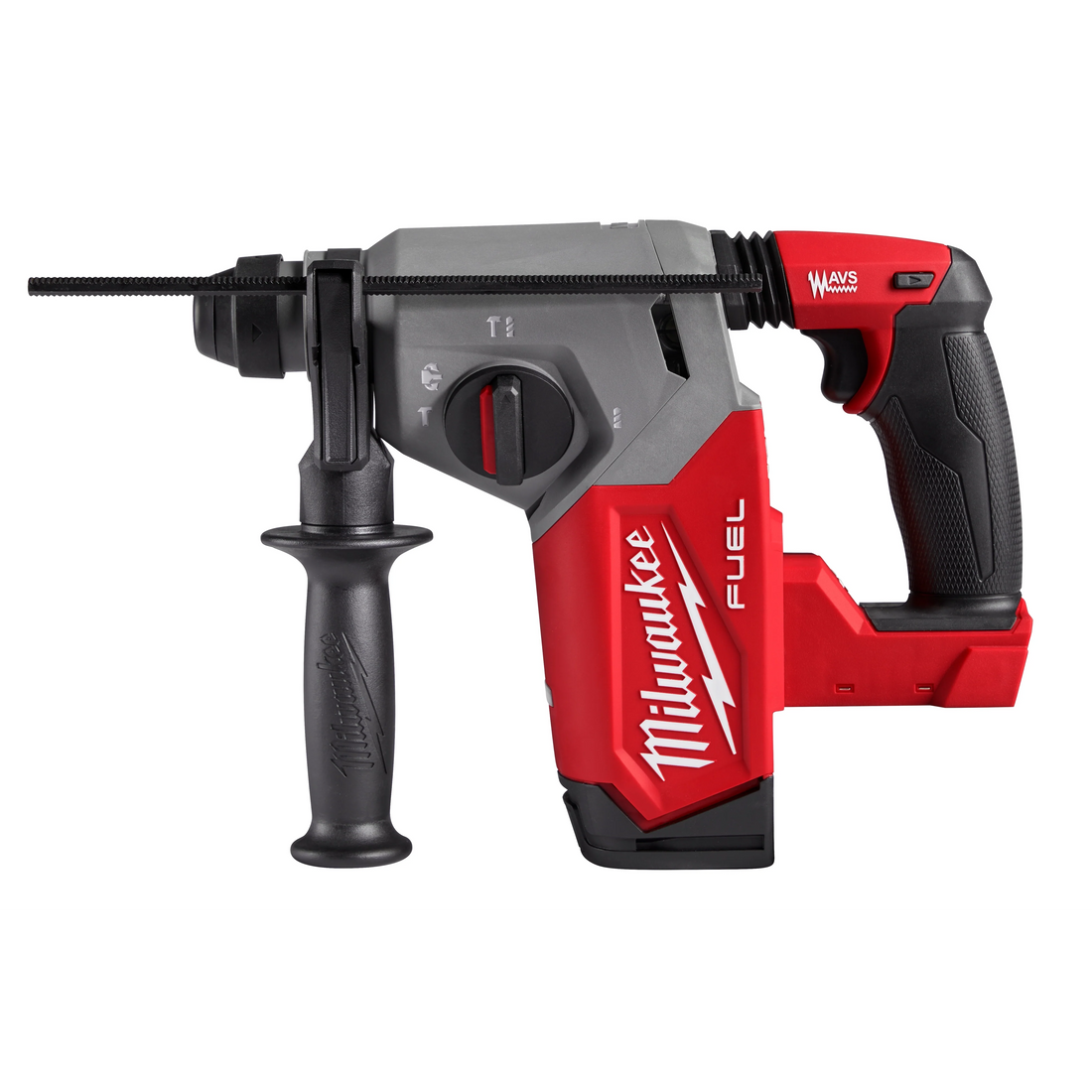
SDS Plus vs SDS Max: Which Rotary Hammer Bit System You Need (and What Fits Your Cordless Tool)
SDS Plus is the 10mm-shank system for everyday concrete drilling — anchors, conduit, and holes up to about 1-1/4". SDS Max is the 18mm-shank system for heavy holes and demolition. They are not interchangeable — a bit fits one chuck, not the other. If you already own a Milwaukee M18 or DeWalt 20V rotary hammer, it's almost certainly SDS Plus.
| SDS Plus | SDS Max | |
|---|---|---|
| Shank diameter | 10 mm | 18 mm |
| Insertion depth | ~40 mm | ~90 mm |
| Typical hole range | Up to ~1-1/4" | ~5/8"–2"+ |
| Tool class | Compact / mid rotary hammer | Full-size rotary hammer / breaker |
| Best for | Anchors, conduit, daily concrete | Large anchors, demo, heavy slab work |
SDS Plus vs SDS Max: Full Spec Comparison
| Spec | SDS Plus | SDS Max |
|---|---|---|
| Shank diameter | 10 mm | 18 mm |
| Insertion depth | ~40 mm | ~90 mm |
| Groove count | 4 (2 open, 2 closed) | 5 (3 open, 2 closed) |
| Practical hole range | Up to ~1-1/4" | ~5/8"–2"+ |
| Typical impact energy | ~2–4 J | ~7–14 J |
| Typical tool weight (bare) | ~5–8 lb | ~14–22 lb |
| Primary use | Anchors, conduit, daily drilling | Large holes, breaking, heavy slabs |
Shank specs and groove counts follow the SDS-Plus and SDS-Max (also known as TE-Y) standards as originally defined by Bosch and adopted industry-wide. Impact energy ranges are drawn from current OEM model spec sheets for the M18 and 20V/FlexVolt rotary hammer lines — see the compatibility section below.
What's Actually Different Between SDS Plus and SDS Max
Why SDS Plus and SDS Max Bits Won't Swap
The shank is what locks the bit into the chuck. SDS Plus uses a 10mm shank with 4 grooves — two open channels where the chuck's ball bearings seat, and two closed slots that keep the bit from spinning inside the chuck during operation. SDS Max uses a wider 18mm shank with 5 grooves — three open, two closed — for a more robust engagement sized to handle higher impact forces.
These dimensions don't overlap. You cannot physically seat an SDS Plus bit in an SDS Max chuck. An SDS Max bit won't enter an SDS Plus chuck. There's no wedge, no trick, no technique that changes this. The geometry is simply different.
Why Tool Size and Impact Energy Can't Be Swapped Either
Impact energy (joules) scales with the tool, and the tool is built around the chuck system. SDS Plus rotary hammers run in the 2–4 J class — enough for anchor bolts, conduit holes, and most commercial or residential concrete drilling. SDS Max tools run in the 7–14 J class and higher. That's not just a bigger chuck on the same motor. It's a different drive mechanism, a heavier counterbalance, and a larger chassis built to absorb and direct that energy.
You can't get SDS Max performance by retrofitting an SDS Plus tool with a bigger chuck. The limitation isn't the chuck — it's everything behind it.
Which One Do You Need?
Pick by Your Most Common Hole Size, Not Your Biggest One
The crossover zone is 1"–1-1/4". Bits in that diameter range exist for both systems, and either can do the job. Outside that zone, the choice is clear:
- Under 1" holes: SDS Plus is the right tool — faster, lighter, and cheaper bits. Drill your 1/2", 5/8", and 3/4" anchor holes all day without overbuying.
- Over 1-1/4" holes: SDS Max is where you want to be. Running a 1-1/2" or 2" core through an SDS Plus tool is slow, hard on the tool, and ultimately the wrong call.
Most anchor, conduit, and residential-to-light-commercial concrete work sits comfortably below 1". That's SDS Plus territory for the vast majority of people choosing between these systems.
How Often You'll Use It Matters Too
How often does large-hole or demolition work actually show up in your schedule?
A few times a year: rent the SDS Max. A $400+ tool that sits in the corner six months at a time isn't a good investment. Rental beats ownership at that frequency.
Weekly or monthly heavy-hole work: owning a mid-size SDS Max makes sense. But it still lives in the truck or shop — not in the daily bag alongside the SDS Plus cordless.
When Both Systems Make Sense
Most working pros run both — an SDS Plus cordless they carry every day, and access to an SDS Max for the occasional slab job or large-anchor day. That split is rational. Just don't buy an SDS Max expecting it to replace your SDS Plus for regular anchor work. Holding 14+ lbs overhead for 20 consecutive anchors isn't how you end a good day.
Cordless Compatibility — What Fits Milwaukee M18 and DeWalt 20V/FlexVolt
This is the part most comparison articles skip. If you're already on a battery platform, your chargers and batteries are part of the equation.
Milwaukee M18 SDS Plus Rotary Hammers
Milwaukee's M18 lineup covers SDS Plus with two main options:
- M18 FUEL 1" SDS Plus Rotary Hammer (model 2912-20)
- M18 1" SDS Plus Rotary Hammer (model 2912-20)
The FUEL version runs a brushless motor with higher impact energy and better runtime under load. The standard M18 1" is the value option for lighter, occasional anchor work. Both accept SDS Plus bits and run on your existing M18 packs.
Milwaukee M18 SDS Max Rotary Hammers

Milwaukee makes one cordless SDS Max option on the M18 platform:
- M18 FUEL 1-9/16" SDS Max Rotary Hammer (model 2718-21HD)
It's a heavy tool that performs best on a High Output M18 pack. Most M18 owners won't need it — but if large holes and demo are steady work, it's there, and it runs the same batteries you already own.
DeWalt 20V MAX SDS Plus Rotary Hammers

DeWalt's 20V MAX platform covers SDS Plus. Current models to know:
- DCH172 — compact 5/8" SDS Plus, currently in active production
- DCH273 — 1" SDS Plus XR brushless, currently in production
- DCH133 — 1/2" SDS Plus compact, active and currently available
These run on your existing 20V MAX batteries.
DeWalt FLEXVOLT SDS Max Rotary Hammers
DeWalt's SDS Max options live on the FLEXVOLT platform:
- DCH481 — 1-3/4" SDS Max, with both DCH481B and DCH481X2 variants currently active on dewalt.com
- DCH614 — 1-3/4" SDS Max, heavier class, currently in production
- DCH892 — 2" SDS Max rotary hammer / breaker, active and currently in production
FLEXVOLT batteries (60V operating mode) are what these tools are sized for. Your 20V MAX packs will physically fit but run the tool at reduced power. If cordless SDS Max is on the list for the DeWalt platform, budget for FLEXVOLT batteries at the same time.
I Own X Battery Platform — Which Should I Add?
M18 owner: Start with the SDS Plus. The M18 FUEL 1" is the most versatile daily driver on the platform, and your existing batteries run it. If your work regularly pushes into 1-1/4"+ holes or demo, the M18 FUEL SDS Max stays in the same battery ecosystem — just a heavier tool to reach for when the job calls for it.
20V MAX owner: Same logic. The DCH273 XR 1" SDS Plus handles most anchor and conduit work without drama. For SDS Max on the DeWalt side, plan on FLEXVOLT batteries and step up to the DCH481 or DCH614.
For chargers, USB adapters, and power inverters to keep your platform running on site, browse our Milwaukee accessories or DeWalt accessories pages.
Can You Use SDS Plus Bits in an SDS Max Tool (or Vice Versa)?
The adapters exist. Use them rarely, if ever.
SDS Plus → SDS Max adapters let you seat an SDS Plus bit in an SDS Max chuck. The problem is energy transfer — the adapter joint absorbs impact that should be going into the bit, you're running a small shank in an oversized chuck, and no OEM recommends this for production work. It'll wear out the adapter fast and underperform the whole time. Don't rely on it.
SDS Max → SDS Plus adapters exist for specific chuck-conversion scenarios, mostly on older corded platforms. Not relevant to the M18 or 20V cordless buyer.
If someone is pitching you an adapter as a cheaper path to SDS Max performance, that's not how the physics work. Buy the right bit for the chuck your tool already has.
FAQ
Are SDS Plus and SDS Max bits interchangeable? No. The shanks are completely different — 10mm vs 18mm diameter with different groove patterns. An SDS Plus bit won't lock into an SDS Max chuck, and an SDS Max bit won't fit an SDS Plus tool.
What's the difference between SDS Plus and SDS Max? Shank size and the tool class built around it. SDS Plus is the 10mm shank on lighter rotary hammers for holes up to about 1-1/4". SDS Max is the 18mm shank on heavier rotary hammers and breakers for holes from about 1" up to 2"+ and for sustained demolition.
Can I use SDS Plus bits in an SDS Max drill? Only with an adapter — and it's not a good idea. You lose impact energy at the adapter joint and add unnecessary wear on both the adapter and the bit. Buy the right bit for your chuck.
What size shank is SDS Plus? 10mm diameter, with roughly a 40mm insertion depth.
What size shank is SDS Max? 18mm diameter, with roughly a 90mm insertion depth.
Which is stronger — SDS Plus or SDS Max? SDS Max, by a significant margin. Tools in that class run 7–14 J of impact energy compared to the 2–4 J typical of SDS Plus rotary hammers. The whole tool is built around delivering more force to the bit.
Do I need SDS Max for concrete? Not for most work. Anchors, conduit, and general concrete drilling up to 1-1/4" is SDS Plus territory. You need SDS Max when hole diameters push above 1-1/4" or when sustained chipping and breaking is part of the job.
Is there a Milwaukee M18 SDS Max rotary hammer? Yes — the M18 FUEL 1-9/16" SDS Max rotary hammer (model 2718-21HD). Most M18 rotary hammers in the lineup are SDS Plus, but the SDS Max option runs the same M18 batteries.
Does DeWalt make a cordless SDS Max? Yes, on FLEXVOLT. Current options include the DCH481 and DCH614, both of which remain in active production with no discontinuation notices on dewalt.com. These require FLEXVOLT batteries to run at full power — 20V MAX packs will fit but run at reduced performance.
What to Do Next
If your work is anchors, conduit, and concrete holes under 1-1/4", SDS Plus on your M18 or 20V platform is the right call. It's lighter, the bits are cheaper, and the cordless options on both platforms handle daily work without complaint. Move to SDS Max when large holes or demo are a regular part of the job — or rent it when they're not.
Once the tool decision is made, the next piece is keeping your batteries charged through a full day on site. Milwaukee M18 owners can find chargers, USB adapters, and power inverters in our Milwaukee collection. DeWalt 20V and FLEXVOLT owners, same in our DeWalt collection.
Digging into tool-bit compatibility more broadly? These are worth reading alongside this one:
- Hex vs. Round Shank Drill Bits and Impact Drivers — how SDS compares to the hex and round shanks in your impact driver
- Hole Saw Arbor Compatibility — arbor fit for hole saws (same compatibility logic applies)
- Circular Saw Blade Compatibility — saw blade fit by platform
- Jigsaw T-Shank Blade Compatibility — jigsaw blade compatibility