
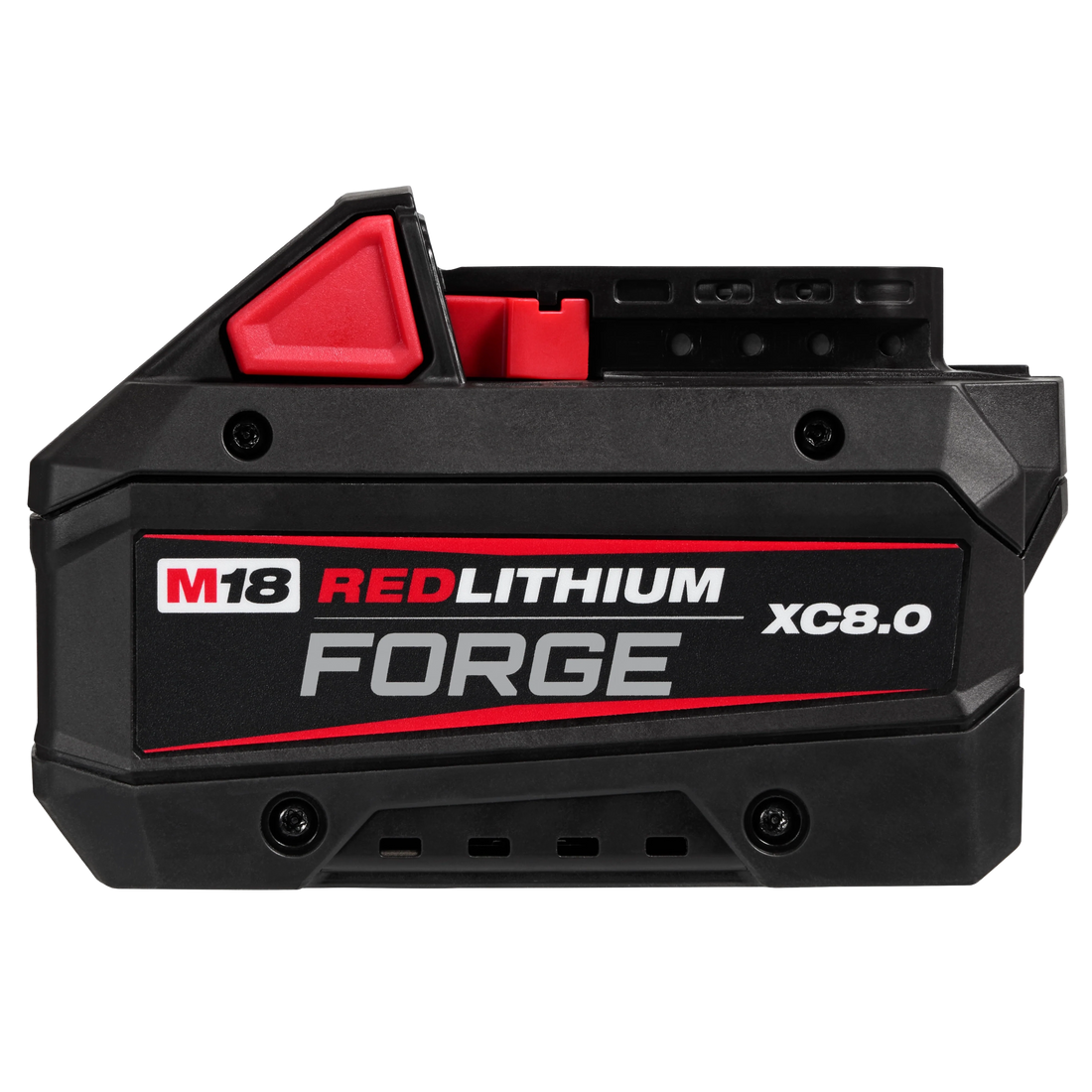
Milwaukee FORGE XC8.0 vs HIGH OUTPUT HD12.0: Which M18 Battery Should You Buy?
If you own a Milwaukee Super Charger and run high-draw FUEL tools — Super Sawzall, M18 table saw, rotary hammer — the FORGE XC8.0 is the better battery. Lighter, faster-charging on the right charger, and better at managing heat under sustained load. If you mostly run a standard Rapid Charger, need the longest runtime per pack, or are buying your first serious M18 battery, the HD12.0 wins — 50% more capacity for less money per watt-hour.
Cheat sheet: FORGE XC8.0 = lighter, faster (Super Charger required), cooler under hard load. HD12.0 = more raw runtime, better cost-per-watt-hour.
Both are M18. Both fit every M18 tool Milwaukee has ever made. Compatibility is settled — the real choice is below.
FORGE XC8.0 vs HD12.0 at a Glance
| Spec | FORGE XC8.0 | HD12.0 |
|---|---|---|
| Model # | 48-11-1881 | 48-11-1812 |
| Capacity | 8.0 Ah | 12.0 Ah |
| Watt-hours | 144 Wh | 216 Wh |
| Cell tech | Tabless pouch | 21700 cylindrical |
| Weight | 2.38 lbs | 3.3 lbs |
| Charge — Rapid Charger | Similar to HD12.0 | 130 minutes |
| Charge — Super Charger | Significantly faster (Super Charger required) | Standard rate only |
| Platform | M18 — all tools | M18 — all tools |
| MSRP | $229.00 | Check milwaukeetool.com for current pricing |
Watt-hours are calculated at 18V nominal (8.0 × 18 = 144 Wh; 12.0 × 18 = 216 Wh) — figures that match the watt-hour ratings Milwaukee lists on the spec pages for both packs.
Which M18 Battery Should You Buy?
"I run a Super Charger + high-draw FUEL tools"
Get the FORGE XC8.0. The Super Charger (48-59-1809) is what unlocks the "2× faster charge" headline. If you're already running one, the FORGE's lighter weight and faster turnaround between packs are genuine job-site advantages. High-draw tools also push harder against thermal limits — the FORGE handles heat better (more on that below).
"I want the longest runtime per battery — charger doesn't matter"
Get the HD12.0. At 216 Wh vs 144 Wh, it carries 50% more energy per pack. On extended demo work, long rip cuts, or anything measured in hours rather than minutes, the HD12 outlasts the FORGE by a significant margin.
"I'm on a budget, or this is my first 'big' M18 battery"
Get the HD12.0. The cost-per-watt-hour math favors it. The FORGE's headline advantages only fully materialize with a Super Charger — an additional purchase if you don't already own one. More capacity, lower entry cost, no charger upgrade required.
"I work overhead or run handheld tools all day"
Get the FORGE XC8.0. Battery weight is irrelevant on a benchtop tool. It's very relevant on a drill aimed at a ceiling joist for 30 minutes or a reciprocating saw run through framing all afternoon. The XC8.0 weighs 2.38 lbs and the HD12.0 weighs 3.30 lbs — a 0.92-lb difference that adds up across a shift.
"I'm powering an inverter or jobsite radio for hours"
Get the HD12.0. This is pure watt-hour arithmetic — more capacity, longer runtime at any given wattage. See the runtime math for the worked numbers; the HD12 wins this use case every time.
Real-World Differences the Spec Sheet Won't Tell You
Weight in the Hand
The HD12.0 is a substantial pack. Twelve amp-hours of cells have mass, and that mass lives at the base of every handheld tool you run it in. The FORGE XC8.0 packs less capacity but uses tabless pouch cells that are denser per unit of energy — the result is a lighter battery despite meaningful power delivery. Parked on a table saw, the weight difference doesn't matter. Held overhead or gripped all day, it absolutely does.
Heat Under Load
This is the FORGE's most underrated edge. Tabless pouch cells — the same architecture used in EV and aerospace applications — conduct heat out of the cell more efficiently than cylindrical cells do. Under sustained hard loads (ripping hardwood on the M18 FUEL table saw, extended demo with the Super Sawzall), the FORGE manages heat better. The battery management system trips the thermal cutoff less often. In summer heat or enclosed spaces, that's real working time you don't lose waiting for a pack to cool down.
Charge Time in Practice — The Super Charger Caveat
Here's what Milwaukee's marketing doesn't lead with: the FORGE's "2× faster charge" is real, but only on the M18 Super Charger (48-59-1809). On a standard M18 Rapid Charger, the FORGE charges at roughly the same pace as the HD12. You've paid the FORGE premium, and you can't access its biggest headline feature.
Before committing to the FORGE, check which charger you own. If you're running a Rapid Charger, either budget for the Super Charger or reconsider whether the HD12 makes more sense. We break down the charger differences in full.
Cycle Life and Warranty
Milwaukee claims the FORGE delivers "2× the cycle life" versus prior HD packs — a meaningful long-term value claim if it holds in the field. A battery that lasts twice as long costs half as much per cycle regardless of sticker price.
Both packs carry Milwaukee's standard M18 battery warranty — a 3-year limited warranty on each, with no separate or extended terms for the FORGE. Storing either pack correctly matters for longevity — see how to store batteries before winter before winter hits.
Cost Per Watt-Hour
Divide MSRP by watt-hours:
- FORGE XC8.0: $229.00 ÷ 144 Wh
- HD12.0: $279.00 ÷ 216 Wh
The HD12 generally wins this comparison. With the FORGE you're paying for the cell technology — lighter weight, better heat management, faster charging on the right charger — not for raw capacity. That premium makes sense if those features fit your workflow. It doesn't if you're buying capacity per dollar.
Tool Compatibility — Do Both Batteries Work in Every M18 Tool?
Yes. Full stop. Both the FORGE XC8.0 and HD12.0 are M18 platform batteries and work in every M18 tool Milwaukee has ever produced — from a 2010 M18 drill to the latest FUEL lineup.
"FORGE" is a cell-technology designation, not a separate platform. There is no such thing as a FORGE-only tool.
That said, certain high-draw M18 FUEL tools only reach their published performance numbers on a HIGH OUTPUT or FORGE battery. The higher sustained current output these packs deliver is what lets tools like the M18 FUEL table saw and M18 FUEL Super Sawzall run at their rated specs. You can run those tools on a standard battery — they just won't perform at full rated speed and power. Specifically, the M18 FUEL Table Saw (2736-20) and Super Sawzall (2722-20) are designated as requiring HIGH OUTPUT batteries to reach their rated specs, while Circular Saws, Grinders, the Impact Wrench (2967), and the Rotary Hammer (2717-22HD) require FORGE batteries for their published performance numbers.
Note: neither battery is compatible with MX FUEL equipment. That's a completely separate, higher-voltage platform for heavy construction gear.
Charger Compatibility — Why It Matters More Than the Specs Suggest
Every M18 charger will charge both batteries — Rapid Charger, Super Charger, dual-bay units, M12/M18 combination chargers. There is no compatibility problem.
The variable is speed, not fit.
| Charger | FORGE XC8.0 | HD12.0 |
|---|---|---|
| M18 Rapid Charger | Similar to HD12.0 | Similar to FORGE XC8.0 |
| M18 Super Charger (48-59-1809) | Substantially faster than Rapid Charger | Standard rate |
On the Super Charger, the FORGE charges substantially faster. On the Rapid Charger, the gap nearly disappears. If your shop runs on Rapid Chargers, you're buying FORGE features you can't access. We break down the charger differences in full.
Accessories — What to Pair With Each Battery
Neither of these packs is only for tools. Both will power USB adapters and inverters, turning your M18 battery into a portable power station on site.
USB-C charging off either pack: The Milwaukee M18 USB-C power supply plugs into any M18 battery and charges phones, tablets, or USB-C laptops at up to 65W. Works on FORGE or HD12 — the HD12 just gives you more sessions before a swap.
120V AC on site: The M18 power inverter gives you a standard outlet plus dual USB ports off any M18 battery. This is where the HD12.0's runtime advantage shows up most clearly — 216 Wh vs 144 Wh is the difference between powering a laptop charger for two hours or three. See runtime calculations for the actual wattage-to-runtime math. And if you're deciding between adding an inverter vs another charger to your kit, review the charger vs. inverter trade-offs.
Frequently Asked Questions
Is the Milwaukee FORGE XC8.0 better than the HD12.0?
Better at different things. FORGE wins on weight, charge time (on the Super Charger), and heat management under sustained load. HD12.0 wins on raw runtime per charge and cost per watt-hour. Pick based on how you actually work — not which one is newer.
Which is lighter, the FORGE XC8.0 or the HD12.0?
The FORGE XC8.0 is meaningfully lighter — 2.38 lbs vs 3.3 lbs for the HD12.0, a difference of 0.92 lbs. The gap matters for overhead and all-day handheld use.
Can I use a FORGE XC8.0 in any M18 tool?
Yes. Every FORGE battery is M18 and works in every M18 tool Milwaukee has ever made. "FORGE" describes the cell technology inside the pack — not a separate platform, not a different voltage.
Do I need the Milwaukee Super Charger to use a FORGE battery?
No — any M18 charger will charge it. But the FORGE's headline "2× faster charge" only happens on the Super Charger (48-59-1809). On a standard Rapid Charger, charge time is close to the HD12.0. If you don't already own a Super Charger, that cost belongs in your calculation.
How long does the FORGE XC8.0 take to charge?
35 minutes to 80% on the Super Charger; 83 minutes on the Rapid Charger. The gap between those two numbers is the whole story.
Is the HD12.0 discontinued now that FORGE is out?
The original HD12.0 (48-11-1812) has been discontinued and replaced by the updated 48-11-1813. The HD12.0 capacity continues in the M18 lineup — FORGE is an addition, not a replacement for the 12 Ah tier. Look for the 48-11-1813 when shopping.
Which gives longer runtime in an M18 inverter?
The HD12.0 — more watt-hours under the same load means longer runtime, every time. Both work with the M18 inverter; the HD12 just runs it longer per charge. See our inverter runtime guide for the numbers.
What's the warranty on each?
Both the FORGE XC8.0 and HD12.0 carry Milwaukee's standard 3-year limited warranty — identical terms, with no separate or extended coverage for the FORGE. Confirm current terms at milwaukeetool.com/support before purchasing.
Whichever pack you pick, the battery is only half the system. A Super Charger, a USB-C adapter, or a 150W inverter is what turns it into a full job-site tool. Browse our Milwaukee collection to get the chargers, USB adapters, and inverters that actually unlock what you paid for.
For the full three-way M18 battery comparison — FORGE, HIGH OUTPUT, and REDLITHIUM — see our complete M18 battery comparison.