
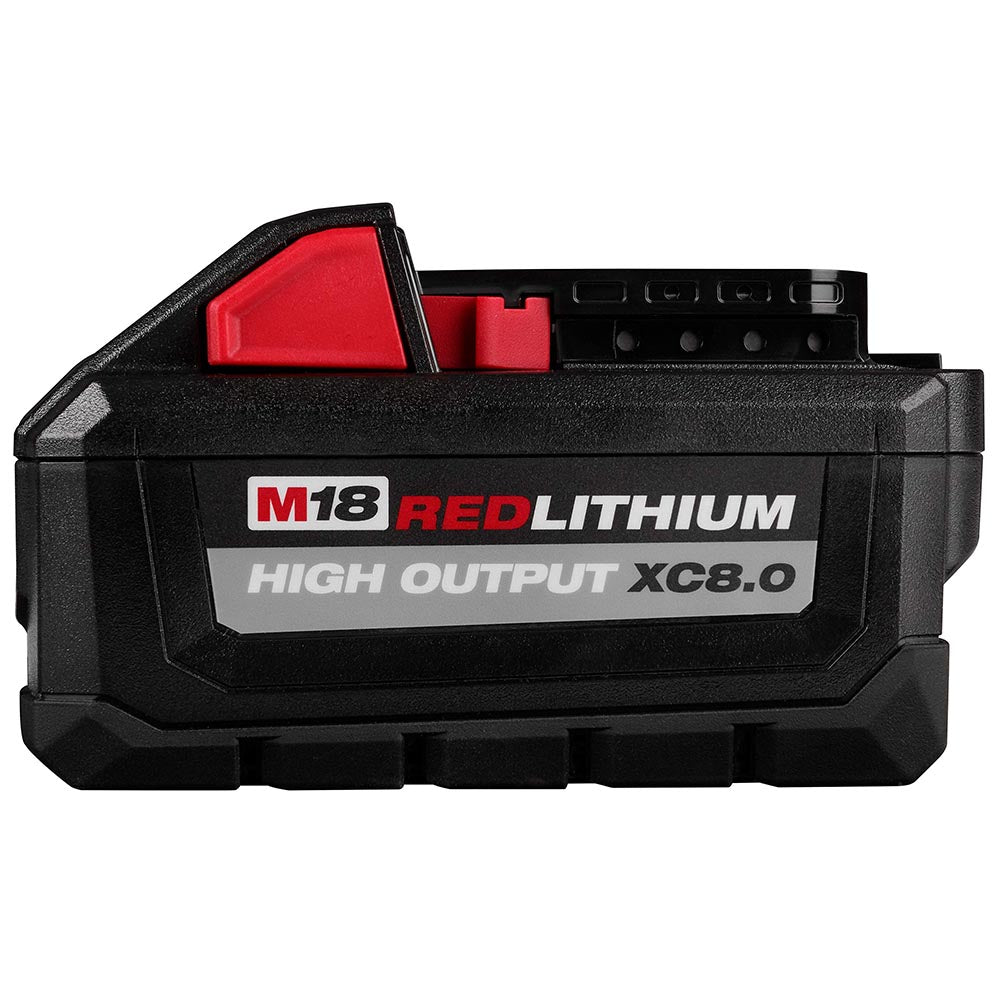
Best Milwaukee M18 Battery for a Power Inverter — Matched by Wattage
For a 150W inverter 150W M18 model, the Milwaukee M18 XC5.0 (48-11-1850) covers most jobs and the HIGH OUTPUT XC6.0 (48-11-1865) adds thermal headroom. For a 220–250W inverter, the HIGH OUTPUT XC6.0 is the minimum — the FORGE XC8.0 (48-11-1881) with superior sustained-load performance is the better pick. For the 350W pure sine inverter premium pure sine option, you need the FORGE XC8.0 or FORGE HD12.0 (48-11-1813). The CP2.0 (48-11-1820) is not suitable for sustained inverter loads — it drains in minutes and runs hot.
All M18 batteries fit all M18 inverters electrically. The question here is performance, not compatibility.
Why Inverter Loads Are Harder on M18 Batteries Than Tool Use
Tools Draw in Bursts — Inverters Draw Continuously
A drill pulls a hard spike of current when it bites into wood, then backs off. An angle grinder surges on the start and settles. In both cases, the pack gets a moment to breathe.
An inverter doesn't breathe. Plug in a laptop, a heat gun, a phone charger — the inverter pulls a steady, unbroken current for as long as that device is running. That's a fundamentally different demand than what most M18 tools put on a battery.
What Sustained Draw Does to a Standard M18 Cell
Run a standard REDLITHIUM cell at high, continuous current and a few things happen: voltage sags as the cell heats up, the battery management system reads the sag as depletion and throttles output or cuts off entirely, and the pack runs warm even at moderate Ah ratings.
The result: shorter actual runtime than the math suggests, and possible battery-protection trips on high-wattage loads.
How HIGH OUTPUT and FORGE Cells Handle Sustained Inverter Draw
Milwaukee's HIGH OUTPUT chemistry was built for sustained high-current delivery — not just higher capacity. Lower internal resistance means less heat and less voltage sag under continuous draw.
FORGE goes further. The cell format is designed to handle even higher sustained current without thermal sag. The FORGE XC8.0 delivers HIGH OUTPUT™ 12.0 power in a smaller size and lighter weight — which is why it outperforms a standard-cell pack under a sustained inverter load even when the Ah numbers look similar on paper.
For inverter work, current delivery without thermal sag is the spec that matters. Learn how FORGE cells compare to HIGH OUTPUT
M18 Battery Comparison Table for Inverter Use
Runtime estimates use: (Ah × 18V × estimated inverter efficiency) ÷ load watts, applying a typical efficiency figure for this class of inverter. These are estimates — real runtime varies with load, temperature, and battery age. See the full math for the complete breakdown.
| Model | Part # | Ah | Cell Line | Best Inverter Tier | Est. @ 150W | Est. @ 350W | Notes |
|---|---|---|---|---|---|---|---|
| REDLITHIUM CP2.0 | 48-11-1820 | 2.0Ah | Standard | Skip for inverters | ~12 min | ~5 min | Runs hot; BMS may cut off |
| REDLITHIUM XC5.0 | 48-11-1850 | 5.0Ah | Standard XC | 150W | ~30 min | ~13 min | Adequate for light 150W use |
| HIGH OUTPUT XC6.0 | 48-11-1865 | 6.0Ah | High Output | 150W–220W | ~37 min | ~16 min | Better thermal margin; 50% more power than standard XC |
| FORGE XC6.0 | 48-11-1861 | 6.0Ah | FORGE | 150W–220W | ~37 min | ~16 min | FORGE cells run cooler under load |
| FORGE XC8.0 | 48-11-1881 | 8.0Ah | FORGE | Up to 350W | ~49 min | ~21 min | Recommended sweet spot |
| FORGE HD12.0 | 48-11-1813 | 12.0Ah | FORGE | Up to 350W+ | ~73 min | ~31 min | Max runtime; heavier pack |
All runtimes are estimates at full rated load. Most real-world usage runs the inverter below its ceiling, so actual runtimes are longer.
Best M18 Battery by Inverter Wattage
150W Inverter
The XC5.0 (48-11-1850) works fine here — roughly 30 minutes at full 150W load is enough for charging a phone, running LED work lights, or keeping a small fan going on a break. If you're running the compact 150W unit hard or in warm conditions, the HIGH OUTPUT XC6.0 (48-11-1865) is worth the step up. Milwaukee rates it at 50% more power than a standard XC pack — that headroom matters on sustained loads.
Not sure if 150W covers your job? Check wattage requirements
220–250W Inverter
The XC5.0 will struggle here on extended runs. Standard cells weren't designed for continuous high-current output at this wattage, and you'll see either runtime that falls short of the math or a battery protection cutoff.
The HIGH OUTPUT XC6.0 is the minimum for this tier. The FORGE XC8.0 with extended runtime is the recommended pick — FORGE cell chemistry keeps heat down under sustained draw, and the extra capacity gives you roughly 25 minutes at a real 220W continuous load. That's a practical working window.
350W Pure Sine Inverter

At 350W continuous, you're near the ceiling of what an 18V pack can comfortably sustain. The FORGE XC8.0 is the sweet spot — weight, runtime (~21 minutes at full load), and cell capability are all in balance. If you need to run a laptop, sensitive medical equipment, or a small power tool for longer than 20 minutes uninterrupted, step to the FORGE HD12.0 (~31 minutes).
At this wattage, two-battery rotation is worth considering. Two FORGE XC6.0 or XC8.0 packs — swapping while one charges — keeps the pure sine inverter running without a break. The HD12.0 is the right call when swapping isn't practical: remote sites, confined spaces, working from a lift.
The 350W unit is pure sine wave, which matters for sensitive electronics and motor loads. Understand why pure sine matters
For help choosing between the 150W, 220W, and 350W M18 inverters, see inverter selection guide.
The One M18 Battery to Skip for Inverter Work

REDLITHIUM CP2.0 (48-11-1820). At a continuous 150W draw, it lasts about 12 minutes and runs warm doing it. The battery management system may cut it off before those 12 minutes are up. This is a solid pack for drills, lights, and short-duration jobs — it's just not built for sustained high-current output. An inverter will expose that quickly.
Milwaukee's 12.0Ah capacity is only available in the FORGE configuration — the standard M18 line maxes at 5.0Ah, so there is no standard-cell 12Ah option to accidentally reach for.
Frequently Asked Questions
What size M18 battery is best for running a power inverter?
For a 150W inverter, a 5.0Ah XC5.0 or 6.0Ah HIGH OUTPUT is the practical floor. For 220–350W, step up to the FORGE XC8.0 (8.0Ah). More Ah means more runtime — but HIGH OUTPUT or FORGE cells mean better sustained current delivery under load. For inverters, cell quality matters first.
How long will a Milwaukee M18 battery run a 150W inverter?
At a continuous 150W load: roughly 30 minutes on the XC5.0, 37 minutes on the HIGH OUTPUT XC6.0, and 49 minutes on the FORGE XC8.0. These are estimates based on 18V nominal voltage and typical inverter efficiency for this class of inverter. Real-world runtime is longer if you're running the inverter below its rated ceiling, which is most of the time.
Is the HIGH OUTPUT battery better for inverter use?
Yes — not because of Ah, but because HIGH OUTPUT cells deliver more current without voltage sag or heat buildup. For sustained inverter loads, that's more important than raw capacity. A 6.0Ah HIGH OUTPUT will handle a 220W inverter better than a 5.0Ah standard XC, even though the runtime math looks close on paper.
Will a CP2.0 battery run a Milwaukee M18 inverter?
It'll connect and turn on. At 150W continuous, expect about 12 minutes before it drains — and it'll run warm doing it. The battery protection circuit may cut it off first. Use the CP2.0 for drills, lights, and short jobs. It's not the right pack for inverter work.
Does a 12Ah battery always mean better inverter performance?
More runtime, yes. Better performance under heavy load, not automatically. The FORGE HD12.0 is built on the same HIGH OUTPUT cell platform as the XC8.0 — it delivers the same sustained current with more capacity. That's the right 12Ah for inverter use. Standard M18 REDLITHIUM batteries max out at 6.0Ah, and 12Ah capacity exists only in HIGH OUTPUT and FORGE tiers, so this isn't a trap you're likely to fall into — but it's worth knowing the distinction.
Running M18 inverters on the job means the right battery matters as much as the right inverter. The FORGE XC8.0 with professional-grade endurance is the pack that handles both 220W and 350W loads without breaking a sweat. Pair it with the high-capacity pure sine model for heavy loads or the lightweight 150W option for light duty, and you've got a portable power setup that actually holds up. Browse the complete Milwaukee collection.
> Stage 7 note — reciprocal link: The published post `milwaukee-m18-power-inverter` should receive a contextual link back to this article — suggested placement: in its battery/compatibility section, with anchor text like "which M18 battery works best with your inverter."