
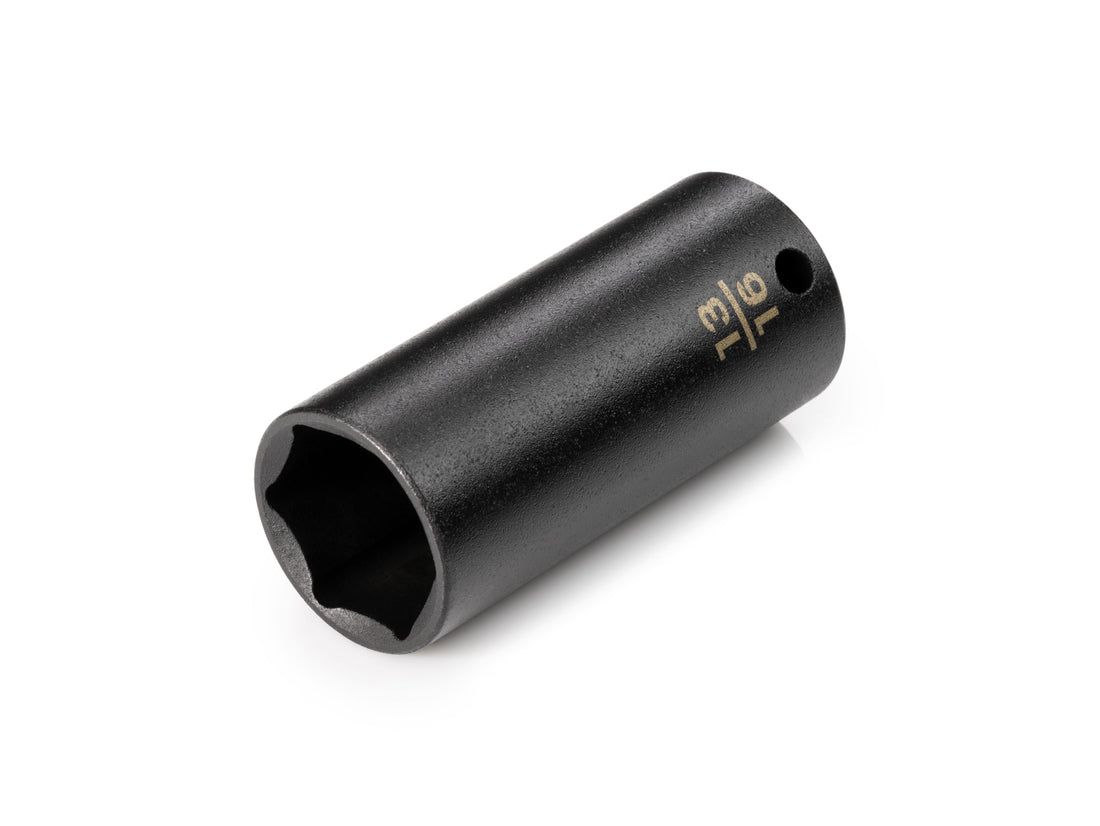
Deep vs Shallow Sockets: Which One to Use (and When)
Shallow (standard) sockets are the default. Shorter barrel, more stable grip, less likely to round a fastener under high torque. Reach for a deep socket only when a bolt or stud sticks out past the nut — threaded rod, U-bolts, suspension studs — or when the fastener sits down in a recess where a standard socket can't reach. Most work calls for both types; if you're starting out, buy shallow and add deep in the specific sizes you actually run into.
The rule every time: bolt through the nut, or fastener down in a hole? Deep. Everything else? Shallow.
What's the actual difference between a deep and a shallow socket?
It's all in the barrel length. A shallow (standard) socket has a noticeably shorter barrel — enough to fully engage the fastener with the nut sitting right at the surface. A deep socket runs considerably longer; for a 1/2"-drive deep socket, that comes to around 3.031 inches, depending on size and manufacturer.
The fastener bottoms out at different points inside each socket. With a shallow socket, the hex engages near the top of the barrel. With a deep socket, there's extra material below the hex engagement — that's the space that accommodates a bolt protruding through a nut, or clears the surrounding material when a fastener is recessed.
Drive size is independent of depth. A 3/8" drive shallow and a 3/8" drive deep both accept the same ratchet or wrench. Depth is just about how tall the socket is, not what drives it.
| Shallow (Standard) | Deep | |
|---|---|---|
| Barrel length | Short (~1.3–1.6 in for 1/2" drive) | Long (~2.0–2.5 in for 1/2" drive) |
| Best use | Open fasteners with good clearance | Studs, threaded rod, recessed nuts |
| Weak spot | Can't reach recessed or long-bolt fasteners | More flex under high torque; harder to start in tight spots |
| Torque stability | Better | Worse — longer barrel = more wobble potential |
| Weight | Lighter | Heavier |
When to use a deep socket
You need a deep socket when the fastener itself has more length than a shallow socket can handle — or when it's buried.
Bolt or stud poking through the nut. Threaded rod, suspension studs, exhaust manifold studs, U-bolts — anything where the bolt extends past the nut. A shallow socket hits the threads before it can engage the hex. Deep sockets were made for exactly this.
Recessed fasteners. A nut or bolt head sitting below the surrounding surface — think a drain plug in a pocket, a fastener in a counterbore, or hardware deep inside engine bay sheet metal. The longer barrel lets you reach down and seat fully on the hex.
Wheel studs and some lug nuts. Depending on the vehicle and wheel, the stud can protrude far enough that a shallow socket won't fully engage. Most lug nut jobs with a standard length stud can go either way, but check before you commit — a shallow socket half-engaged on a lug nut is asking for rounded corners.
When to use a shallow socket
Most of the time, this is your socket.
Tight vertical clearance. If there's a panel, bracket, or another component above the fastener, a shallow socket clears it when a deep socket won't even fit. An inch of extra barrel height matters under a dash, in an engine bay, or in tight framing situations.
Breaking a fastener loose — anything high torque. This is where shallow sockets earn their place. Less barrel means less flex in the socket itself, which means less wobble, which means the socket stays square on the fastener under load. The longer the barrel, the more opportunity for the socket to cock sideways under torque — and that's when corners round. When you're breaking loose a rusted bolt, grab the shallow socket, not the deep.
Everyday bolt work. Bolts that don't protrude through their nuts — which is most of them — don't need the extra length. Shallow gives you a more positive feel and better tactile feedback through the ratchet.
The trade-offs nobody mentions
Deep socket + extension = flex. Add a long extension to a deep socket on a stubborn fastener and you've created a flex point at both ends of the drive train. Under high torque, that wobble is enough to round bolt corners. The fix: keep the drive train as short as possible at high torque. Use the shortest socket that works, and use a 6-point socket rather than 12-point — six-point grips the flats, twelve-point grips the corners, and corners are what rounds. (For a full breakdown of that trade-off, see 6-point vs 12-point socket guide.)
Mid-length / semi-deep sockets exist — and most articles skip them. Manufacturers like SK Professional Tools and Sunex make a socket category between standard and deep: sometimes called "semi-deep" or "mid-length." They give you maybe 30–50% more reach than a shallow socket without the full instability of a deep. For fasteners that are *almost* recessed but not quite, or studs that only poke through a thread or two, mid-length is often the better call. Worth knowing the category exists before you default to a full deep.
Spark plug sockets are a specialized deep socket — don't overgeneralize. Common sizes are 5/8" (16mm) and 13/16" (21mm). They have a deep barrel to reach down the plug bore, plus a rubber or magnetic insert to hold the plug. That rubber insert makes them useless for general deep socket work — you lose drive feedback and they're prone to slipping under torque. A spark plug socket is not a stand-in for a standard deep socket and vice versa.
Chrome vs. impact-rated deep sockets. Standard chrome-vanadium hand sockets have a polished finish. Impact sockets are chrome-moly (chrome-molybdenum) with a matte/black oxide finish — they're thicker-walled and rated to absorb the hammer blows of an impact wrench. Never put a chrome hand socket on an impact wrench, deep or shallow. The chrome-vanadium alloy can shatter rather than deform, and socket shrapnel is a real injury risk. If you're running a deep socket on an impact to spin off lug nuts or suspension fasteners, it needs to be impact-rated. More on this at impact socket requirements.
Deep, shallow, or just own both?
Own both — but don't feel like you need a full deep set for every size.
A sensible starter socket set is mostly shallow: 1/4", 3/8", and 1/2" drive, shallow, in the common metric and SAE sizes. That covers maybe 80% of work.
Add deep sockets in the sizes you actually encounter — typically a handful of metric sizes for suspension and engine work, and a few SAE sizes for U-bolts or plumbing. For most DIYers, a complete shallow set plus maybe six to ten deep sockets covers the real world without buying duplicate sets in every size.
If automotive is your thing and you're doing suspension, brakes, or wheel work regularly, a full deep set in 3/8" and 1/2" drive makes sense. For general construction, woodworking, or light mechanical work, a few deep additions are all you'll need.
One thing that doesn't change regardless of depth: buy 6-point sockets for anything you're breaking loose or running on an impact. The grip-on-flats geometry matters more than whether the socket is deep or shallow. For high-torque work with a torque wrench or breaker bar, see breaker bar strategy and automotive torque-wrench selection for guidance on matching the tool to the job.
FAQ
What is a deep socket used for? Reaching a nut on a long bolt or stud that sticks out past the nut, or seating on a fastener recessed below the surrounding surface where a standard socket can't reach.
Can I use a deep socket instead of a shallow one? Usually yes on open, exposed fasteners — but a deep socket has more barrel to flex under torque, which increases the chance of wobbling and rounding corners. Use shallow when you have the clearance.
Do deep sockets round bolts more than shallow ones? The socket walls aren't weaker, but the longer barrel (especially combined with an extension) flexes more under load. That flex lets the socket come off-square and contact the corners instead of the flats. 6-point sockets and short drive trains are the fix.
What is a semi-deep (mid-length) socket? A socket between standard and deep length — more reach than shallow without the full instability of a deep socket. Useful when a stud barely pokes through the nut, or a fastener is slightly recessed. SK Professional Tools and Sunex both carry the category.
Should I buy deep or shallow sockets first? Shallow. They cover most work. Add deep in the specific sizes you need as you encounter jobs that require them.
Is a spark plug socket the same as a deep socket? It's a specialized deep socket — same reach, but with a rubber or magnet insert to hold the plug. That insert makes it unsuitable for general socket work. Don't substitute one for the other.
Can I use a deep impact socket for lug nuts? Yes, if it's impact-rated (chrome-moly, matte finish). Never put a standard chrome hand socket on an impact wrench — chrome-vanadium can shatter under impact loading.
For lug nuts, fastener selection, and impact socket sizing, the sibling posts impact socket guidance and point geometry for sockets cover what you need to know next. If you're building out a socket set for automotive work, complete socket and torque guide ties it all together.