
Best Wire Crimping Tool — Match the Crimper to the Connector Type
There is no single best wire crimping tool. The right one depends entirely on your connector type. Insulated ring and spade terminals need a ratcheting insulated-terminal crimper. Wire ferrules (end sleeves) used on terminal blocks and panel boards need a dedicated hexagonal ferrule crimper. Coax F-connectors need a coax-specific tool. Micro-connectors (JST, Dupont, Molex) need a precision ratcheting micro tool. Use the wrong one and the crimp *looks* finished but can pull loose under vibration or load. Here's the matching guide, then verified picks for each category.
Before you crimp, you need to strip — our wire stripper guide covers that step.
Which type of crimping job do you have?
Start here. The answer determines every tool decision below.
| Job | Connector / terminal type | Tool type you need |
|---|---|---|
| Automotive harness, residential electrical | Color-coded insulated terminals (ring, spade, butt) | Ratcheting insulated-terminal crimper |
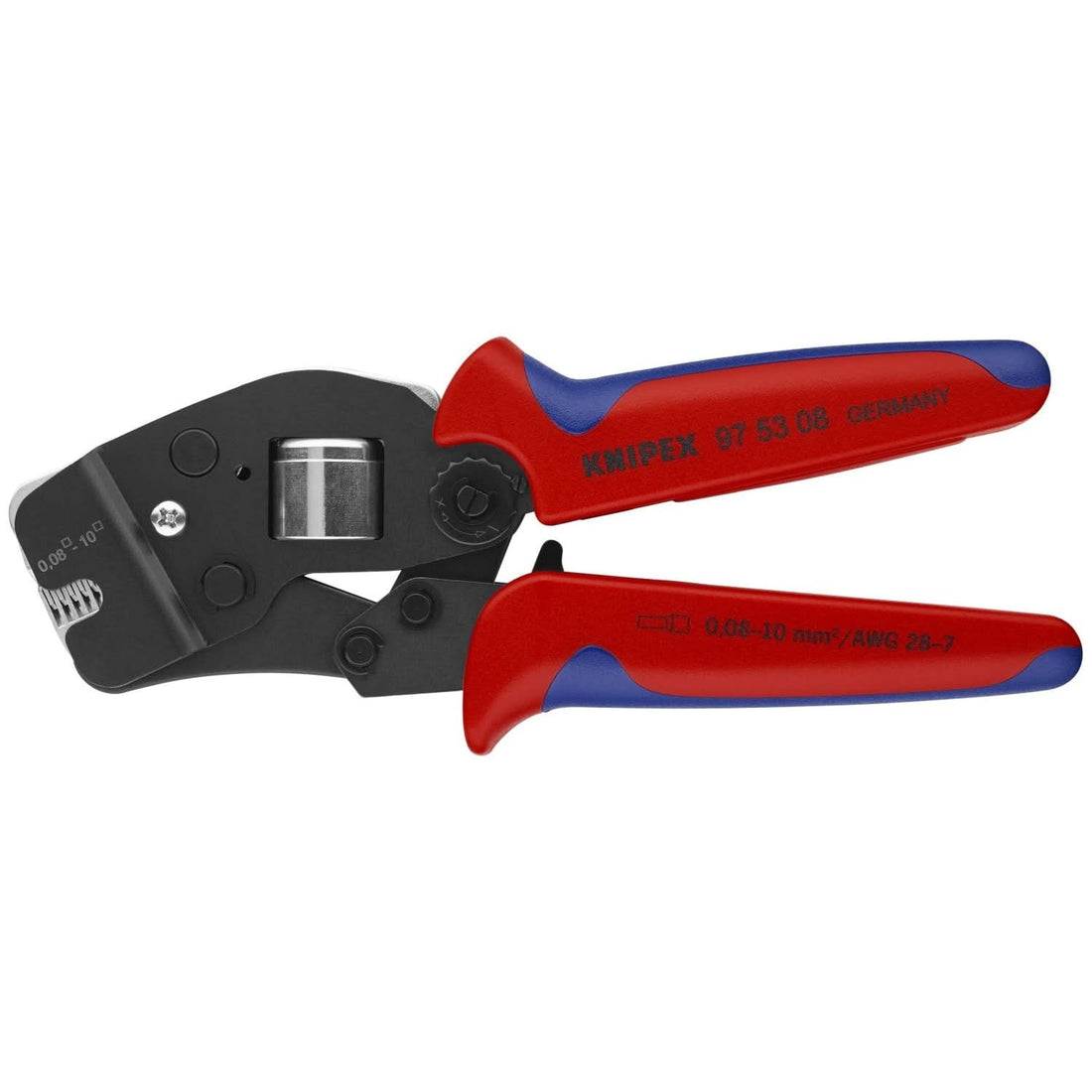
| Panel wiring, VFDs, terminal blocks | Wire ferrules / end sleeves | Hexagonal ferrule crimper |
| Satellite / cable TV | Coax F-connectors (RG6 / RG59) | Coax-specific crimp or compression tool |
| Large-gauge connections, bare copper lugs | Non-insulated / open-barrel terminals | Open-barrel crimper (B-crimp or hex die, large AWG) |
| Electronics, custom harnesses | JST-XH, Molex KK, Dupont-style 2.54mm | Precision micro-connector ratcheting crimper |
If you're buying one crimper, the question isn't brand — it's connector type. A ferrule crimper bought for panel wiring is useless on a ring terminal. And a coax crimper can't form a ring terminal no matter how hard you try.
Best Wire Crimping Tools by Job Type
Insulated terminals — automotive and residential electrical (22–10 AWG)
This category covers the color-coded insulated terminals most people picture when they hear "wire crimping" — ring terminals, spade terminals, butt splices with color-coded insulation sleeves. US-standard tooling uses color coding to match AWG range: red for 22–18, blue for 16–14, yellow for 12–10.
Pick 1 — Klein J1005 (non-ratcheting, workhorse)
The J1005 is the pliers handed to every electrician's apprentice on day one. Non-ratcheting, so the pressure is operator-controlled. AWG range: 10–22. For a tradesperson running hundreds of terminals a week with calibrated hands, it's a perfectly capable tool. For everyone else — or anyone whose hands fatigue by the third hour — the next pick is the right call.
Pick 2 — Knipex 97 51 12 (ratcheting, professional tier)
The ratchet mechanism won't release until the crimp cycle completes. You physically cannot open the jaws mid-stroke and produce a half-crimped terminal. Conductor range covers the full span of color-coded insulated-terminal work. German-made, noticeably tighter tolerances than budget alternatives, and the jaw alignment stays true after years of daily use. This is the pick when every connection must hold under vibration or pass inspection.
For a full breakdown of the Knipex vs. Klein brand trade-offs across their hand tool lines, see our Knipex vs. Klein electrician pliers post.
Trade-off in plain terms: The Klein saves money upfront. The Knipex earns it back the first time you avoid re-terminating a harness connector that pulled out. The Klein J1005 lists at $40.99; ratcheting options in this category generally run $40–80, and Knipex premium tools run $80–150+.
Wire ferrules / end sleeves — terminal blocks and panel wiring
Ferrules — also called bootlace ferrules or end sleeves — are the small copper or tin tubes crimped onto stranded wire ends before insertion into a screw or spring-clamp terminal block. Every VFD installation, DIN-rail panel, and PLC I/O module expects properly ferrule-terminated wires. Skip the ferrule and you're inserting raw stranded wire into a terminal designed for a solid, uniform contact point.
The hexagonal die is non-negotiable. An insulated-terminal crimper produces a trapezoidal crimp that oval-shapes the ferrule. The result can slip in the terminal block under normal torque — sometimes immediately, sometimes after a few thermal cycles. The hexagonal die fully encloses the ferrule and produces a uniform, gas-tight connection that won't rotate or back out.
Pick 1 — IWISS IWS-1424B (ratcheting, budget-accessible)
Orange handles, ratcheting mechanism, widely stocked. AWG range: 24–14. At the budget end of the ratcheting ferrule category, this is the tool most panel builders reach for first. Budget ferrule crimpers in this class typically run $20–40.
Pick 2 — Knipex 97 62 145 A (ratcheting, handles TWIN ferrules)
Covers single ferrules from 0.25 to 2.5 mm² and handles TWIN ferrules across a broad range of conductor sizes. If you're terminating two conductors into a single terminal block position (standard practice in many panel designs), a tool that can't handle TWIN ferrules creates a manual workaround every single time. The 97 62 145 A lists at $56.50.
Coax — RG6 / RG59 F-connectors
Satellite dishes, cable TV drops, antenna runs — these use compression or crimp F-connectors over coax, and the tool geometry has nothing in common with wire terminal crimpers.
Pick — Klein VDV211-063
It supports Mini-coax, RG58, RG59, RG62, RG6/RG6Q, RG7, and RG11 cables, with F-type, BNC, and RCA connector compatibility. Worth noting: coax crimpers are genuinely single-purpose. If you have four terminations to make once, a compression tool may serve better — compression connectors are more weather-resistant and don't require a separate die per connector size. For ongoing cable work, the dedicated crimp tool is faster and more consistent.
Open-barrel and non-insulated terminals — lugs and large AWG
Bare copper lugs, uninsulated ring terminals, battery cables, grounding connections. Anything in the 8 AWG and larger range that doesn't use a color-coded insulation sleeve.
Pick — Knipex 97 21 215
Conductor range: 0.75 – 6.0 mm² (AWG 18–10). The die geometry on open-barrel terminals differs from insulated-terminal dies — a B-crimp die wraps around the conductor and terminal tab rather than compressing a sleeve. Applying an insulated-terminal crimper to a bare lug does not produce a secure mechanical connection regardless of how hard you squeeze. Wrong die shape means wrong result, every time.
Micro-connectors — JST, Dupont, Molex (electronics and custom harnesses)
The 1.0–2.54mm pitch connectors found on sensor leads, PCB connectors, RC electronics, and custom automotive control wiring. The pins are small enough that a standard terminal crimper will fold them flat rather than form a crimp.
Pick — Engineer PA-09
A precision ratcheting tool designed specifically for this category. Officially listed compatible families include JST-XH 2.54mm and Molex KK; it also handles Dupont-style 2.54mm pins in practice, though they are not formally specified by Engineer. Note that TE Connectivity MTA connectors use IDC technology and are incompatible with this tool. The ratchet mechanism matters here more than anywhere — micro-pins have almost no tolerance for over-crimp. This tool is widely specified in electronics assembly and custom harness work for exactly that reason. The PA-09 lists at $49.95.
Ratcheting vs. Non-Ratcheting — Where the Quality Line Is
The ratcheting mechanism does one thing: it won't release the jaws until the crimp cycle completes. You can't open the tool mid-stroke, which means every terminal gets the same force regardless of how fatigued your hands are at the end of an eight-hour harness job.
Non-ratcheting crimpers are operator-dependent. An experienced hand produces consistent crimps. A tired or distracted hand over- or under-crimps. That variance is real, and it compounds across hundreds of connections.
Ratcheting is the call for: any connection in a vehicle, in a building, in a control panel, or that will see vibration or sustained load. A pulled crimp in an automotive harness or electrical panel is a fire hazard.
Non-ratcheting is acceptable for: temporary bench wiring, hobby work, low-stakes connections where you can re-terminate easily if something fails.
The combo-tool trap. Strip/cut/crimp combination pliers look useful. For field emergencies, they are. For production work or anything structural, they're not. The die geometry is compromised across multiple functions, and a combo tool cannot deliver the consistent, repeatable force a dedicated ratcheting crimper does. Own one for the truck. Don't depend on it for a harness that lives inside a door panel.
What to Look for When Buying a Wire Crimping Tool
AWG / mm² range — verify it covers your wire. Many insulated-terminal crimpers stop at 12 AWG. If you're terminating 10 AWG, check the spec before you buy. A quick reference: 10 AWG ≈ 5.3 mm², 12 AWG ≈ 3.3 mm², 14 AWG ≈ 2.1 mm², 22 AWG ≈ 0.33 mm². US tools list AWG; European and premium tools (Knipex, Rennsteig) list mm². Same dimension, different unit — the conversion keeps you from buying the wrong tier. For the authoritative AWG-to-metric reference, ASTM B258 is the governing standard; NEMA publications such as WC 70 and MW 1000 also cross-reference both unit systems.
Die shape — it has to match the connector. Trapezoid dies handle insulated terminals. Hexagonal dies are for ferrules. B-crimp dies handle open-barrel lugs. Buying a tool without checking the die type is how you end up with the wrong crimper for the job in front of you, repeatedly.
Interchangeable die sets. Premium manufacturers — Knipex, Rennsteig — sell die sets for different terminal families. If you work across connector types regularly, a tool that accepts multiple dies reduces the total number of crimpers you need to carry. The base tool investment is higher, but the trade-off works out over a busy year.
Jaw alignment and feel. Both jaws must close parallel. Test before you buy if you can: rack the jaws closed slowly and watch for any lateral shift or wobble. A rough or sticky ratchet mechanism indicates poor tolerances, and poor tolerances produce inconsistent crimps. Premium tools close smoothly with no slop — that's the functional spec, not a luxury.
Wire Crimping Tool FAQ
What is the best wire crimping tool for electricians?
For insulated electrical terminals — ring, spade, butt connectors — a ratcheting insulated-terminal crimper is the professional standard. Klein or Knipex at the mid-to-premium tier covers most residential and commercial electrical work. For panel board and terminal block connections, add a dedicated ferrule crimper (IWISS or Knipex). Ratcheting on anything that must hold under load; non-ratcheting only on work you can afford to redo.
Do I need a different crimper for wire ferrules?
Yes. Ferrule crimpers use hexagonal dies that fully enclose the terminal and form a uniform, gas-tight connection. An insulated-terminal crimper applied to a ferrule produces an uneven oval crimp that will slip loose in a terminal block — sometimes under initial torque, sometimes after a thermal cycle. They are genuinely different tools.
Can I use the same crimper for insulated and non-insulated terminals?
Not reliably. The die geometries serve different mechanical functions, and mixing them risks an incomplete or asymmetric crimp. Some professional multi-die tools handle both connector families, but a dedicated tool per type is better practice for structural or code-relevant work.
What is the best wire crimping tool for automotive wiring?
A ratcheting insulated-terminal crimper covering 10–22 AWG handles most harness work. For weatherproof connectors — Deutsch DTM, Molex Weather Pack — you need a crimper rated specifically for that connector family. Connector manufacturers publish their own tooling recommendations; match the spec, not the brand name.
How do I know if my crimp is good?
Two checks. First, the tug test: the wire must not pull free when you apply a firm, steady pull on the conductor. Second, visual: no insulation pulled inside the terminal barrel, the conductor was fully seated before crimping, no cracked or split terminal body. Both checks pass, the crimp is good. Either fails, re-terminate.
What size crimper do I need for 10 AWG wire?
Confirm the tool's listed AWG range explicitly includes 10 AWG — many insulated-terminal crimpers max out at 12 AWG. Verify against the manufacturer's data sheet for your specific pick before purchase; don't assume based on tool category alone.
Are cheap wire crimpers worth it?
For temporary, low-stakes, or bench hobby connections, a budget non-ratcheting crimper is workable. For anything in a vehicle, building, or control panel — any connection that will see vibration or sustained load — the extra $30–50 for a ratcheting tool is not optional. A pulled crimp in an automotive harness or electrical panel is a fire hazard, not just an inconvenience.
Once the wire is crimped, the job has two more steps: you stripped clean before terminating (see our wire stripper recommendations for that), and the wire tail needs to come off flush. For trimming conductors clean and cutting wire to length, see our diagonal cutter guide.
*editorial, no money page*