
Best Ratcheting Screwdriver: Ranked by the Spec That Actually Matters in Tight Spaces
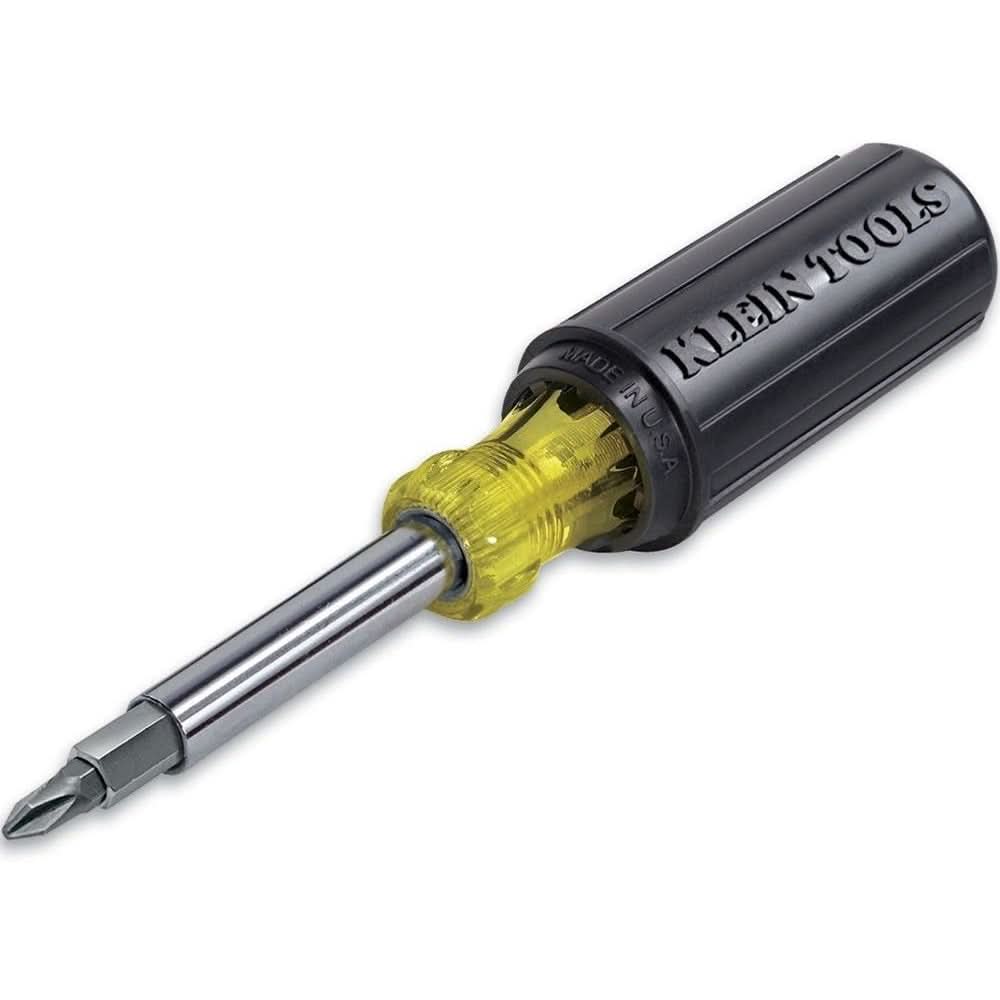
For most people, the Klein Tools 32500 is the best ratcheting screwdriver for everyday work: under $30, 11 bits stored in the handle, and a standard 1/4" hex chuck so any bit you already own will fit. If you need to work in actual tight spaces — outlet boxes, cabinet hinges, door panel fasteners — the number you actually care about is tooth count. More teeth means a smaller swing arc per click, which means the tool works where others don't. Most roundups never mention this. Here are five picks organized by use case, with tooth counts and bit compatibility called out for each.
What to Look For Before You Buy
Tooth count — the spec that determines whether it fits your job
Tooth count controls how much arc you need to advance the bit one click. The math is straightforward: 360° ÷ tooth count = minimum arc per click.
A 20-tooth ratchet (common in budget models) needs 18° of swing. A 72-tooth needs 5°. Inside a cabinet or an electrical panel, 18° may mean you can't complete a useful stroke at all. At 5°, you can work in almost any confined space. Typical range in this category runs from around 20 teeth on the low end to 72 on high-tooth-count models. For any genuine tight-space application, target ≥60 teeth.
Bit shank: standard 1/4" hex vs. proprietary
Most ratcheting screwdrivers use a standard 1/4" hex chuck (ISO 1173-C6.3). That means any bit from your drill or impact driver set drops straight in — no adapter, no separate bit purchase. A few brands use proprietary chucks that limit you to their own bits.
Worth noting: impact-rated bits work fine in a ratcheting screwdriver at hand-tool torque. The torsion zone is a durability feature, not a compatibility problem. If you have a set of impact driver bits on the bench, they'll seat and drive just like standard hex bits.
Flex head vs. fixed head
Swivel heads let you drive at an angle. The trade-off: they add mechanical bulk right at the drive end — the worst place to add it when you're working inside a recess. A fixed head is shorter, stiffer, and more capable in confined spaces. Flex heads are genuinely useful for off-axis driving in open areas where that extra length doesn't hurt. If you're buying specifically for tight-space work, fixed head is the right call.
Handle length and leverage
Longer handles give more torque leverage; shorter handles maneuver better in confined areas. Typical overall length varies by model — check the manufacturer's spec sheet for any model you're seriously considering, because this varies more than you'd expect at a glance.
The Best Ratcheting Screwdrivers
| Pick | Best For | Tooth Count | Shank | MSRP |
|---|---|---|---|---|
| Klein Tools 32500 | Overall / most jobs | Not published by manufacturer | Standard 1/4" hex | Check current pricing |
| GearWrench 41940 | Tight spaces | 120 | Standard 1/4" hex | Check current pricing |
| Wera Kraftform Kompakt RA | Pro daily carry | See manufacturer spec sheet | Standard 1/4" hex (Rapidaptor) | Premium; check current pricing |
| Stanley FatMax Ratcheting | Value under $20 | Not published | Standard 1/4" hex | Under $20; check current pricing |
| Klein Tools 32303 | Electricians | N/A — non-ratcheting design | Fixed proprietary bits | Check current pricing |
Best overall — Klein Tools 32500
The Klein 32500 is the benchmark in this category. Eleven bits ride in a pop-out compartment in the handle — enough variety for most household and trade tasks without a separate pouch — and the standard 1/4" hex chuck means you're not locked into anything. Any Phillips, Torx, slotted, or nut driver hex bit you already own fits.
Klein does not publish a tooth count for the 32500 on its product spec page.
Honest limitation: since tooth count is not published by the manufacturer, this model cannot be assessed for tight outlet-box work on that spec alone. It's still the right call for general use — homeowners, tradespeople who need one versatile handle, anyone building their first set of hand tools. Check current pricing at kleintools.com or Home Depot before buying.
→ Verify at: https://www.kleintools.com (search "32500")
Best for tight spaces — GearWrench 41940
The GearWrench 41940 is built for this exact scenario, with a manufacturer-confirmed 120-tooth ratchet mechanism — well above the 60-tooth threshold needed for genuine tight-space work.
At 120 teeth, the minimum arc per click is 3°. That's tight enough for electrical panel screws, cabinet hinges with no swing clearance, and automotive interior fasteners where a full-size ratchet won't rotate at all.
The fixed head keeps drive-end bulk to a minimum. Confirm the chuck type on the manufacturer's product page to verify standard 1/4" hex bit compatibility before purchase. Check current pricing at gearwrench.com or major retailers.
→ Verify at: https://www.gearwrench.com (search "41940")
Best pro-grade / daily carry — Wera Kraftform Kompakt RA

Wera's ratcheting line sits at the top of the category on build quality and ratchet mechanism feel. The current model to evaluate is in the Kraftform Kompakt RA series — check us.wera.de and search "ratcheting screwdriver" in the Kraftform Kompakt line for the current SKU and availability.
Before relying on this pick, confirm the tooth count on the product spec sheet at us.wera.de. Verify that the Rapidaptor chuck accepts standard 1/4" hex bits directly — it is designed to, but confirm on the spec sheet — and check how many bits are included in the kit. Look up current pricing at us.wera.de or major retailers before finalizing.
On the price premium: Wera's Rapidaptor chuck allows fast bit changes with one hand and no collar to hold back. The Kraftform handle geometry is designed to support three distinct grip positions — pinch, palm, and power — per Wera's own product documentation. Whether that's worth the delta over a Klein is a judgment call based on how often you use it. What you verify first are the specs: tooth count and chuck compatibility. The rest follows from that.
→ Verify at: https://us.wera.de (search "ratcheting screwdriver")
Best value under $20 — Stanley FatMax Multi-bit Ratcheting Screwdriver
For light DIY, occasional use, or a gift for someone who doesn't need a daily-carry pro tool, the Stanley FatMax ratcheting screwdriver is the candidate. Stanley's FatMax line includes several configurations — confirm the current model number, bit count, tooth count if published, and pricing at stanleytools.com or Home Depot before purchase.
Important caveat: if tooth count is not published on the spec sheet, this model is not suitable for tight-space work and should be presented as a general-use option only — not a versatile pick. Say so in the post rather than leaving it ambiguous.
What you give up vs. the Klein 32500: build quality, bit storage design, and likely some smoothness in the ratchet mechanism. The price gap between this and the Klein is $10–15. If you're using a ratcheting screwdriver on any kind of regular basis, closing that gap is worth it.
→ Check: https://www.stanleytools.com and https://www.homedepot.com
Best for electricians — Klein Tools 32303
Electricians in panels and junction boxes need two things: enough working clearance to drive fasteners in tight spaces, and a handle that won't conduct if something's still live when it shouldn't be.
The Klein 32303 is a fixed-bit, adjustable-length design — not a ratcheting model. Because it lacks a ratcheting mechanism, tooth count does not apply in the way it does for the other picks in this roundup. Confirm the specific bit types included, whether the handle material is rated non-conductive, and current MSRP at kleintools.com before finalizing this pick for electrician applications.
Key distinction: for a fixed-bit design, bit selection is limited to what ships with the tool — you cannot swap in VDE-rated 1/4" hex bits the way you can with a standard-chuck ratcheting model. If your panel work requires specific insulated bit types beyond what the 32303 includes, a ratcheting screwdriver with a standard 1/4" hex chuck paired with VDE-rated bits is the more flexible approach. A non-conductive handle with VDE-rated hex bits in a compatible ratcheting model covers the relevant safety need.
If Klein doesn't check all those boxes, Wiha's ratcheting line is worth evaluating — look for a model compatible with VDE-rated 1/4" hex bits and check the tooth count and current pricing at wiha.com. See also: our insulated driver guide for the broader insulated driver comparison.
The reason an electrician reaches for a ratcheting screwdriver over a drill in a panel isn't about arc flash — hand tools don't generate it. It's about physical fit in tight spaces and the tactile control of hand torque when you're threading a terminal screw that has zero tolerance for being stripped.
→ Verify at: https://www.kleintools.com (search "32303") and https://www.wiha.com
When to Reach for a Drill Instead
A ratcheting screwdriver is a precision and access tool. It is not a drill replacement.
Ratcheting screwdriver wins:
- The space is too tight for a drill
- You're seating a small number of fasteners where tactile feedback matters — brass inserts, plastic terminal connectors, anything that strips easily at the first sign of overcranking
- There's no power, or a drill is genuinely overkill for one or two screws
Drill wins:
- More than 10–15 fasteners of the same type
- The fastener needs real torque
- Your drill fits the space — it will be faster every time, without exception
If you're fastening more than one screw of the same type and your drill fits, use the drill. Speed wins. The ratcheting screwdriver earns its keep specifically in the cases where a drill physically won't fit or where hand-torque control matters more than throughput.
If the question is actually about choosing between a ratcheting screwdriver and a socket ratchet for the same tight-space job, that's a different trade-off — see the socket ratchet comparison, and the ratchet handle comparison for quality details.
FAQ
What is the best brand of ratcheting screwdriver?
Klein Tools for everyday value — the 32500 is the benchmark under $30. Wera for pro-grade daily carry. Wiha for high-tooth-count tight-space models. Brand matters less than tooth count and bit compatibility for the specific job. Start with the spec, then pick the brand that delivers it at the price that makes sense.
Is a ratcheting screwdriver worth it?
Yes, for repetitive same-direction fastening or in spaces a drill won't fit. For a single screw anywhere a drill can reach, the drill wins on speed every time. If you do occasional home repairs, a quality ratcheting screwdriver is genuinely useful and earns its spot in the bag. If you're running high-volume production work, a drill beats it on every job where space isn't the constraint.
What does tooth count mean on a ratcheting screwdriver?
It sets the minimum swing you need to advance the bit one click: divide 360° by the tooth count to get the arc per click. A 20-tooth ratchet requires 18° of arc; a 72-tooth requires 5°. More teeth means smaller required arc, which means you can work in tighter corners where there isn't room for a full back-swing.
Do ratcheting screwdrivers use standard bits?
Most do. A standard 1/4" hex chuck (ISO 1173-C6.3) accepts any bit from your drill or impact driver set with no adapter. Some models use proprietary chucks that limit your bit selection. Check the chuck type listed on the product spec page before buying — it's not always obvious from the product photo.
What is the best ratcheting screwdriver for tight spaces?
Look for ≥60 teeth and a fixed (non-flex) head to keep bulk at the drive end minimal. The GearWrench 81228T is a confirmed option for this slot — at 90 teeth, the minimum arc per click is 4°, which is workable in nearly any confined space. If the tooth count isn't published on the manufacturer's spec sheet, that model can't be evaluated for this slot.
Can I use impact driver bits in a ratcheting screwdriver?
Yes, with a standard 1/4" hex chuck. Impact-rated bits have a torsion zone built to absorb an impact driver's impulse hammering — at hand-tool torque levels, that's just extra durability. They seat and drive exactly like standard 1/4" hex bits.
What is the difference between a ratcheting screwdriver and a regular screwdriver?
A ratcheting screwdriver engages in the driving direction and free-spins on the return stroke. You don't lift the tool off the fastener to reset — you swing the handle back and drive again. Faster for multiple fasteners in the same direction; same torque potential as a fixed screwdriver either way.
If you're comparing Wera, Wiha, and PB Swiss on fixed screwdrivers — not ratcheting handles — that breakdown is in fixed screwdriver comparison. And if the decision you're actually facing is ratcheting screwdriver vs. proper socket ratchet, the socket ratchet guide covers that trade-off directly.
Pick by use case, not brand. If tight spaces are the job, tooth count is the only spec worth leading with — and it should be the first thing you look up on any product page before buying.