
Wera vs Wiha vs PB Swiss Screwdrivers: Which Is Actually Worth Your Money?
Short answer: PB Swiss if you want the best-engineered screwdriver you'll hand to your grandkids and price doesn't stop you. Wera if you're a mechanic or maintenance tech and need a tip that grips a rounded Phillips like it's angry at it. Wiha if you want 90% of the quality for about 60% of the cost — the SoftFinish line is the smart-money buy, and their VDE insulated screwdrivers are the default for working electricians. All three smoke anything from the big-box aisle. Here's when each one earns its price tag.
Wera vs Wiha vs PB Swiss at a Glance
| Wera Kraftform Plus | Wiha SoftFinish | PB Swiss SwissGrip | |
|---|---|---|---|
| Made in | Wuppertal, Germany | Germany or Vietnam (varies by SKU) | Wasen im Emmental, Switzerland |
| Flagship handle | Kraftform Plus 300 | SoftFinish | SwissGrip / Classic |
| Tip tech | Lasertip micro-etch | ChromTop hardened | Ingi precision-ground |
| Handle shape | Tri-lobe | Oval + soft rubber | Tapered barrel |
| VDE line | Kraftform Kompakt VDE | SlimFix VDE | 8215 series |
| Impact-rated variant | 350 impaktor | TorqueControl | None |
| Warranty | Lifetime | Lifetime (most lines) | Lifetime, defect only |
| 6-pc set price (USD) | Mid-range | Most affordable | Premium |
Prices shift — check KC Tool or Amazon for the current number. The pattern is consistent: Wiha is the most affordable of the three, Wera sits in the middle, and PB Swiss runs 2–3× the price of a comparable Wiha set. You're always paying for something real with that premium; the question is whether it's the thing you actually need.
What Makes Wera Kraftform Screwdrivers the Mechanic's Top Pick?
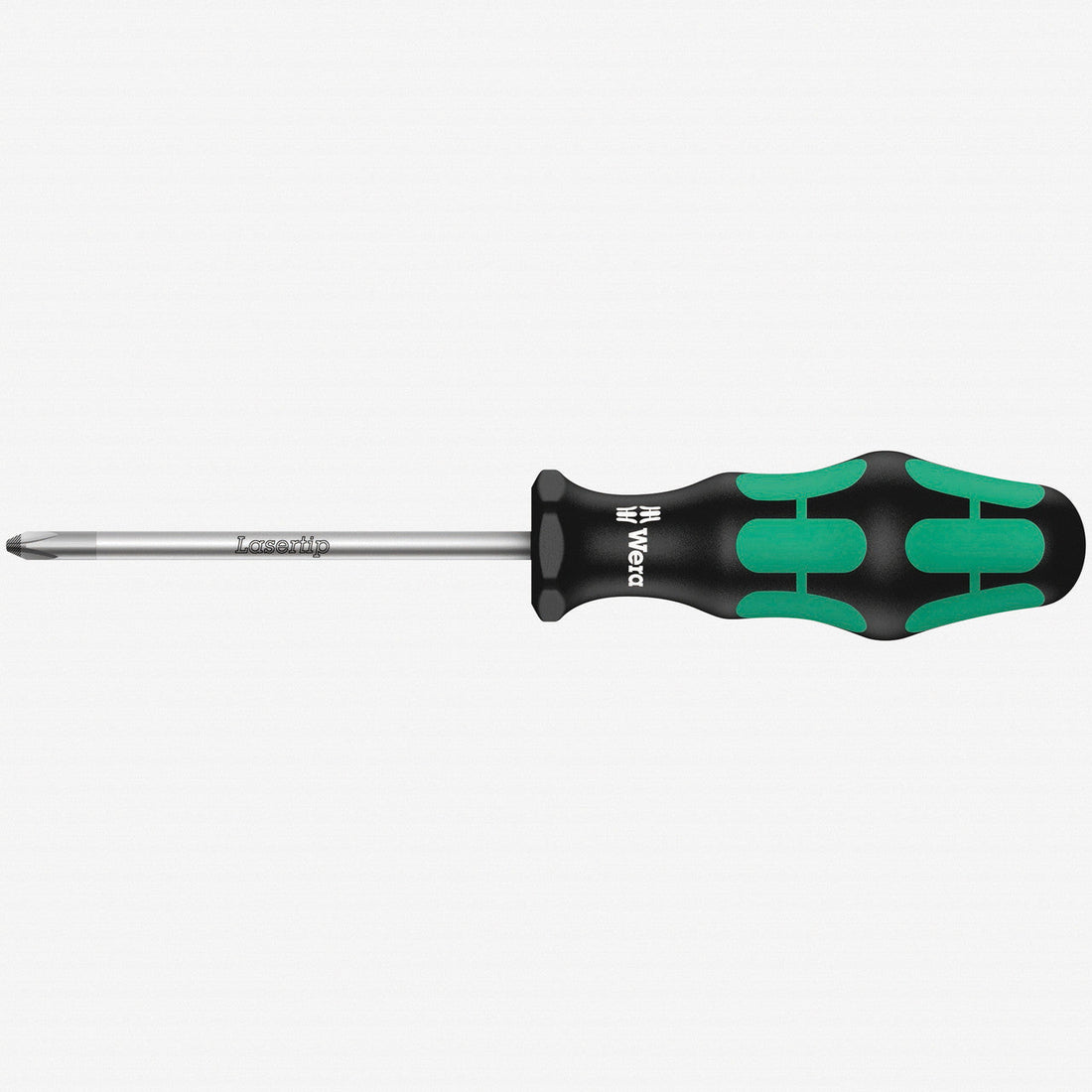
If you're a mechanic or work maintenance, Wera is the answer before you finish asking the question. The reason is the Lasertip — not marketing language, an actual functional difference you feel on the first stripped fastener.
What the Lasertip Actually Does
The Lasertip uses laser-roughened tips that bite into the Phillips or Pozidriv recess, reducing cam-out.
In plain terms: the tip is matte and slightly rough under magnification instead of polished. That texture grabs the inside of the Phillips or Pozidriv recess rather than gliding across it. When you're driving into a fastener that's been hit a few times already — or you're going in at a slight angle with hand pressure alone — that friction is what keeps you seated instead of skating across the head.
A polished tip requires significant downward force to stay in a Phillips recess. With the Lasertip, the contact is more like a grip. It's a real difference, not a spec-sheet difference, and you notice it most in automotive work on soft-metal fasteners and anything that's been in the ground.
Kraftform Plus 300 vs. 350 vs. 334 SK
- 300 series: The standard hand-driver. What most people mean when they say "Wera Kraftform." Available across Phillips, Pozidriv, slotted, Torx. This is the starting point for 95% of buyers.
- 350 impaktor: Wera's impact-driver-rated variant of the Kraftform Plus, with a strengthened tip and reinforced handle — you can run this in an impact driver without snapping the shaft. Useful if you want the Lasertip grip but drive fasteners with a hammer-mode tool.
- 334 SK: Chisel-driver hybrid. Hardened striking cap, heavier handle. You can tap it. Niche, but very useful on stubborn slotted screws in wood or drywall anchors that need a tap to break loose.
If you're buying your first Wera, start with the 300. Get the 334 SK if you work rough construction. The 350 if you need a manual backup that can take an impact.
Where Are Wera Screwdrivers Made?
Kraftform Plus 300 handles are made in Wuppertal, Germany. Among the accessories, Wera's Rapidaptor handles and bit holders are confirmed Czech Republic production.
The tools are German. Some Wera accessories — nut setters, bit adapters, ratchet bits — are produced elsewhere. Check the packaging if origin matters to you for a specific SKU.
Best For: Mechanics and Maintenance Techs
Mechanics, maintenance techs, assembly workers, anyone driving into worn or soft fasteners. For automotive Phillips work specifically, the Lasertip advantage is large enough that Wera is the only real answer in this comparison. If you're also shopping for ratchets in the Wera ecosystem, our Zyklop comparison covers the flex-head in detail. And if torque wrenches are next on the list: see our torque wrench guide.
The Smart-Money Buy: Wiha SoftFinish (and the Electrician's Default)

Wiha is the right recommendation for most people — not because it's a compromise, but because for general use, DIY, and panel-work, the price-to-performance ratio beats the other two.
SoftFinish vs. PicoFinish vs. MagicRing
- SoftFinish: Wiha's core line. Two-component oval handle with a soft grip zone. Works for most hand sizes. This is the one to buy.
- PicoFinish: Slimmer profile aimed at electronics and precision work. You give up torque leverage on larger fasteners, but it reaches where the SoftFinish won't.
- MagicRing: A bit-holder system with a locking collar rather than a fixed tip. Good for production work with mixed fastener types, not a general-purpose pick.
Start and stop at SoftFinish for general use.
Why Do Electricians Keep Buying the Wiha SlimFix VDE?
The Wiha SlimFix VDE is what most journeymen and licensed electricians in the US keep in the pouch. The reason isn't just the VDE rating — it's the shaft profile.
The SlimFix VDE is rated to 1,000V AC and individually tested to 10,000V AC per IEC 60900.
Terminal blocks and panel breakers are cramped. A standard-diameter shaft won't get in cleanly on recessed terminals without risking contact with adjacent conductors. The SlimFix's tapered shaft solves that. Combined with individual testing on each driver (not batch certification), it earns its place in every electrician's pouch.
For a full head-to-head including Klein's insulated line, see our Klein vs Wera comparison.
The Made-in-Germany vs. Made-in-Vietnam Question
This is the caveat most reviews skip, and it catches buyers off guard.
Here's the current picture: all current SoftFinish SKUs are made in Germany, across Wiha's Schonach and Mönchweiler facilities. The Industrial line is also German production. Vietnam manufacturing at Wiha covers bits, pliers, and cutters only — not screwdrivers.
Wiha's premium lines — the ones aimed at the electrician and precision trade — are still made in Schonach, Germany. Their Industrial line, which is what often shows up in big-box stores and lower-priced Amazon listings, is frequently made in Vietnam. The tip hardness and long-term durability differ from the German-made line. You're not always getting the same product for a lower price — you're sometimes getting a different product.
Check the shaft or the packaging before you buy. "Wiha" on the label is not enough. Look for "Made in Germany."
Best For: Electricians and General DIY
Electricians (SlimFix VDE), general DIY (SoftFinish), buyers who want quality without the premium-brand tax. If you're buying one set of screwdrivers and you don't need VDE insulation, the SoftFinish is the answer.
The Forever Tool: PB Swiss Classic and SwissGrip

PB Swiss operates in a different category. These are not good screwdrivers — they're precision instruments built in Switzerland by a company with roots in the watchmaking trade. They cost more. The premium is real and the reasons for it are real.
What Is the PB Swiss Ingi Tip — and Why Does It Cost More?
The Ingi tip isn't just hardened and finished. It's ground to specification. The geometry of a Phillips recess follows a defined standard, and the closer a driver tip matches that geometry, the more contact surface engages under load. More contact surface means less cam-out force concentrated at a single point — and at high torque, that's the difference between staying in the fastener and gouging the head.
That precision costs real money to produce. You're not paying for Swiss nationalism. You're paying for the tolerance.
Classic vs. SwissGrip vs. 8100 Series
- Classic: Cellulose acetate butyrate (CAB) handle. Looks like polished wood. Better in clean environments. The watchmaker's historical choice.
- SwissGrip: Two-component rubberized handle, tapered barrel. The trade-use version. Better in oil or wet conditions. This is the right pick for shop and field work.
- 8100 series: The rainbow-handled precision line for electronics and instrument work. Lighter, slimmer, not built for production torque.
If you're comparing PB Swiss to Wera and Wiha for trade use, the SwissGrip is what you're actually deciding between.
PB Swiss 8215 VDE: Is It Worth the Splurge for Electricians?
The 8215 series carries full VDE certification per IEC 60900, with each unit individually tested before it leaves the factory.
If you want the most durable VDE insulated screwdriver in this comparison, this is it. The insulation is thicker and more rugged than the Wiha SlimFix. The trade-off is shaft diameter — the 8215 is not a slim-shaft tool. It won't thread into a recessed terminal the way the SlimFix will. For durability and longevity: PB Swiss. For tight panel access: Wiha.
Are PB Swiss Screwdrivers Really Made in Switzerland?
PB Swiss manufactures 100% of its tools in Switzerland — split between facilities in Wasen im Emmental and Sumiswald, both in the Emmental region.
Unlike Wiha, PB Swiss has never outsourced production. Every tool ships from Switzerland. If provenance matters — gift quality, tools you want to leave on a bench for 30 years — that's part of what you're buying.
Best For: Lifetime Tools and Precision Work
Buyers who want a lifetime tool without asterisks. Precision workers, electronics technicians, watchmakers, and anyone giving a tool as a serious gift. Also the right call for electricians who prioritize durability in their VDE line over slim-shaft access.
Handle Shape and Grip: The Thing Nobody Tells You
Reviews cover the specs. They skip the ergonomics. Here's how the three actually feel.
Wera Kraftform: Tri-Lobe
The Kraftform's three-lobed cross-section prevents rolling — that alone is worth something on a busy bench. The lobe shape also transmits rotation without slipping in your palm, which increases efficiency on high-torque driving. But some people find the lobes dig in after extended use, particularly with smaller hands. If you're sensitive to handle pressure, try one before committing to a full set.
Wiha SoftFinish: Oval + Soft Rubber
The most universally comfortable handle of the three. The oval prevents rolling, the soft grip zone cushions the palm for extended driving, and the taper at the top gives your fingers room to index naturally. Fits most hands out of the box. This is one of the reasons it's the default recommendation for general use.
PB Swiss SwissGrip: Tapered Barrel
The taper is deliberate — wider at the top where your fingers wrap and index, narrowing toward the shaft where you apply rotational pressure. It performs notably better in oily or wet hands compared to the other two. Mechanics, HVAC techs, and plumbers who work with contaminated hands notice this advantage. In a clean shop or lab environment, the difference is minimal.
Tip Technology Compared: Lasertip vs ChromTop vs Ingi
Three different approaches. Three different strengths.
Wera Lasertip: Microscopically roughened by laser, the tip bites into the Phillips or Pozidriv recess and reduces cam-out effect. Most effective on worn or soft fasteners where a polished tip would skate. Also holds well on JIS (Japanese Industrial Standard) screws common in Asian-manufactured equipment — a real advantage for techs servicing imported machinery.
Wiha ChromTop: The SoftFinish shaft is chrome-vanadium-molybdenum steel, through hardened, chrome-plated, and finished with Wiha's ChromTop® coating. A polished, hardened tip. Holds its edge well under normal use. On new fasteners in clean conditions, you'd struggle to tell it from the Lasertip. Where ChromTop falls short is on already-compromised fasteners — the polished surface has less purchase.
PB Swiss Ingi: Precision-ground to closely match the geometry of the Phillips or Pozidriv recess. The advantage isn't friction — it's fit. The tip fills the recess more completely, so cam-out force spreads across a larger contact surface. On pristine fasteners at high torque, this geometry reduces cam-out better than the Lasertip. On worn fasteners, the Lasertip's friction advantage wins back ground.
Shaft finish and corrosion: Most Wera Kraftform shafts are blackened (burnished). Wiha SoftFinish shafts are typically nickel-plated and brighter. PB Swiss uses a polished chrome-nickel shaft. Blackened shafts hide surface wear better and don't show rust spotting as quickly in tool belts with moisture exposure — a small but real point for outdoor or construction trades. Nickel-plated shafts are slightly easier to clean in production environments.
VDE Insulated Screwdrivers Head-to-Head: Wera vs Wiha vs PB Swiss
For electricians working live circuits, this is the table that matters.
| Wera Kraftform Kompakt VDE | Wiha SlimFix VDE | PB Swiss 8215 | |
|---|---|---|---|
| Rated voltage | 1,000V AC | 1,000V AC | 1,000V AC |
| Test voltage | 10,000V DC | 10,000V DC | 10,000V DC |
| Individually tested | Yes | Yes | Yes |
| Certification | IEC 60900 | IEC 60900 | IEC 60900 |
| Slim shaft | No | Yes | No |
| Interchangeable tips | Yes (Kompakt system) | No | No |
| Best for | Mixed-fastener service work | Recessed terminals, panel work | Maximum insulation durability |
The Wiha SlimFix wins for panel electricians on slim-shaft access alone. If your work takes you into crowded terminal blocks, that shaft profile is not optional — it's the difference between clean access and risking contact with an adjacent live terminal. The Wera Kompakt VDE's interchangeable tip system is genuinely useful for service techs who see a variety of fastener types on a single call. The PB Swiss 8215 wins on ruggedness and long service life.
If you're also comparing Klein's insulated line, our Klein vs Wera guide goes deeper on the full field.
Which Set Should You Actually Buy?
| Trade / Use Case | Buy This | Why |
|---|---|---|
| Mechanic / automotive | Wera Kraftform Plus 300 series | Lasertip is the right answer for worn Phillips in automotive work |
| Electrician — panel work | Wiha SlimFix VDE set | Slim shaft reaches recessed terminals; IEC 60900 with individual testing |
| Electrician — durability first | PB Swiss 8215 VDE | Thickest insulation, longest service life of the three |
| General DIY / homeowner | Wiha SoftFinish 6-piece | Best price-to-performance, comfortable for all-day use |
| Precision / electronics | PB Swiss 8100 or SwissGrip set | Ingi tip geometry, Swiss manufacture, keeps precision |
| Gift or lifetime tool | PB Swiss SwissGrip or Classic | Quality is obvious the moment you pick it up |
Where to buy: In the US, KC Tool and Chad's Toolbox carry all three brands with full line depth — not the subset Amazon stocks. Amazon is fine for common SKUs (Wiha SoftFinish sets, Wera Kraftform 300 assortments), but you'll hit dead ends on specific VDE configurations and most of the PB Swiss line. Go to KC Tool or Chad's Toolbox when you need a specific SKU.
If nut drivers are next on the list, our nut driver guide covers the options in the same quality tier.
FAQ
Are Wera and Wiha the same company?
No. Both are German, both family-owned, both competing directly in the premium screwdriver market — but they are entirely separate companies. Wera is based in Wuppertal; Wiha is headquartered in Schonach im Schwarzwald. The similar-sounding names are coincidence. Different cities, different ownership, different design philosophies.
Is PB Swiss worth the price?
Yes, if you want a lifetime tool with the tightest tip tolerances on the market and 100% Swiss production. No, if you just need a reliable screwdriver and aren't doing precision work — Wiha SoftFinish delivers 90% of the performance at roughly 40% of the cost. Know which problem you're solving before you spend the money.
What's the difference between a Wera Lasertip and a regular tip?
The Lasertip adds a laser-roughened microsurface to the Phillips/Pozidriv tip, which increases friction inside the recess and reduces cam-out. A standard polished tip is slippery inside a Phillips recess — you rely on downward force to stay seated. The Lasertip's rough matte surface adds friction so the tip grips the recess under rotation. The difference is most obvious on worn, soft, or small fasteners, and any time you're driving at a slight angle.
Which VDE screwdriver is best for electricians?
For panel work: Wiha SlimFix VDE — the slim shaft accesses recessed terminal rows that standard-diameter drivers can't reach cleanly. For durability over a long career: PB Swiss 8215 — the toughest insulation in this comparison. For service techs with mixed fastener types on every call: Wera Kraftform Kompakt VDE, for the interchangeable tip system.
Are these screwdrivers actually made in Germany?
Wera: yes, Wuppertal. PB Swiss: no — 100% Swiss, Wasen im Emmental. Wiha: depends. The premium professional lines are made in Schonach, Germany. The Industrial line and some value-tier SKUs are made in Vietnam. For the vast majority of Wiha's catalog the answer is Made in Germany; a small number of SKUs (77890, 77891, 77892) are Made in USA. Don't assume — read the packaging before you buy.
Which brand has the best warranty?
All three offer lifetime warranties against defects. In practice, Wera is the most permissive about what counts as a warrantable claim. PB Swiss specifies defect-only — abuse isn't covered. Wiha falls between them. For normal hand-driving use, all three last long enough that the warranty difference is academic.
Can I use any of these with an impact driver?
Only the Wera Kraftform Plus 350 impaktor series is explicitly rated for impact driver use — designed with a reinforced shaft and handle built to withstand percussive tool loads. Don't put a Wiha SoftFinish or PB Swiss Classic in an impact driver — you risk snapping the tip or cracking the handle. Wiha makes TorqueControl-rated models for controlled-torque driving, but the standard SoftFinish is not impact-rated. If you need impact-rated manual screwdrivers, Wera is the only brand of the three with a clear answer.
Buy Wiha unless you've got a specific reason to spend more. If you do, buy Wera for turning and PB Swiss for keeping.
For electricians sorting out the full VDE insulated-driver decision: see our Klein vs Wera guide. For nut drivers to round out your kit: check our nut driver guide.