
Best Precision Screwdriver Sets — What Trades and DIYers Actually Need
Picking the right precision screwdriver set comes down on what you're opening and how often. For most people, the answer is the Wera Kraftform Micro — CrMoV steel, handles that don't destroy your hand after an hour, and tip geometry that holds up. If you work on Japanese equipment — cars, motorcycles, power tools, consumer electronics — you also need a Vessel JIS set, because those screws look like Phillips but strip if you treat them that way. Doing phone and laptop teardowns occasionally? iFixit Pro Tech Toolkit handles that without overpaying. The biggest mistake: buying a 64-piece kit because the number looks good. More bits doesn't mean better tips. Here's what actually separates these sets, and why JIS matters more than most guides will tell you.
Quick Comparison — The Sets Worth Buying
| Set | Best For | Blade Steel | ESD Safe? | Price Tier | JIS? |
|---|---|---|---|---|---|
| Wera Kraftform Micro | Trades, general precision | CrMoV | No | Mid-premium | No |
| Vessel JIS Precision Set | Japanese OEM equipment | Hardened tool steel* | No | Budget–Mid | Yes |
| iFixit Pro Tech Toolkit | Electronics teardowns, Apple devices | S2 tool steel | No† | Mid | No |
| Wiha SoftFinish Precision | Sustained professional use | CVM | No† | Premium | No |
| Klein 32614 | Budget trades pick | Tool steel§ | No | Budget | No |
\* Vessel does not publish a specific blade steel grade designation for this set; the blades are hardened tool steel appropriate to precision JIS work. † Neither the iFixit Pro Tech Toolkit nor the Wiha SoftFinish Precision set carries IEC 61340 ESD-S certification; both brands offer dedicated ESD product lines for applications requiring that protection. § Klein does not prominently publish a blade steel grade for this set; tip construction is consistent with the brand's professional-tier standards at this price point.
*Price tiers approximate — Budget under $30 / Mid $50–80 / Mid-premium $80–120 / Premium $100+. Confirm current prices at each retailer before purchasing, as pricing changes.*
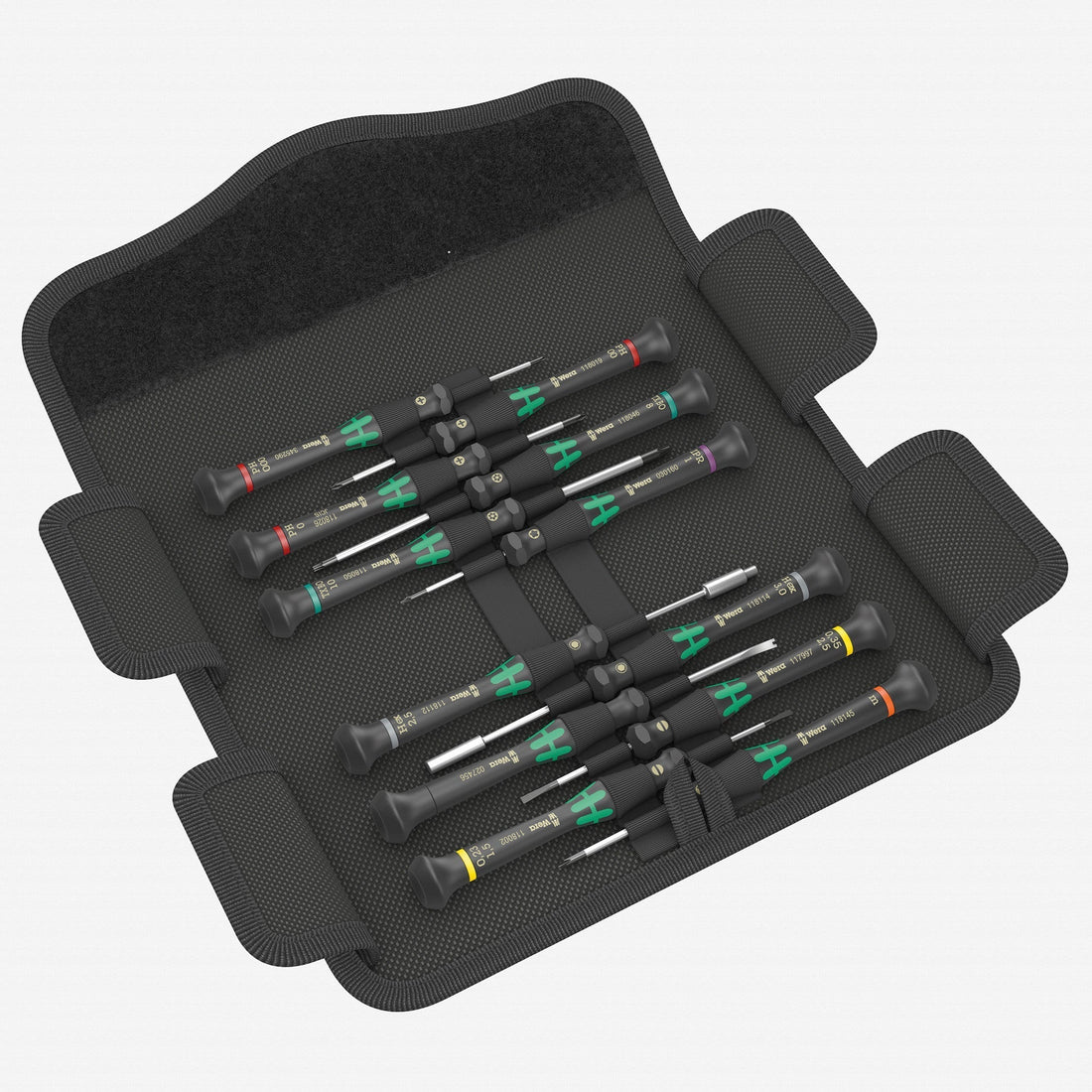
Best Overall for Trades: Wera Kraftform Micro Set
The Wera Kraftform Micro earns the top spot on handle feel alone — and that matters if you're using these tools for more than thirty seconds at a time. The two-component Kraftform handle uses a hard zone for the grip body and a softer zone where your fingertips actually contact the driver. That's not marketing copy; it's why you can work small fasteners for an hour without your hand cramping up.
Blade steel is CrMoV (chrome-molybdenum vanadium) — a meaningful step up from standard chrome-vanadium in tip hardness and edge retention. If you've had a cheaper driver slip and round a recess before the screw came out, that's the difference you're buying.
The set doesn't cover JIS. If you need JIS, you need a second set. But for standard Phillips, Torx, flathead, and hex work on American and European equipment, this is the benchmark.
Wera produces the Kraftform Micro in multiple configurations — check the current lineup at wera.de for available models and piece counts.
For a deeper head-to-head at the premium tier, see our comparison of Wera, Wiha, and PB Swiss.
Best for JIS Work: Vessel Tools JIS Screwdriver Set

Vessel is a Japanese manufacturer, and one of the only brands that takes JIS seriously enough to build a precision set around it. Their JIS drivers are purpose-ground to the JIS B 1012 standard — not "JIS-compatible" Phillips with a looser fit, but actual JIS geometry.
The set covers JIS #0, #1, and #2 at minimum; consult vessel-usa.com for the full size lineup and current model number. Handle material provides a functional grip designed for fingertip torque control.
These aren't going to replace a full Wera or Wiha set for general precision work — handle ergonomics are functional, not exceptional. But for anyone working on Japanese automotive, motorcycles, or consumer electronics, this is the tool that prevents you from turning a fastener into a stripped circle. Buy it alongside your main set, not instead of it.
Best for Electronics Teardowns: iFixit Pro Tech Toolkit

iFixit's Pro Tech Toolkit has one job: cover every fastener you'll encounter opening phones, laptops, tablets, and game consoles. At 64 bits, it does that better than anything else near the price. The bit library includes Pentalobe (Apple devices), Tri-point, Torx Security, and the proprietary sizes that normal sets skip entirely.
Blade steel is S2 tool steel — the shock-resistant grade that quality driver sets use. That's a real step up from the soft plated steel on budget kits. The magnetic bit holder keeps small bits from disappearing into carpet or a parts tray.
The handles are functional for occasional use. If you're repairing your own gear a few times a year, they're fine. If you're a repair tech doing this eight hours a day, handle geometry will start to matter — and that's where Wera and Wiha pull ahead.
The handles carry no ESD rating — the Pro Tech Toolkit is not an ESD tool and should not be used on live circuit boards or ESD-sensitive components without additional precautions. iFixit offers dedicated ESD product lines for that requirement.
Best Premium Pick: Wiha SoftFinish Precision Set
Wiha's precision line is German-made and built around the kind of sustained use that separates professional tools from competent consumer ones. The SoftFinish handle uses a two-zone design — hard grip body, soft contact zone — and laser-etched tip markings that don't fade off.
Where Wiha stands apart is long-session comfort. The handle diameter and zone placement are tuned for fingertip control on small fasteners over extended work — the kind of job where a cheaper handle starts biting into your fingers before the work is done.
Blade steel is chrome-vanadium-molybdenum (CVM) — the same high-performance alloy used across Wiha's professional precision range. This set does not carry IEC 61340 ESD-S certification; Wiha produces dedicated ESD product lines for that requirement, but the SoftFinish Precision series is not one of them.
Best Budget Pick: Klein 32614 Precision Set
Klein's precision set is the right answer when you need capable tips without spending mid-premium money, and you're not doing daily electronics work. Klein's build quality is reliable — the tips are properly formed, the handles are functional, and the brand stands behind the tool.
Klein does not prominently publish a blade steel grade for this set, but tip construction is consistent with the brand's professional-tier standards. Check kleintools.com for the current model number if the 32614 lineup has been updated since publication.
Skip this if you're using precision drivers daily for sustained sessions. But for a tradesperson who occasionally opens an instrument panel or works through a small electronic component, it's solid value.
JIS vs. Phillips — Why Most Guides Miss the Most Important Thing
Here's the problem with JIS screws: a Phillips bit fits. It goes in, it seats, it feels right — and then it strips the fastener.
JIS (Japanese Industrial Standard, specification B 1012) screws look identical to Phillips at a glance. The recess geometry is different — the walls are more vertical, the engagement angle differs slightly. A Phillips bit contacts the JIS recess at the wrong angle and rides out under torque instead of driving down. The result is a rounded recess and a fastener you're now extracting instead of removing.
Who actually needs JIS drivers:
- Anyone servicing Japanese cars or motorcycles (Honda, Toyota, Yamaha, Kawasaki, Suzuki) — especially vehicles from before roughly 2010
- Anyone working on Japanese power tools (Makita, Hitachi/Metabo HPT, older Ryobi)
- Consumer electronics manufactured in Japan or to JIS spec — which covers a lot of Sony, Panasonic, and older Nintendo hardware
How to spot a JIS screw: Look for a small raised dot stamped near the center of the recess, or near the fastener head. It's subtle. Most people miss it until they've already stripped the screw.
If you work exclusively on American or European equipment, skip JIS. Standard Phillips covers you.
If you touch Japanese OEM anything with any regularity, a Vessel JIS set is cheap insurance. Buy it once, stop having conversations about why the screw is now a smooth circle.
What to Actually Look For
Blade Steel
S2 tool steel (shock-resistant) holds a tip edge longer than chrome-vanadium (CrV) under repeated torque. It's what iFixit uses and what you want in any driver you'll reach for regularly. CrMoV (chrome-molybdenum vanadium, used by Wera) adds molybdenum for improved hardness and corrosion resistance — competitive with S2 and slightly better than standard CrV. Basic CrV is fine for light occasional use; it rounds faster under stress.
Tip Magnetism
You need enough magnetism to hold a 1mm fastener while you guide it into position. Quality sets use tips with permanent magnetism. Ask whether it degrades — cheap sets often lose holding power after a year of use.
Handle Diameter and Material
For fingertip control on small fasteners, precision driver handles run considerably smaller in diameter than standard screwdrivers — narrow enough to roll between your fingertips rather than grip in your palm, which is what controlled torque on small fasteners demands.
Two-component handles (hard body, soft contact zone) reduce fatigue noticeably on long sessions. Single-material plastic is fine for occasional work.
If you're comparing precision screwdrivers to ratcheting options for efficiency on a job, those are a different tool category — see ratcheting options.
ESD Ratings
ESD (electrostatic discharge) protection matters only if you're working on live circuit boards or handling ESD-sensitive components. For most trades and DIYers — even those doing occasional electronics work — it's a non-issue. If you need it, look for IEC 61340 ESD-S certification specifically. Don't assume a "precision" label implies ESD safety; it doesn't.
Bit Count vs. Tip Quality
This is the trade-off most guides get wrong. A 64-piece kit with soft plated tips is worse than a 10-piece set with precision-ground S2 or CrMoV steel. The sizes covering 90% of real work: PH00, PH0, PH1, T5, T6, T8, T10, a 2mm flathead, a 3mm flathead. Add Pentalobe P2 and P5 if you work on Apple hardware. The rest of a large bit kit covers edge cases most users never hit.
A multi-bit driver is a different product entirely — see multi-bit drivers for that comparison. Don't confuse bit count in a precision kit with versatility in a multi-bit driver.
FAQ
What's the difference between precision screwdrivers and regular screwdrivers?
Precision screwdrivers have smaller-diameter handles designed for fingertip control rather than palm torque, shorter blades, and finer tip tolerances. They're built for small fasteners in electronics, optics, and instruments where overdrive ruins the screw or the component. Regular screwdrivers are built for leverage and grip strength — the opposite of what you want on a 1.2mm Phillips in a laptop hinge.
Do I need JIS screwdrivers?
If you work on Japanese-made equipment — cars, motorcycles, power tools, or consumer electronics manufactured to JIS spec — yes. JIS screws look like Phillips but have a different recess angle; a Phillips bit slips and strips them. If you work exclusively on American or European equipment, skip it.
Are iFixit screwdrivers worth it?
For occasional phone and laptop repairs, yes. The Pro Tech Toolkit's bit library covers proprietary fasteners (Pentalobe, Tri-wing, Torx Security) that nothing else matches at the price. For sustained trade use where handle ergonomics matter over hours, Wera or Wiha serve you better.
Are Wera precision screwdrivers worth the price?
For regular use, yes. The Kraftform handle geometry genuinely reduces fatigue on long sessions, and CrMoV tips hold their edge longer than cheaper steel. If you open a laptop twice a year, iFixit is fine and costs less. Daily use justifies the Wera premium.
What precision screwdrivers do electricians use?
Klein for budget-conscious trades work; Wiha SoftFinish for ergonomics on sustained sessions; Wera Kraftform for daily professional use. Electricians working on Japanese-manufactured equipment — certain VFDs, imported fixtures, some panel hardware — should add a Vessel JIS set to avoid stripping JIS fasteners. For the insulated-driver side of this question, see Klein vs. Wera insulated drivers.
What does S2 steel mean on a screwdriver?
S2 is a shock-resistant tool steel grade that holds a sharp tip better than standard chrome-vanadium under repeated torque cycles. It's the blade material used by iFixit and worth looking for in any precision driver you'll use regularly. Better tip retention means fewer slipped bits and fewer rounded screws.
What sizes do I actually need in a precision screwdriver set?
For 90% of jobs: PH00, PH0, PH1, T5, T6, T8, T10, a 2mm flathead, and a 3mm flathead. Add Pentalobe P2 and P5 if you work on Apple hardware. Everything else in a large bit kit covers edge cases most people encounter once a year, if that.
If you're choosing between the premium brands at the Wera/Wiha/PB Swiss tier, that comparison goes deeper at this detailed breakdown. Electricians weighing insulated driver options alongside precision sets should see insulated screwdriver comparison.
*Editorial post — no money page.*