
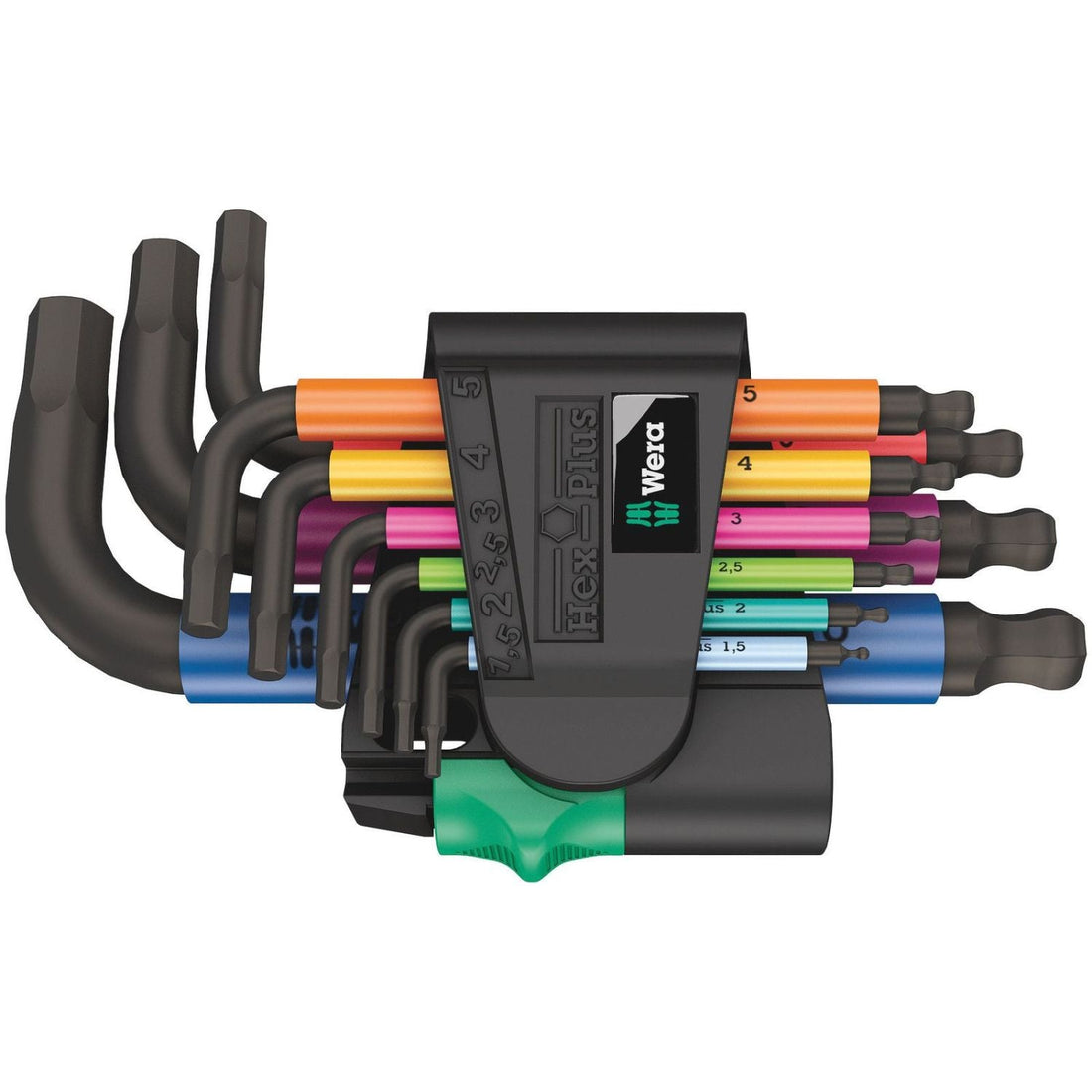
Best Hex Key Sets: L-Keys, T-Handles, and the Ball-End Question — Straight Answer
The best hex key set for most shops and garages is a 9-piece metric L-key with ball ends — it covers 90% of fasteners you'll ever hit. Bondhus BriteGuard and Wera 950 Hex-Plus are worth the extra $15–25 over the hardware-store bin — not because they feel nicer, but because the ball-end engages at up to 30° off-axis instead of stripping out at a lower angle, and both brands will sell you a single replacement key when you trash a 4mm. If you work on older American equipment, add an SAE set. T-handle sets are for repetitive high-torque assembly, not general use.
L-Key vs T-Handle — Which Type Are You Buying?
This is the question most hex key guides skip. They go straight to the brand picks. Don't let them. The type matters more than the brand for most buyers.
L-Key Sets (the default choice)
An L-key — the classic bent-hex-rod format — is what you want for general use. You get two usable sides from every key: the long arm reaches into recessed fasteners (machinery, bike components, furniture with deep bolt holes), and the short arm gives you leverage when you need to torque something down without slipping.
Long-arm reach matters in practice. A 5mm long-arm key reaches significantly deeper into a recessed cavity than the short arm — on the Wera 950 PKL, that's 160 mm of long-arm reach versus 28 mm of short-arm; the Bondhus 10999 runs approximately 119 mm long-arm and 27 mm short-arm — and if you've ever fought an M5 bolt on a bike derailleur or a piece of machinery, you know the short arm alone isn't enough.
Short-arm-only sets exist. They make sense if storage is the hard constraint, or if you're building a single-purpose kit. Otherwise, get long-arm.
T-Handle Sets (the torque tool)
A T-handle hex driver gives you significantly more torque than any L-key because of grip diameter. You hold it like a screwdriver, which means your whole hand applies force — not just your fingertips. That matters for bike bottom brackets, heavy furniture assembly, or production work where you're driving the same fastener hundreds of times.
T-handles are not a substitute for an L-key set. They typically cover limited size ranges, and switching sizes mid-job gets old fast. They're a supplement, not a replacement.
Rule of thumb: Buy an L-key set first. Add a T-handle only when a specific job keeps beating you for torque.
Metric vs SAE — Do You Actually Need Both?
For most people: no. Modern equipment — IKEA furniture, road and mountain bikes, HVAC hardware, imported machinery, most power tools — runs on metric fasteners. A 9-piece metric set covering 1.5mm–10mm handles the overwhelming majority of what you'll hit.
SAE is still required for older American-made equipment, vintage vehicles (pre-1980s domestic, roughly), some plumbing fittings, and certain electrical panel hardware. If you don't work on any of that, metric alone is all you need to start.
Buy order: Metric 9-piece first. Add SAE when your metric set won't fit something you actually need to work on.
| Use Case | Metric Covers It? | SAE Needed? |
|---|---|---|
| IKEA / flat-pack furniture | Yes | No |
| Modern imported machines | Yes | Probably not |
| Road / mountain bikes | Yes | Rarely |
| Older U.S.-made equipment | Partially | Yes |
| Automotive (mixed fleet) | Mostly | Occasionally |
| HVAC / refrigeration | Yes | Sometimes |
The Best Hex Key Sets: Our Picks
Best Overall — Wera 950/9 Hex-Plus Metric L-Key Set
The Wera 950 Hex-Plus is the standard recommendation for a reason, and it's not just because Wera has good marketing.
The Hex-Plus profile is the real differentiator. Standard hex keys have flat contact faces that engage a fastener socket on its flat walls. When a socket gets even slightly worn or rounded, a standard key chews it further. Wera's Hex-Plus geometry uses a proprietary modified profile that transfers load more effectively and resists rounding out worn fastener sockets.
In plain terms: you can use a Wera Hex-Plus on a fastener that a regular key would destroy. That's geometry, not marketing.
Other specs: chrome vanadium steel, through hardened, with a ball-end designed for substantial off-axis engagement, across 9 sizes: 1.5, 2, 2.5, 3, 4, 5, 6, 8, 10 mm.
Individual keys are sold separately in the 950 series — Wera lists 59 individual SKUs spanning five product lines: metric PKLS, metric PKL ball-end, metric PKL BM BlackLaser, imperial PKL, and multicolour SPKL. When your 4mm dies, you order one key.
Who it's for: Mechanics, tradespeople, anyone who routinely runs into previously-worked-on fasteners. See how Wera's build quality translates to other precision tools in our screwdriver breakdown and ratchet comparison.
Best for USA-Made and Replacement Keys — Bondhus BriteGuard Balldriver Metric Set
Bondhus is a Minnesota company that's been making hex keys since 1964. The BriteGuard line uses Protanium steel — Bondhus's proprietary alloy, described by the company as stronger than standard chrome-vanadium.
The ball-end engagement angle on Bondhus ball-driver L-keys is 25°, cleanly outperforming the unlisted angles on cheap hardware-store ball-ends that deform the socket instead of driving it.
Model to look for: Bondhus 10999, 9-piece metric long-arm set with BriteGuard nickel finish. Sizes: 1.5, 2, 2.5, 3, 4, 5, 6, 8, 10 mm. Made in the USA. Individual replacement keys are sold by size as single-key SKUs.
The BriteGuard finish resists corrosion in wet environments. If your keys live in a van or service truck, that's not a cosmetic feature.
Who it's for: Pros who want USA-made, individual key replacement, and a ball-end that handles tight approach angles.
Best Budget / First Set — Tekton Hex Key Set (Metric + SAE Combo)
If you don't know which sizes you'll use most — or you're buying your first set — a Tekton combo saves you the second purchase. You get metric and SAE in one box at a price that doesn't hurt if you upgrade later.
Tekton uses 8660 nickel chromium molybdenum steel with solid dimensional tolerances for general DIY work. It's not Hex-Plus geometry. It's not Protanium. For occasional furniture assembly, a home workshop, or a starter kit, it's more than adequate.
Model: Tekton 25253 — a 30-piece set with 15 SAE and 15 metric keys.
Tekton sells individual replacement L-keys directly at tekton.com — standard ball end, flat end, and short-arm styles start at $3 per key — so if you trash a 4mm, you're buying one key, not a new set.
For context on how Tekton performs across other hand-tool categories, see our combination wrench comparison.
Who it's for: Homeowners, occasional DIYers, anyone buying their first set and not yet sure what they'll need most.
Best T-Handle — Wera 454 HF

The Wera 454 HF earns its spot because of one feature: Holding Function. A small retention mechanism at the tip holds the fastener during positioning and early driving. When you're working overhead, inside a cabinet, or in any cavity where a dropped fastener disappears, that matters more than a few grams of steel hardness difference.
The current model is the 454/7 HF Set 1 — a 7-piece metric set (SKU 05023450001).
T-handle geometry translates directly to torque: you grip it like a screwdriver, your whole hand drives it, and you can apply meaningfully more force than with an L-key long arm. That's what bike bottom brackets and cam-lock furniture fasteners need.
Who it's for: Bike mechanics, furniture assemblers, any production work where you're driving the same fastener size repeatedly in volume.
Best Folding Set — Portability Over Reach
A folding hex key set trades long-arm reach for compactness. Everything folds into a single handle; you flip out the size you need. That's the win. The loss: folding sets can't deliver the leverage of a full long-arm key, and the mechanism adds bulk relative to a bare L-key pouch.
If you need a kit for a tool bag or a job where space is genuinely the constraint, a folding set makes sense. If you can carry a pouch, the L-key set is more capable.
Look for a folding set with ball-end tips — the off-axis engagement is more valuable in tight quarters, which is exactly the scenario a folding set gets used in.
The Bondhus BF5M (SKU #12897) is the recommended option — a ball-end fold-up hex set covering 5–10 mm metric. Note that smaller sizes below 5 mm aren't offered in this folding format due to breakage risk at the mechanism, so if your work regularly includes sub-5mm fasteners, you'll still need a separate L-key set for those sizes.
Who it's for: Anyone who needs a hex key set they can pocket or tuck into a bag for fast size switching on-site.
What Do Hex Key Specs Actually Mean?
Listings throw a lot of terms at you. Here's what to actually look at.
Ball-end engagement angle (25°–30°): This is the quality tell. A 30° off-axis engagement means you can approach a fastener at a steep angle and still drive it cleanly. Cheap ball-ends have lower engagement angles — often unlisted — and the ball deforms the socket walls instead of driving them. If the listing doesn't state the angle, assume it's not 30°.
Material: Chrome-vanadium is the minimum for anything that'll see real use. Bondhus Protanium and Wera's tool steel are at the top end. Carbon steel sets — often unlabeled — will deform before a stuck fastener does. Never buy a set that doesn't list the steel type.
Individual key replacement: Ask this before you buy. Wera and Bondhus both sell individual L-keys by size. Most hardware-store branded sets don't. The math: when your 4mm key strips — and it will, especially on bike assembly and flat-pack furniture — a replacement key from Bondhus or Wera costs a few dollars. A new budget set costs $15–30. That math runs for years of ownership.
Size coverage: A 9-piece metric set covering 1.5mm–10mm handles modern fasteners. Your real daily drivers are 2mm, 2.5mm, 3mm, 4mm, 5mm, and 6mm. For SAE, an 8-piece set covering .050", 1/16", 5/64", 3/32", 7/64", 1/8", 9/64", and 5/32" covers most American fastener sizes.
Long-arm vs standard: If you work with recessed M5 or M6 socket heads — standard on machinery, bike components, furniture — long-arm isn't optional. Short arm gets you torque. Long arm gets you reach. Both sides are on every L-key. Get both.
Hex Key FAQs
What is the difference between a hex key and an Allen key?
The same tool. "Allen key" is a brand name from Allen Manufacturing, now part of Apex Tool Group. "Hex key" is the generic term. Both refer to a six-sided cross-section tool that drives socket-head cap screws and set screws. Use either term — they mean the same thing.
Do I need both metric and SAE hex key sets?
For most modern work — bikes, furniture, HVAC, imported machinery — metric alone covers you. Add SAE only when you work on older American-made equipment, vintage vehicles, or certain plumbing fittings. Buy metric first. Buy SAE when you hit something the metric set won't fit.
What size hex key set do I need?
A 9-piece metric set covering 1.5mm–10mm handles most applications. The most-used sizes are 2mm, 2.5mm, 3mm, 4mm, 5mm, and 6mm. For SAE, an 8-piece set covering 5/64"–5/16" handles most American fastener sizes.
What is a ball-end hex key and does it matter?
A ball-end hex key has a spherical tip that lets you drive a fastener at an angle — typically 25°–30° off-axis — when you can't approach it straight. It matters because cheap ball-ends have smaller, often unspecified engagement angles and strip the fastener socket instead of driving it. If a listing doesn't state the engagement angle, assume it's lower than 25°.
Are Wera hex keys worth the extra money?
For regular use, yes. The Hex-Plus profile grips worn or slightly rounded fasteners that a standard key would damage further. The premium is typically $15–25 over a budget set. If you've ever ruined a fastener with a cheap key, the math is easy. If you're a first-time buyer who rarely uses hex keys, start with Tekton and upgrade when you need to.
Long arm or short arm hex keys — which should I get?
Long-arm for almost everyone. The long side reaches into recessed fasteners; the short side gives you leverage for torquing. Both sides are on every long-arm L-key. Short-arm-only sets make sense only when storage space is the hard constraint.
Can I replace individual hex keys in a set?
With Bondhus and Wera, yes — both sell individual L-keys by size. With most hardware-store and private-label branded sets, no. When a 4mm key strips — common for bike assembly and furniture work — you want to spend a few dollars on one key, not $20–40 on a new set.
<!-- Pillar link: add when hand-tools hub post is published -->
For complementary fastener tools, see our nut driver set guide. If you're building out a Wera collection, our ratchet comparison and screwdriver breakdown cover the rest of the precision German-tool lineup.
*editorial, no money page*