
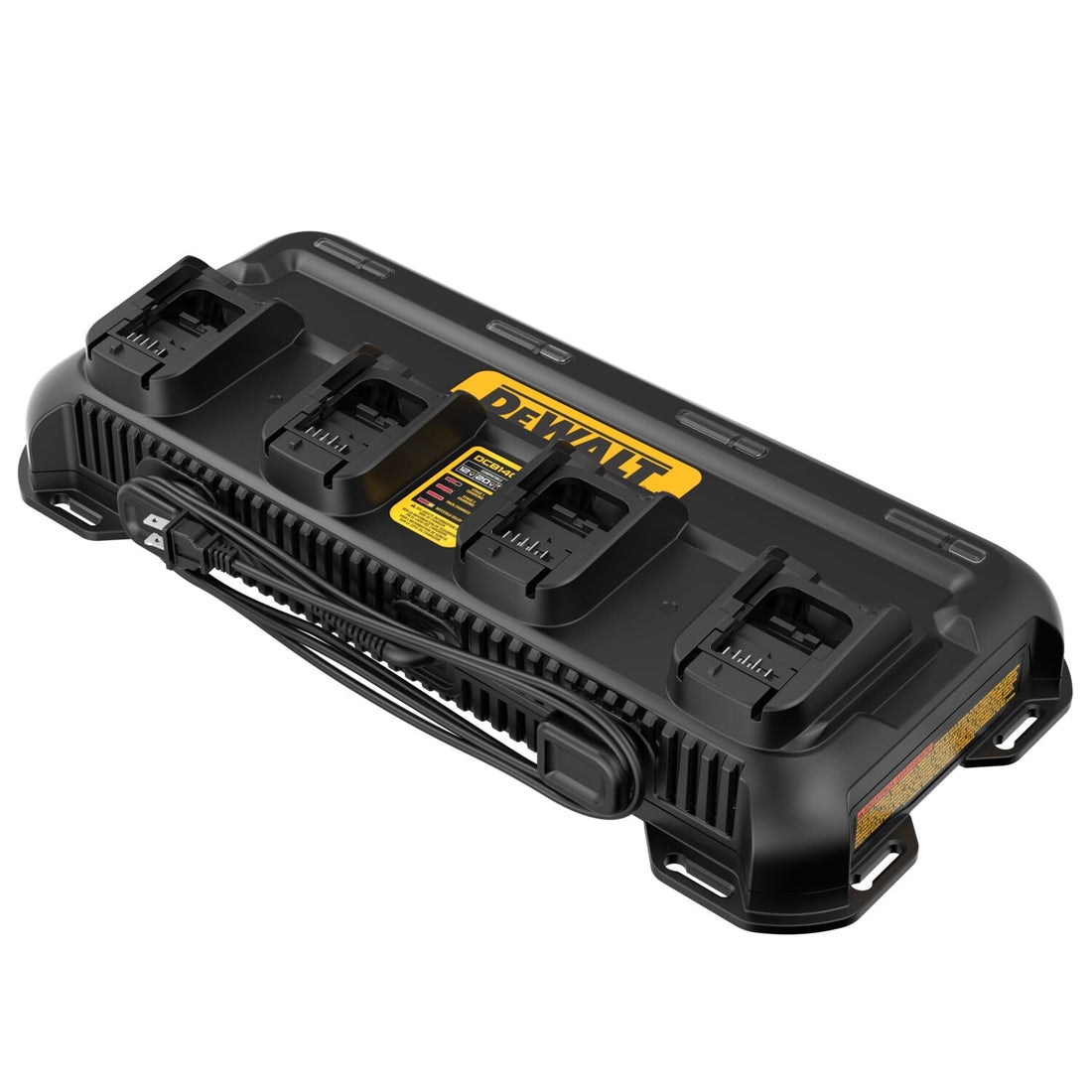
DeWalt DCB1404 vs DCB104: What Changed, What Didn't, and Which 4-Port Charger to Buy
The DeWalt DCB1404 is the renamed version of the DCB104 — same 4-bay sequential charger, same 12V MAX / 20V MAX / 60V MAX FLEXVOLT Li-ion compatibility, updated model number under DeWalt's new naming scheme where the last two digits equal the amp rating per port. If you already own a DCB104, don't spend a dollar upgrading. If you're buying a 4-port charger today, get the DCB1404 — it's the current SKU with better parts and warranty support. Here's the full breakdown. Review our charger compatibility guide.
DCB1404 vs DCB104 at a Glance
| Spec | DCB1404 | DCB104 |
|---|---|---|
| Bays | 4 | 4 |
| Charging mode | Sequential | Sequential |
| Amp rating per bay | See current spec sheet | See current spec sheet |
| Voltages supported | 12V MAX, 20V MAX, 60V FLEXVOLT | 12V MAX, 20V MAX, 60V FLEXVOLT |
| Chemistry | Li-ion only | Li-ion only |
| Input voltage | 120V AC | 120V AC |
| Weight | See current spec sheet | See current spec sheet |
| Warranty | 3-year limited | 3-year limited |
| Status | Current SKU | Discontinued |
Charge times in the table below — they're the same for both units, assuming the same amp rating per bay.
Are the DCB1404 and DCB104 the Same Charger?
For every practical purpose, yes.
What DeWalt's New Charger Naming Actually Means
DeWalt rolled out a new naming convention across their charger lineup: the last two digits of the model number equal the amp rating per port. Follow the pattern:
- DCB1404 → 4-bay, 4A per bay
- DCB1104 → single-port, 4A
- DCB1112 → single-port, 12A FLEXVOLT fast charger
So "DCB104 → DCB1404" is the same story DeWalt ran on the battery side when the PowerStack became the 20V MAX XR: a nomenclature refresh, not a redesign. Learn more about that naming convention.
The DCB1104 and DCB1112 both confirm the pattern on dewalt.com — worth cross-checking before this post ships.
What Physically Changed Between DCB104 and DCB1404
Straight answer: the two models appear to share the same core housing and functional design. Any visible differences are cosmetic at most — minor finish or indicator updates — and none affect charging speed or compatibility. Treat it as a pure rename unless a direct side-by-side comparison of the spec sheets reveals otherwise.
What Didn't Change
Everything that matters stayed the same:
- 4 bays
- Sequential operation (one battery charges at a time)
- 12V MAX, 20V MAX, 60V MAX FLEXVOLT Li-ion compatibility
- Li-ion only — no NiCd
- 120V AC wall input
- 3-year limited warranty
What Batteries Does Each Charger Fit?
Both chargers cover the same DeWalt Li-ion lineup. Here's how it breaks down platform by platform.
12V MAX Batteries
Full compatibility with all DeWalt 12V MAX Li-ion packs — DCB120 (1.5Ah), DCB127 (2.0Ah), and the rest of the family. If you run compact 12V tools alongside your 20V kit, one charger handles both.
20V MAX (Including PowerStack)
Covers the full 20V MAX lineup: standard DCB200-series packs and the PowerStack DCBP-series batteries. PowerStack uses a different cell geometry but it's still 20V MAX Li-ion — charges normally, same bay.
60V MAX FLEXVOLT
Both units handle the entire FLEXVOLT line — DCB606 (6.0Ah), DCB609 (9.0Ah), and the newer tabless DCB6112 (12.0Ah). Fair warning: a 12Ah pack on a 4A charger takes a while. Plan accordingly.
What They Do NOT Charge
Neither charger works with:
- Legacy 18V NiCd packs (DC9096, DW9096, DW9098) — wrong chemistry, wrong protocol
- 40V MAX outdoor platform — different connector, not compatible
- Non-DeWalt batteries — no cross-brand support
This trips people up in Amazon Q&As more than anything else. If you've got older yellow 18V NiCd packs from a decade ago, these chargers won't wake them up. You need a NiCd-capable unit like the older DC9310 for that.
How Fast Does Each Charge?
Functionally identical between the two models — same amp rating, same charge times. Charge time scales directly with battery capacity on any amp-limited charger; for exact published figures, consult the current DCB1404 spec sheet. The ordering from fastest to slowest stays consistent:
| Battery | Capacity | Estimated Charge Time |
|---|---|---|
| 20V MAX DCB203 | 2.0Ah | Shortest of the lineup |
| 20V MAX DCB204 | 4.0Ah | Moderate |
| 20V MAX DCB205 | 5.0Ah | Moderate to long |
| 20V MAX PowerStack DCBP520 | 5.0Ah | Moderate to long |
| 60V FLEXVOLT DCB609 | 9.0Ah | Extended |
| 60V FLEXVOLT DCB6112 (tabless) | 12.0Ah | Longest of the lineup |
One thing to get straight before buying: sequential does not mean simultaneous. Four bays hold four batteries. But the charger works through them one at a time — it finishes bay one, then starts bay two, and so on. Load four dead 5.0Ah packs and you're waiting four charge cycles, not one.
That's not a flaw, it's how the product works. But it changes how you use it. Plug in overnight and you're fine. Expect a full fleet charged by lunch and you'll be disappointed.
For Milwaukee owners doing a similar comparison, see our Milwaukee charger comparison.
Should You Upgrade from DCB104 to DCB1404?
No. Unless yours is dead.
The charging behavior is identical. There's no speed gain, no new battery type unlocked, no feature you're missing. Buying a new unit when your old one works is just moving money from one pocket to another — and you still end up with the same charge times.
When it actually makes sense to swap:
- Your DCB104 has a failed bay, cracked housing, or is out of warranty and beyond economical repair
- You're splitting kits — giving the DCB104 to a second location and equipping your primary with the current SKU
- You want to simplify warranty claims: current-SKU chargers are easier to get serviced
- You're starting a new kit from scratch — just buy the DCB1404, it's what's on shelves
When to save your money:
- DCB104 working fine → keep it
- Faster charging is the real need → step up to the DCB1112 (12A fast charger), not a DCB1404
- Need to charge batteries away from a wall outlet → the 4-port wall charger can't help you there
Better Options If You Actually Want Portable Charging
Both the DCB1404 and DCB104 require a 120V wall outlet. On a job site with no power yet, in a truck, up on a roof — neither one does anything for you.
If the actual problem is charging devices off your DeWalt battery, that's a different product entirely. Our USB-C charger plugs directly into any DeWalt 20V MAX battery and delivers up to 65W USB-C output — enough for a laptop, two phones, or a job-site tablet. No outlet, no extension cord.
For running a corded tool or small appliance where power isn't available, the power inverter for 20V MAX batteries gives you a 120V outlet plus two USB ports off a DeWalt 20V MAX battery at 150W continuous. See how long a battery can power an inverter.
Neither replaces the DCB1404 for charging your actual tool batteries overnight — that's still a wall-outlet job. But if the real gap is *power in places without outlets*, the OEM charger lineup has no answer for that. Learn about USB charging solutions
Frequently Asked Questions
Is the DCB1404 the same as the DCB104?
Functionally yes. Same 4-bay sequential design, same DeWalt 12V MAX / 20V MAX / 60V MAX FLEXVOLT Li-ion compatibility, same charging behavior. The DCB1404 is DeWalt's current-SKU name under a new convention where the last two digits indicate amps per port. Physical differences, if any, are limited to cosmetic details — housing finish or LED indicator layout — and do not affect charging speed or compatibility. See also: our charger compatibility reference for full DeWalt charger compatibility by model.
What batteries does the DCB1404 charge?
DeWalt 12V MAX, 20V MAX (including PowerStack), and 60V MAX FLEXVOLT lithium-ion batteries. It does not charge legacy 18V NiCd packs (DC9096, DW9096) or the 40V MAX outdoor platform.
Does the DCB104 charge FLEXVOLT batteries?
Yes — the DCB104 was built to charge 12V MAX, 20V MAX, and 60V MAX FLEXVOLT batteries in one unit. That compatibility is unchanged in the DCB1404.
How long does the DCB1404 take to charge a 5.0Ah battery?
Charge time for a standard 20V MAX 5.0Ah pack (DCB205) varies by charger output — consult the current DCB1404 spec sheet on dewalt.com for the published estimate. Remember: sequential charger — if other packs are in the queue, add their charge times to the wait.
Can the DCB1404 charge 4 batteries at once?
No. It holds 4 batteries but charges them one at a time, moving to the next bay when the current pack reaches full charge. It's a sequential charger, not simultaneous. Great for overnight fleet charging; not what you want if you need four packs ready in two hours.
Is the DCB1404 a fast charger?
Not by current standards. The '04' suffix in the model name signals the charger's per-bay amp rating — adequate for standard 20V MAX packs, but slow on high-Ah FLEXVOLT batteries. If fast charging is the priority, the DCB1112 (12A) is DeWalt's answer — charge times are dramatically shorter on large packs.
Where is the DCB1404 made?
Country of origin for the DCB1404 is not prominently listed on DeWalt's product pages — check the product packaging or label for this information.
The DCB1404 and DCB104 are the same tool with a new badge — that's the honest answer, and it's what the spec sheets will confirm. For anyone on the DeWalt platform, the more useful question is usually what you can run *away from a wall outlet*, and that's where the accessories the OEM doesn't make earn their keep.
Browse the full DeWalt accessory lineup — USB-C adapters, 150W inverters, and more — at our complete DeWalt collection.