
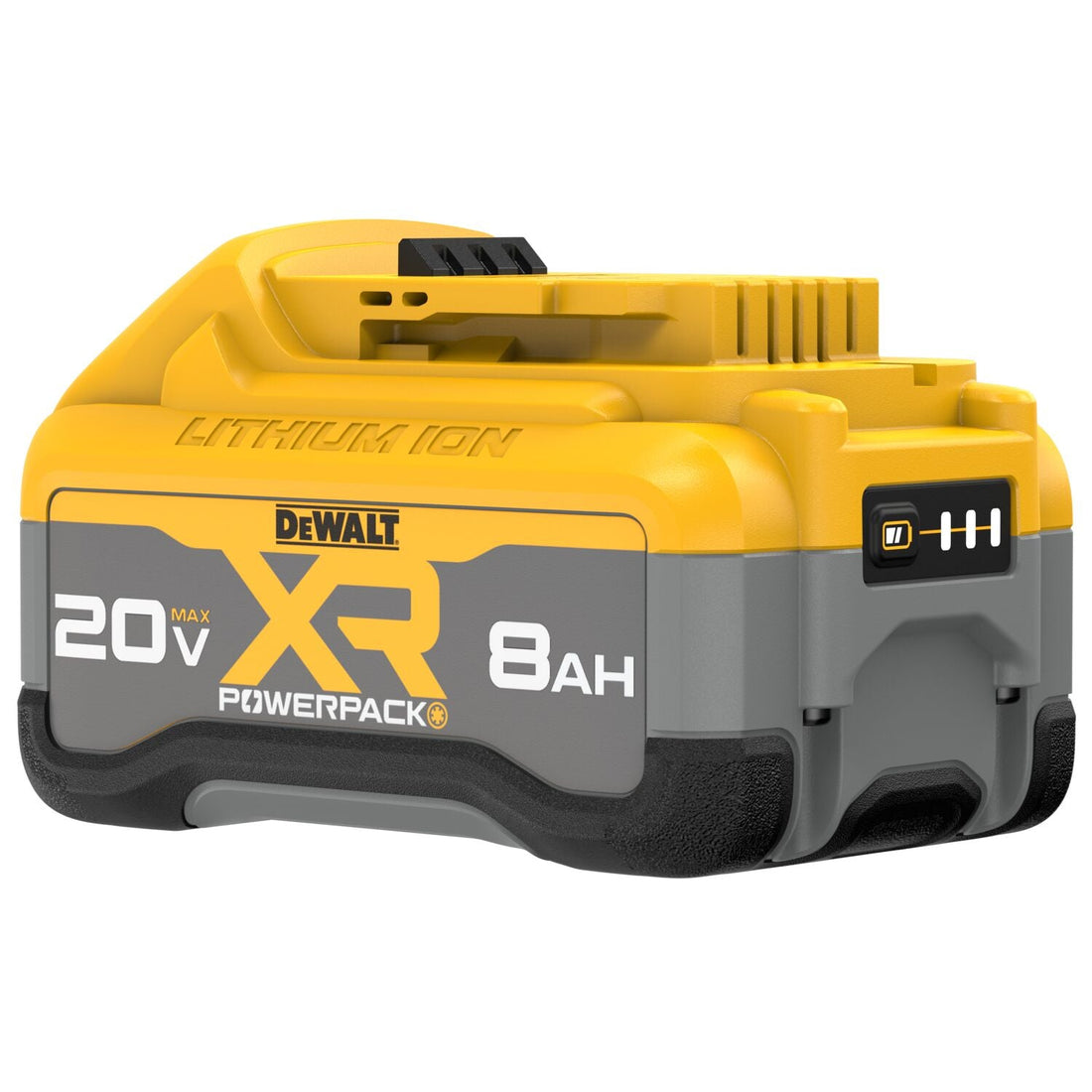
DeWalt DCB2108 vs DCBP520: Which 20V MAX Battery Is Right for You?
Both the DCB2108 and DCBP520 are DeWalt 20V MAX batteries — either one slides onto every 20V MAX tool you own. FLEXVOLT batteries use patented auto-switching technology to work with both 20V MAX and 60V MAX tools, while standard 20V MAX batteries like these are compatible across the full 20V MAX platform. Short answer: pick the DCBP520 (PowerStack pouch-cell) for lighter weight and a slimmer profile on daily handheld work; pick the DCB2108 when you need the longest single-charge runtime or the highest sustained current for high-draw tools. Below: the spec table, the real trade-offs, and the accessories that pair with either.
DCB2108 vs DCBP520 at a Glance
Side-by-Side Specs
| DCB2108 | DCBP520 | |
|---|---|---|
| Voltage | 20V MAX (18V nominal) | 20V MAX (18V nominal) |
| Capacity | 8.0Ah | 5.0Ah |
| Watt-hours | ~144Wh | ~90Wh |
| Cell type | Multiple-tab cylindrical | POWERSTACK™ pouch cell |
| Weight | 2.2 lbs | 1.5–1.6 lbs |
| Std. charge time | — | — |
| Fast charge time | — | — |
| Platform fit | All 20V MAX tools | All 20V MAX tools |
The two packs share voltage and platform fit, but they're built differently — that's where every real trade-off lives.
What the DCB2108 Is (and Who It's For)
Cell Chemistry: Multiple-Tab Cylindrical Cells
The DCB2108 uses a multiple-tab cylindrical cell design that routes energy through multiple tabs per cell to reduce electrical resistance and heat. Traditional cylindrical cells connect to the pack's terminals through a single metal tab; the multiple-tab approach shortens the effective current path and lets each cell run cooler under load. For more on how this cell technology plays out at the extreme end of the platform, see our guide to tabless cell design.
Lower resistance isn't a marketing claim — it means the BMS can sustain higher amps longer before thermally throttling the pack.
Runtime and Power-Delivery Strengths
At 8.0Ah and ~144Wh, the DCB2108 carries roughly 60% more energy than the 5.0Ah DCBP520. On a tool pulling moderate current — a drill/driver, a reciprocating saw at medium load — that translates to proportionally longer runtime between swaps.
On high-draw tools, the larger cell count also gives more amp headroom before the pack gets hot.
Weight and Size Trade-Off
More cells, more weight. At 2.2 lbs, the DCB2108 is noticeably heavier than the DCBP520 at 1.5–1.6 lbs, and physically longer. That matters on a drill you're holding overhead for twenty minutes; it matters less on a circular saw resting on a workpiece.
What the DCBP520 Is (and Who It's For)

PowerStack Pouch-Cell Design — What "PowerStack" Actually Means
Instead of cylindrical cells, PowerStack packs use flat lithium-ion pouch cells stacked together. DeWalt's pitch: more active cell surface area in the same footprint, better energy density per unit of size, and a pack that runs lighter and smaller than a comparably rated cylindrical pack. For the full background on the technology, see our PowerStack explainer.
One housekeeping note: the DCBP520 remains an active SKU — DeWalt's current catalog still lists it (though naming has shifted as of 2024/25). If you're shopping now and see a different SKU number, look for "PowerStack" or "XR pouch cell" language to confirm you're getting the same technology.
Slim Profile and Balance In-Hand
The pouch-cell stack is physically shorter and slimmer than a 10-cell 21700 pack. On a compact drill or impact driver, the DCBP520 sits closer to the tool's balance point and gives you better sight lines to the bit tip. Over a full day of the same motion, that difference is real.
Peak Current for Its Size
Pouch cells sustain high amp draws well relative to their weight. The DCBP520 handles burst loads — impact driver driving long lag screws, rotary hammer in concrete — without obvious throttling. What it can't do is sustain that current as long as the DCB2108: it simply carries less total energy.
Head-to-Head — Which Battery Wins On…
Runtime Per Charge
DCB2108 wins. More Wh, more runtime. The DCB2108's 8.0Ah versus the DCBP520's 5.0Ah means roughly 60% more run time from the bigger pack.
Sustained High-Draw Performance
DCB2108 wins again. Under continuous heavy load — a circular saw through stacked lumber, a blower clearing a wet driveway — the multiple-tab cells' lower internal resistance means less heat per amp. The DCBP520 handles peak bursts fine; it drains faster under sustained full-throttle use.
Weight and Fatigue Over a Full Shift
DCBP520 wins. The pouch-cell pack is meaningfully lighter, a difference you feel immediately on handheld tools. On a drill or impact driver you're carrying up ladders or working overhead, lighter means less wrist fatigue by day's end. That's the main reason pros with multi-tool setups often run the light pack on handheld tools and keep the big pack on the saw.
Physical Fit and Tight-Space Work
DCBP520 wins on profile. The shorter, slimmer form sits lower on the tool handle, fits tighter access points, and doesn't snag on framing in close quarters. If you're doing finish work or running a compact drill in confined spaces, the DCBP520 gets out of your way.
Charge Time
Both packs accept every DeWalt 20V MAX and FLEXVOLT charger — standard, fast, and rapid. (See the full compatibility breakdown.) The DCB2108's larger capacity means a longer absolute charge time; a fast charger cuts both times significantly compared to a standard charger.
Value: Price Per Watt-Hour
Skip comparing sticker prices — they move too much. Divide whatever each pack costs today by its watt-hours. The pack with the lower cost-per-Wh wins on raw energy value. The DCBP520 typically carries a size and weight premium; the DCB2108 usually offers better dollar-per-Wh at standard retail. That premium is worth it if lighter daily carry matters to you — it's not worth it if you're buying a shop battery that stays on the tool all day.
Compatibility — What Fits What
Tools
Both are 20V MAX packs. They slide into every DeWalt 20V MAX tool — drills, impact drivers, circular saws, reciprocating saws, nailers, vacuums, OPE — with no adapter required. FLEXVOLT batteries automatically switch voltages to work across 20V MAX, 60V MAX, and 120V MAX platforms, while standard 20V MAX batteries like these are compatible across every tool on the 20V MAX platform. There is no tool on the 20V MAX platform that accepts one and not the other.
Chargers
Every DeWalt 20V MAX and FLEXVOLT charger accepts both. (See the full compatibility breakdown.) Standard, fast, and rapid chargers all work on both packs — the only variable is how fast they refill.
Accessories: USB Power and 120V Inverter
Here's the piece most comparisons miss entirely. Both batteries also drop into the same aftermarket accessories:
- USB-C Fast Charger — turns either pack into a USB-C fast charger (up to 65W dual-port) for your phone, tablet, or laptop. Works on any DeWalt 20V MAX battery.
- 150W Power Inverter — turns either pack into a 150W 120V outlet with two USB ports and an onboard LED. Either battery runs it the same way.
Your accessory decision is independent of your battery decision. Buy the DCBP520 for weight savings on the impact driver — you still have full USB and inverter capability. Buy the DCB2108 for runtime on the saw — same accessories, same compatibility.
PowerStack → XR Rename: Does It Affect Either SKU?
In 2024/25, DeWalt dropped the "POWERSTACK™" sub-brand in favor of "20V MAX® XR® 5Ah Battery" — but the DCBP520 remains an active SKU. Learn more about the naming shift and check the current listing before buying; if the DCBP520 number looks different, look for "XR pouch cell" to confirm you're getting the same technology.
Which One Should You Buy?
Buy the DCBP520 If…
- You're running a drill, impact driver, or compact handheld tool for hours and wrist fatigue is real.
- You work in tight spaces where a slimmer pack improves clearance and sight lines.
- You want a lighter kit to carry on a tool belt or up a ladder.
- You prioritize compact tool balance over maximum runtime per charge.
- You're building a light grab-and-go kit rather than a high-output worksite setup.
Buy the DCB2108 If…
- You're running high-draw tools — circular saw, blower, hedge trimmer, reciprocating saw on tough material — and need maximum runtime before swapping.
- You're working in a shop or truck where the battery sits on the tool and weight isn't a daily-carry factor.
- You want to minimize how often you're reaching for the charger during a shift.
- You're stocking a fleet battery and want the most Ah-per-pack for the money.
Buy Both If…
This is the most common pro setup and it makes sense: keep the DCBP520 on the drill or impact driver (lighter, easier to maneuver, more than enough Ah for fastening), and the DCB2108 on the circular saw or reciprocating saw (high sustained draw, where the bigger pack earns its weight). Two different tools, two different battery needs — and both still share the same charger, the same USB adapter, the same inverter.
Turn Either Battery Into More Than a Tool Battery
Once you're on DeWalt 20V MAX, the batteries do more than spin tools.
Drop either pack into the USB-C Fast Charger and you've got a USB-C fast charger on your truck seat — 65W output means a laptop charges at full speed, not a trickle. Useful if you're billing hours in a van or need your phone not dead by noon.
The 150W Power Inverter gives you a 150W 120V outlet anywhere on the job. A phone charger, a small work light, keeping a device alive when you're nowhere near a circuit — 150W covers more than people expect, and either battery runs it.
Neither of these cares which pack you chose. The DCB2108 just runs them longer.
While you're stocking up on accessories, the magnetic bit holder fits Milwaukee and DeWalt alike — worth having one on every driver regardless of platform.
FAQ
Are the DCB2108 and DCBP520 interchangeable in the same tool? Yes. Both are DeWalt 20V MAX packs and physically fit every 20V MAX tool without an adapter. You can swap between them on the same tool with no settings change.
Which battery lasts longer per charge? The DCB2108. It holds more energy. The DCB2108 20V MAX XR carries 8.0Ah against the DCBP520 20V MAX XR POWERSTACK's 5.0Ah — roughly 60% more runtime from the larger pack at the same tool and load.
Which is lighter? The DCBP520. PowerStack pouch cells deliver more energy per unit of weight than cylindrical cells, so the smaller pack is meaningfully lighter in hand.
Do both use the same charger? Yes — every DeWalt 20V MAX and FLEXVOLT charger (standard, fast, and rapid) accepts both packs, with a fast charger cutting charge time on both.
Which is better for high-draw tools (circular saw, blower, hedge trimmer)? The DCB2108. The multiple-tab cells sustain heavy current longer before the BMS throttles down to protect against heat. The DCBP520 handles burst loads fine but drains faster under continuous full-throttle use.
Is the DCBP520 the "new PowerStack" battery? The DCBP520 is a PowerStack pouch-cell pack, currently listed in the 2024/25 catalog as the 20V MAX XR POWERSTACK 5Ah battery (see the naming update). Whether you see the original DCBP520 number or a slightly different label, the underlying pouch-cell technology is the same — look for "PowerStack" or "XR pouch cell" to confirm.
Which is the better value? Calculate cost per watt-hour: price ÷ Wh (Wh = voltage × Ah). Whichever pack gives more Wh per dollar wins on energy value. The DCB2108 typically scores better on that math. If the DCBP520's weight and size advantage matter to your workflow, that premium is worth paying; if you're buying a bench battery that never leaves the shop, it isn't.
Both packs are solid. Pick the one that fits how you actually work — then browse the full DeWalt accessory lineup to get more out of whichever one you choose.