
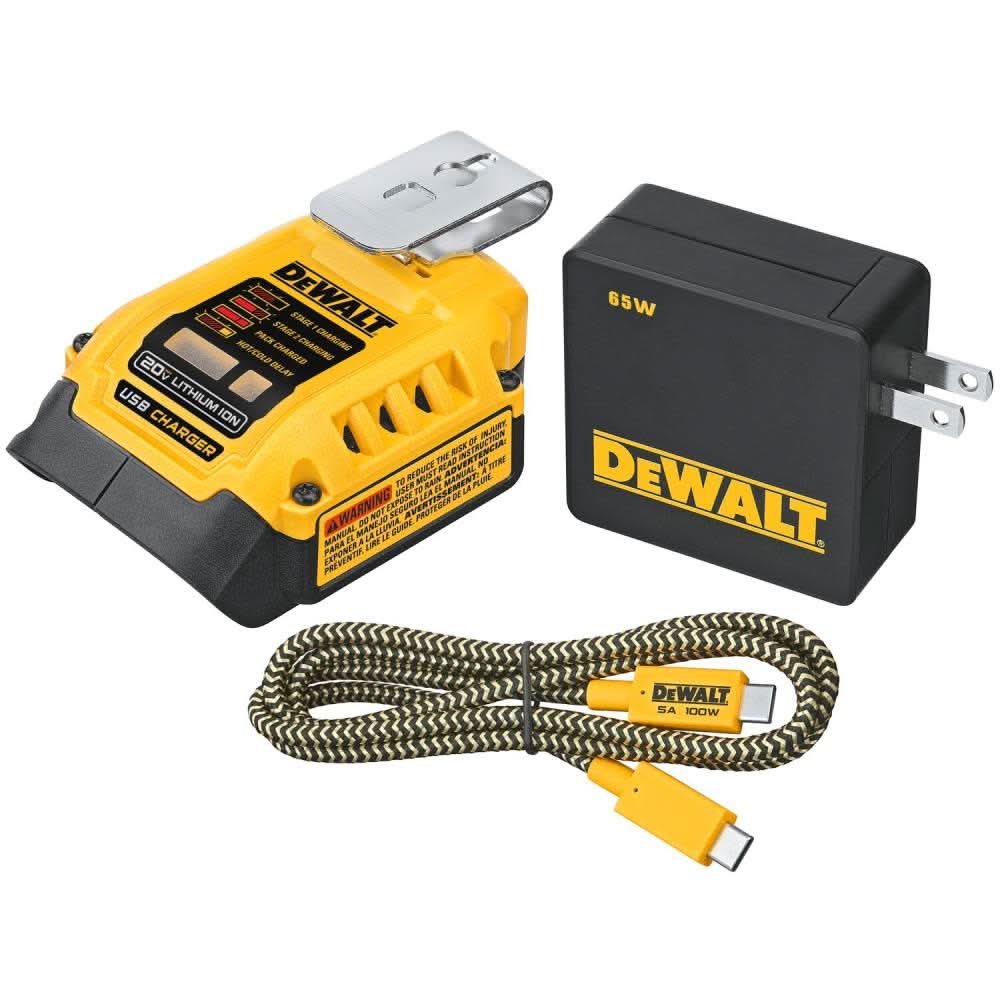
DeWalt 20V USB Charger vs Inverter: Which One Do You Actually Need?
Short answer: If you need to charge phones, tablets, earbuds, or a USB-C laptop drawing under 65W off your DeWalt 20V MAX battery, buy the USB-C fast charger — smaller, lighter, and the USB-C port delivers up to 65W Power Delivery. If you need a real 120V wall outlet on a job site — for a corded worklight, a soldering iron, a laptop with a barrel-plug brick, or anything over 65W — you need the 150W inverter. Both adapters clip onto every DeWalt 20V MAX and FLEXVOLT battery. Here's the honest breakdown.
The 30-Second Verdict
Side-by-Side Spec Comparison
| USB-C Fast Charger | 150W Inverter | |
|---|---|---|
| Output | 65W USB-C PD + USB-A | 150W 120V AC + 2× USB-A |
| Ports | 1× USB-C, 1× USB-A | 1× 120V socket, 2× USB-A, 1× LED work light |
| LED Battery Meter | Yes | Yes |
| Included Cable | — | 1.2m combo (USB-C / Lightning / micro-USB) |
| Battery Compatibility | All DeWalt 20V MAX + FLEXVOLT | All DeWalt 20V MAX + FLEXVOLT |
| Best for | Phones, tablets, USB-C laptops | Corded tools, barrel-plug laptops, anything 120V |
Buy the USB Charger If…
- You're topping off phones, tablets, wireless earbuds, or a GoPro
- Your laptop charges via USB-C (MacBook Air, most modern Windows ultrabooks, Chromebooks)
- You want the lightest, most pocketable option
- Fast charging matters — 65W PD beats any USB-A port on the inverter and skips AC conversion loss
Buy the Inverter If…
- You need a real 120V socket on the job site
- Your laptop runs on a barrel-plug power brick, not USB-C
- You're powering a corded LED worklight, a soldering iron, or a small battery charger for another brand's tools
- You need to run more than one device type at the same time
What Each One Actually Does
The USB-C Fast Charger
The USB-C fast charger clips directly onto any DeWalt 20V MAX battery. One USB-C port rated up to 65W PD, one standard USB-A port, and an LED battery level indicator so you know how much is left without pulling the pack. That's it.
What it does *not* have: any 120V outlet. If your device doesn't charge via USB, this adapter won't help you. The 65W USB-C ceiling covers most modern laptops — Apple, Dell, Lenovo, and HP all ship mainstream ultrabooks with USB-C chargers in the 45–65W range — plus fast-charge phones and tablets without issue. For a deeper look at the USB adapter side, see our USB adapter breakdown.
The 150W Inverter
The 150W power inverter converts DeWalt battery DC power into AC, giving you one standard 120V outlet, two USB-A ports, and a built-in LED work light. It ships with a 1.2m combo cable (USB-C, Lightning, micro-USB tips) in the box.
The 120V AC outlet is the only way to run a corded device off your DeWalt pack — that's the whole point. Everything from a corded LED flood to a small power supply to a laptop brick runs through that socket.
Worth knowing: the inverter's waveform type is not published in official specifications — check the label on your unit to confirm before use. Pure sine is friendlier to sensitive electronics; modified sine handles resistive loads (lights, soldering irons, most phone chargers) without issue. Check before running audio equipment or older motor-driven tools.
Battery Compatibility — Which DeWalt Packs Work?
Fits: All 20V MAX and FLEXVOLT Slide-Packs
Both adapters are confirmed compatible with the full DeWalt 20V MAX slide-pack lineup — the DCB200 series (DCB203, DCB204, DCB205, DCB206, DCB208) and every FLEXVOLT pack (DCB606, DCB609, DCB612). FLEXVOLT batteries are backward-compatible in 20V mode, so they slide into these adapters the same way they drop into any 20V MAX tool. For the full compatibility picture, see the charger compatibility guide and the 20V MAX vs FLEXVOLT breakdown.
Does NOT Fit
- DeWalt 12V MAX — different, smaller slide-in interface
- 60V-only tool-side FLEXVOLT connections — these adapters use the battery's 20V slide interface; they don't engage the tool-side 60V configuration
- POWERSTACK packs — compatible with 20V MAX tools generally, but confirm the slide-in interface on your specific POWERSTACK model before ordering
Runtime Math — How Long Will a DeWalt Battery Actually Last?
The formula, stated once:
> Runtime (hours) ≈ (Battery V × Ah) ÷ Device load (W) ÷ 0.85 efficiency
DeWalt 20V MAX batteries run at 18V nominal — "20V" is the peak/no-load voltage, a marketing convention across the industry. So:
- DCB205 (5.0Ah): 18V × 5.0Ah = 90 Wh
- DCB609 FLEXVOLT (9.0Ah in 20V mode): 18V × 9.0Ah = 162 Wh
Worked Examples off a 5.0Ah / 90 Wh Pack
| Device | Approx. Load | Runtime (5.0Ah, ~0.85 eff.) |
|---|---|---|
| Phone charging | ~10W | ~7.5 hrs |
| USB-C laptop | ~45W | ~2.1 hrs |
| Corded LED worklight | ~20W | ~3.8 hrs |
| Soldering iron | ~60W | ~1.4 hrs |
| Heat gun | 1,200–1,800W | Overloads the 150W inverter — don't attempt |
The 0.85 efficiency factor accounts for conversion losses — particularly the DC→AC→DC round-trip when you're running a laptop brick through the inverter. The USB-C charger skips the AC step entirely for USB-C PD laptops, which is why it delivers more runtime per Ah on the same pack. For runtime numbers across larger FLEXVOLT packs, see our battery runtime guide.
What Each One Can't Run
Inverter Limits
150W continuous is useful for job-site electronics, not appliances. It handles:
- Laptop bricks (check yours — most land between 45W and 130W)
- LED worklights (20–100W)
- Small soldering irons (40–80W)
- Phone and tablet chargers (5–20W)
It will not run:
- Heat guns (1,200–1,800W) — immediate overload
- Hairdryers or electric kettles (1,000–1,500W) — same problem
- Most corded circular saws or miter saws (1,200–1,800W) — wrong tool for the job; those need a generator or a large inverter
DeWalt's battery BMS will cut power before things get dangerous on an overcurrent event, but don't leave an inverter running unattended and don't try to start high-surge motor loads that spike well past 150W. If the 150W ceiling might be too tight for your use case, read our 150W inverter capacity guide before you pull the trigger.
USB Charger Limits
No 120V outlet. If your device doesn't charge via USB-A or USB-C — a barrel-plug laptop, a corded worklight, another brand's battery charger — the USB adapter is the wrong tool.
USB-C Laptops: Charger or Inverter?
If your laptop charges via USB-C, you can technically use *either* adapter. Use the USB-C fast charger anyway.
The inverter converts DC from your DeWalt pack to AC, then your laptop's charger converts that AC back to DC — two conversion stages, each bleeding off 8–15%. The USB-C charger skips the AC round-trip and delivers regulated DC straight to the laptop via PD. Fewer losses means more runtime per Ah. On a MacBook Air or a 45W Chromebook, the USB charger gives meaningfully more screen time off the same battery than the inverter would.
The inverter earns its keep with USB-C laptops only when you need to run something else at the same time, your laptop demands more than 65W, or you're keeping a single adapter for mixed corded/USB use.
Price & When to Just Get Both
The USB-C fast charger is $25. The 150W inverter is $30. Combined, you're still under what a single DeWalt-compatible battery jump-starter combo unit costs — and you end up with a more useful split of capabilities.
The "one battery, two adapters" kit is a real job-site strategy:
- USB charger in your apron or vest pocket — phones, earbuds, and tablets topped off without thinking about it
- Inverter in the truck or on the scaffold — ready when you need the worklight or the soldering iron
Both are light enough that carrying both isn't a burden. If your work regularly mixes USB devices *and* occasional corded tools, there's no reason to choose.
FAQ
Can a DeWalt 20V battery power a 120V outlet?
Only through an inverter. The USB-C adapter has no AC outlet — it's USB-C and USB-A only. The Tool Army 150W inverter gives you one 120V socket plus two USB-A ports off any 20V MAX or FLEXVOLT pack.
How many watts can a DeWalt 20V battery inverter handle?
The Tool Army DeWalt-compatible inverter is rated at 150W continuous. That covers laptops, phone chargers, LED lights, and small soldering irons — not heat guns, kettles, or hairdryers.
What's the fastest way to charge a phone off a DeWalt battery?
The USB-C fast charger. Its USB-C PD port outputs up to 65W, which is faster than any USB-A port on the inverter and skips the AC conversion loss entirely.
Will the USB charger or inverter fit a FLEXVOLT battery?
Yes — both adapters slide onto every DeWalt 20V MAX slide-pack and every FLEXVOLT battery (DCB606, DCB609, DCB612). They do not fit 12V MAX packs.
How long will a DeWalt 5.0Ah battery run a laptop through the inverter?
Roughly (18V × 5Ah = 90Wh) ÷ 45W laptop load ÷ 0.85 efficiency ≈ 2 hours. A FLEXVOLT 9.0Ah pack roughly doubles that. Check the Wh label printed on your specific pack for the most accurate starting point.
Which one is worth buying first?
If you own one DeWalt battery and mostly need to top off phones and tablets, start with the USB-C charger. If you already have one and want to run corded gear from the truck or scaffold, add the inverter next.
If you're still deciding: USB-C device under 65W — grab the DeWalt USB-C charger. Need a 120V outlet — that's the DeWalt power inverter. See the full DeWalt accessory lineup in our DeWalt collection. Running Milwaukee M18 instead of DeWalt? The same tradeoffs apply — read the M18 comparison for the M18 version.