
Best Blades for Your DeWalt 20V Circular Saw (Size, Tooth Count & Why Thin Kerf Matters)
Picking the best blades for your DeWalt 20V circular saw starts with one question: which size does your model take? DeWalt's 20V line splits into two blade sizes: 6-1/2" (DCS565, DCS391) and 7-1/4" (DCS570, DCS575). Both use a standard 5/8" arbor, so any quality blade in the right diameter fits your saw — brand has nothing to do with compatibility. On a cordless platform, always default to thin-kerf over full-kerf: less material removed per pass means fewer amps drawn per cut, which means more cuts per charge. For most jobs, a thin-kerf 40T blade is the right starting point. Here's how to choose by material.
Which blade size does your DeWalt 20V take?
Get this right before you order anything. A 7-1/4" blade won't fit a 6-1/2" saw.
6-1/2" models: DCS565 and DCS391
The DCS565 (brushless, current generation) takes 6-1/2" blades with a 5/8" arbor. The DCS391 (brushed, older) uses the same compact blade format — check the specs on your unit or the manufacturer's site to confirm compatibility before ordering. The 6-1/2" format is the more common cordless size — lighter, more compact, and easier to run off a smaller pack.
7-1/4" models: DCS570 and DCS575
The DCS570 and DCS575 use 7-1/4" blades, also on a 5/8" arbor. Same arbor standard, bigger blade — useful for thicker stock or when you prefer the larger format.
> Note on arbor bushings: Some 7-1/4" blades ship with a 1" arbor hole and a knockout bushing that reduces it to 5/8". Both work — just confirm the bushing is installed before running the blade.
Will any brand's blade fit?
Yes. The only factors are blade diameter and arbor size. A Diablo, Milwaukee, Freud, or any other brand's blade with a 5/8" arbor in the correct diameter fits your DeWalt 20V without issue. You are not locked into DeWalt-branded blades. Learn more about compatible blade sizes
Why thin kerf matters more on cordless than on corded saws
This is the argument most blade guides skip entirely.
A corded saw on a 15-amp circuit doesn't care much about kerf — if the motor needs more current, the outlet delivers it. A 20V MAX motor works from a finite battery. Every extra amp you pull shortens the charge.
Kerf width is the thickness of the slot the blade cuts through the material:
- Thin kerf: approximately 0.059"
- Full kerf: approximately 0.126"
That gap seems small. But multiply it across every pass through 2x4 framing lumber or a sheet of plywood and the motor is doing meaningfully less work per cut. Less work means less amp draw, which means the pack lasts longer.
On a 2.0 Ah battery, the difference is felt immediately. On a 5.0 Ah, you have more buffer — but there's no reason to burn it with a full-kerf blade when thin-kerf does the same job.
Full-kerf blades belong on table saws and corded worm-drives, where high RPM, heavy stock, and sustained throughput make blade stiffness and kerf consistency more important than amp economy. On a cordless 20V, they're the wrong default.
See the full comparison: thin-kerf vs full-kerf for cordless
Best blades by job
Quick-reference table first, then the reasoning behind each pick.
| Job | Tooth count | Blade type | Notes |
|---|---|---|---|
| Framing, rough cuts | 24T | Thin-kerf ATB | Fastest feed, lowest amp draw |
| Plywood, OSB, sheet goods | 40T | Thin-kerf ATB | Workhorse — balances speed and finish |
| Trim, finish carpentry, crosscuts | 60T | Thin-kerf ATB or TCG | Slower feed, cleaner edge |
| Fiber cement / hardie board | Dedicated | Fiber cement–rated blade | Standard wood blades dull almost instantly — see below |
Framing and rough cuts — 24T

For studs, headers, sheathing, and anything where edge quality doesn't matter, 24T thin-kerf is correct. Large gullets clear chips fast, you can feed aggressively, and the motor runs easy. This is the blade to have on the saw when you're framing walls or decking a floor.
For 6-1/2" saws: the Diablo D0624X (6-1/2", 24T, thin-kerf) fits this profile. For 7-1/4" saws: the Diablo D0724X (7-1/4", 24T, thin-kerf).
Plywood, OSB, and sheet goods — 40T
The 40T thin-kerf is the blade most people should keep as their everyday option. It handles framing lumber adequately, cuts plywood without major tearout, and doesn't require a slow feed rate. If you're only buying one blade, this is it.
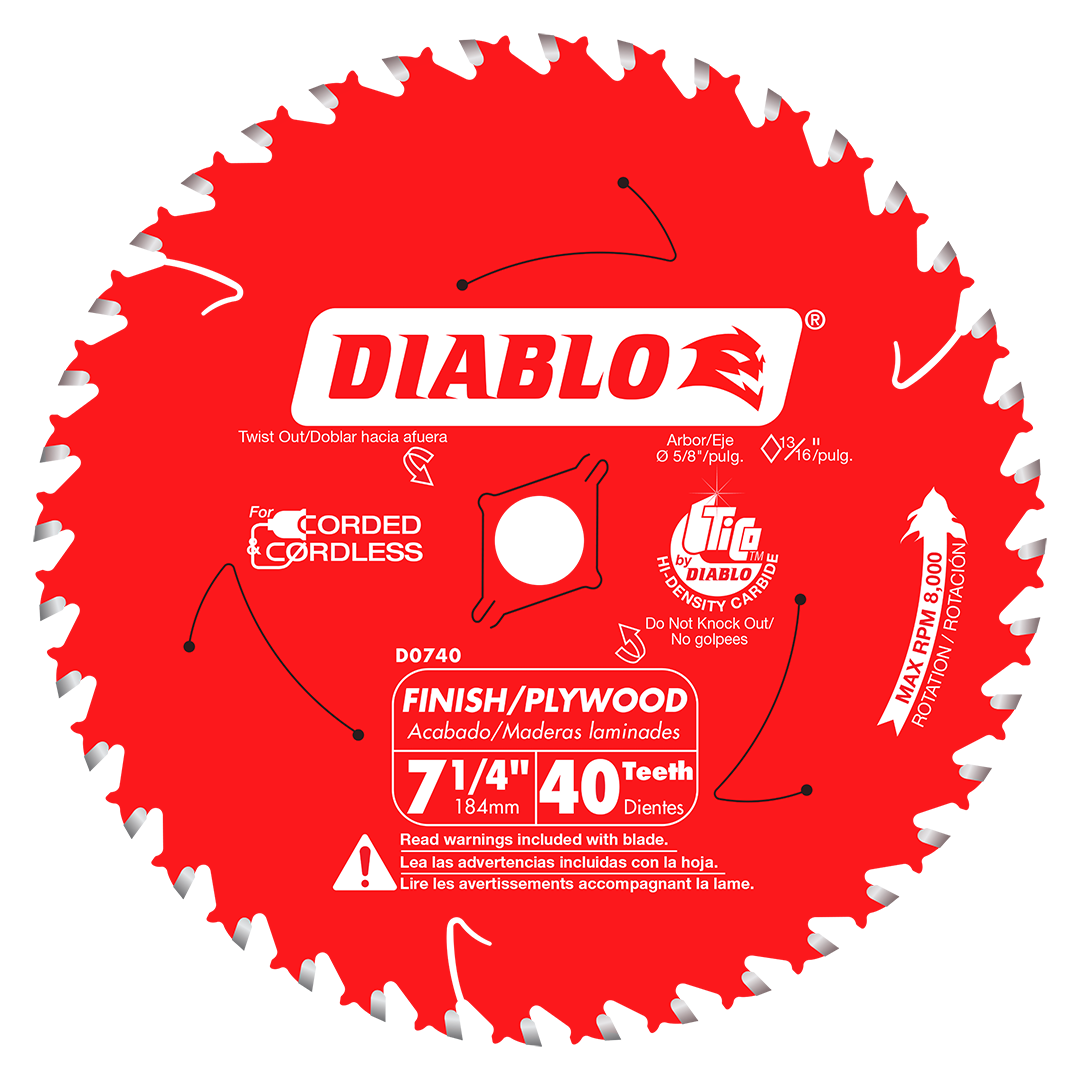
For 6-1/2" saws: the Diablo D0640X (6", 40T, thin-kerf). For 7-1/4" saws: the Diablo D0740X (7-1/4", 40T, thin-kerf).
Trim, finish carpentry, and crosscuts — 60T
More teeth mean slower chip evacuation but a cleaner edge. The trade-off is a slower feed rate and slightly more amp draw per inch. For baseboards, door casings, and furniture-grade cuts, the cleaner edge is worth it.
The Diablo D0660X (6-1/2", 60T, thin-kerf) is the option in this range. One honest caveat: a 60T blade cutting hardwood on a 2.0 Ah pack will drain it fast. Step up to a 4.0 Ah or 5.0 Ah for finish work.
Fiber cement and hardie board — dedicated blade required
Standard wood blades dull almost immediately on fiber cement. You need a purpose-built blade — typically PCD (polycrystalline diamond) or dedicated carbide construction — sized to your saw's blade diameter.
For fiber cement, the right choice is a 4-tooth PCD (Polycrystalline Diamond) blade, sized to match your saw's diameter, with a maximum rated speed of 10,000 RPM.
Check the blade's max RPM against your saw's no-load RPM before running it. Fiber cement also produces silica dust — use a properly rated respirator, not just a dust mask.
Brand comparison — what's actually worth buying
| Brand | Kerf availability | Notes |
|---|---|---|
| Diablo (Freud) | Thin-kerf in every size and tooth count | Our pick for most buyers — consistent quality, widely available, full lineup |
| DeWalt OEM | Often full kerf — check the label | Convenient alongside a kit, but often worth upgrading immediately |
| Milwaukee | Thin-kerf available | Fits any DeWalt 20V (5/8" arbor); good if you're already a Milwaukee accessory buyer |
| Budget no-names | Inconsistent | Uneven kerf and inconsistent tooth set strain the motor — false economy on cordless |
Compare Diablo, Milwaukee & DeWalt blades
If you own the DeWalt DCS565P1 20V MAX XR 6-1/2" brushless circular saw kit, the kit includes the DWA161218 — a thin-kerf blade at 0.059" — so you're already starting with the right kerf for cordless use. When it's time for a replacement, choose a thin-kerf blade in the tooth count that best matches your most common job.
On the Milwaukee platform and curious how the same logic applies there? Milwaukee's circular saw blade lineup
FAQ
What size blade does a DeWalt 20V circular saw use?
Depends on the model. The DCS565 and DCS391 use 6-1/2" blades; the DCS570 and DCS575 use 7-1/4" blades. Both use a standard 5/8" arbor. Check your model number before ordering.
Do I need a special blade for a cordless circular saw?
No special blade type is required, but thin-kerf blades work better on cordless because they draw less current per cut and extend battery runtime. Avoid full-kerf blades on your 20V if runtime matters to you.
Can I use Diablo blades on a DeWalt 20V circular saw?
Yes. Diablo blades with a 5/8" arbor in the correct diameter (6-1/2" or 7-1/4") fit all DeWalt 20V circular saws. Arbor size and blade diameter are the only compatibility factors — brand doesn't matter.
What tooth count is best for framing with a DeWalt 20V?
24T. Cuts fast, clears chips efficiently, and draws the least amp load. For rough framing where edge quality doesn't matter, 24T thin-kerf is the right call.
What's the best blade for cutting plywood on a DeWalt 20V?
A 40T thin-kerf blade. It balances speed and finish quality and handles most sheet-good work without a blade swap.
Will Milwaukee blades fit my DeWalt 20V circular saw?
Yes, as long as the blade diameter matches your saw (6-1/2" or 7-1/4") and it has a 5/8" arbor. The tool brand doesn't lock you into any blade brand.
How do I know when to replace a circular saw blade?
When cuts require noticeably more force, produce burn marks, or sound labored. A dull blade draws more current — on a 20V that means shorter runtime and more heat on the pack. Sharper blade, easier on the battery.
Two blades cover most of what a cordless circular saw does
If you own the DCS565 or DCS391, start with a 6-1/2" thin-kerf 24T and a 6-1/2" thin-kerf 40T. The 24T handles framing and rough work; the 40T handles everything else. Add the 60T when you're doing finish work that actually matters.
For the rest of what the DeWalt 20V platform needs — chargers, power inverters, and USB adapters that run off the batteries you already own — head over to the DeWalt collection.