
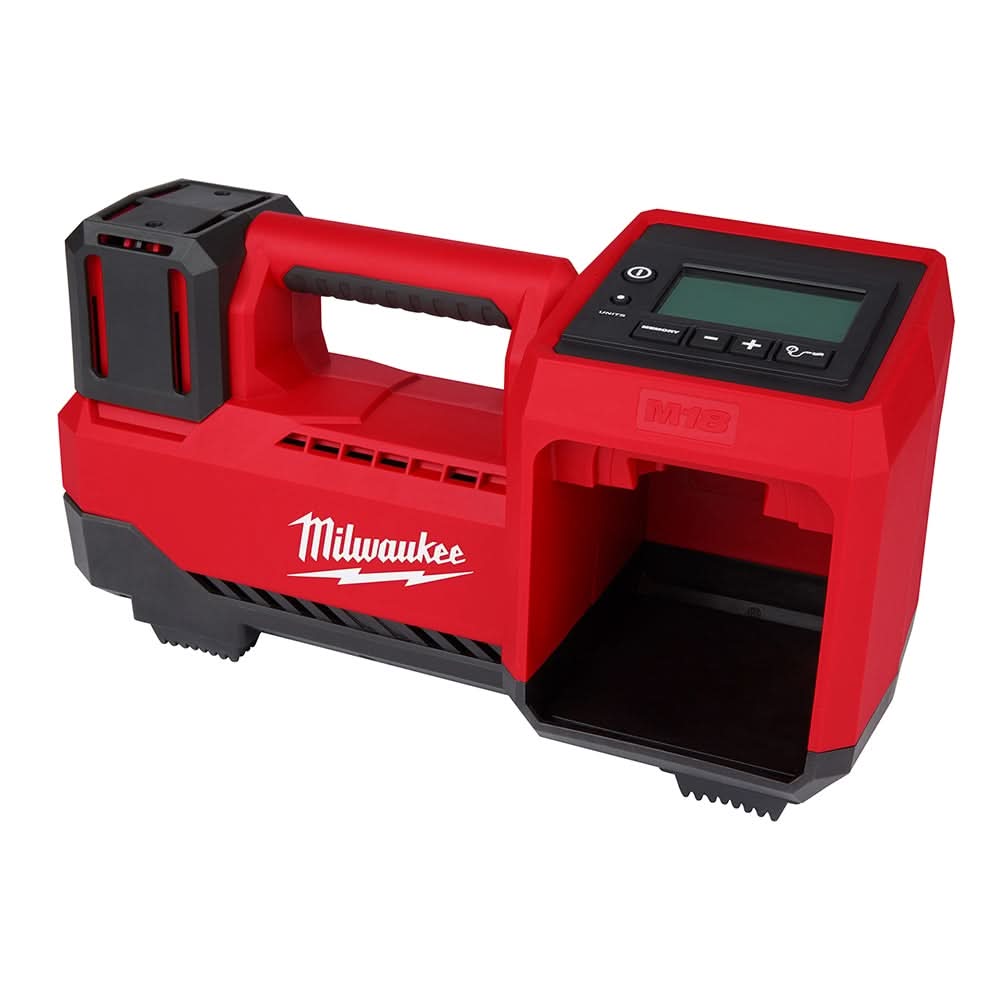
Milwaukee vs DeWalt Cordless Tire Inflator: Which One Actually Wins (and Which Platform You Should Buy Into)
Choosing between a Milwaukee vs DeWalt cordless tire inflator? Buy the one that runs on the batteries you already own. On Milwaukee M18, the 2848-20 is the daily driver — 150 PSI, dual-mode, handles everything from road bikes to truck tires. On DeWalt 20V MAX, the DCC020IB covers the most ground at 160 PSI with AC and 12V DC fallback; the DCC030 is the lighter pure-cordless option. Own neither platform yet? DeWalt edges it for garage and auto duty. Pure jobsite portability? Milwaukee. Below: how each model performs by job type, the real trade-offs, and the spare battery and charger you'll want either way.
Quick Verdict by Use Case
Best for Auto / Daily Driver
DeWalt DCC020IB. Highest max PSI in this comparison (160 PSI), three power sources — battery, 12V DC, 120V AC. Parks in the garage, runs off the truck's power outlet on the road. If you're deep in Milwaukee M18, the 2848-20 handles car tires without issue — but the DCC020IB has the edge for pure garage utility.
Best for High-Volume (Truck, Trailer, Low-Pro)
Milwaukee M18 2848-20. The high-volume mode is designed for exactly this — low-pressure, big-volume jobs. Trailer tires, ATV tires, low-pro truck tires at 65+ PSI. The DCC020IB competes on raw PSI ceiling, but Milwaukee's two-mode design handles the volume side better in reported use.
Best for Bikes and Small Inflatables
Milwaukee M12 2475-20. Lighter, easier to hold precise pressure in the 60–100 PSI range where road and MTB tires live. The M18 2848-20 can overshoot a bike tire fast. If you own M12 batteries, this is the right tool for the job.
Best for Jobsite Portability
Milwaukee M18 2848-20. Pure cordless, compact, runs the same battery as your drill and circular saw. The DCC020IB's most useful mode (AC) requires an outlet or inverter; the DCC030 is the pure-cordless DeWalt, but it tops out at a lower PSI.
Head-to-Head Spec Comparison
| Spec | Milwaukee M12 2475-20 | Milwaukee M18 2848-20 | DeWalt DCC020IB | DeWalt DCC030 |
|---|---|---|---|---|
| Max PSI | 120 PSI | 150 PSI | 160 PSI | Lower than DCC020IB |
| Power source | M12 battery only | M18 battery only | 20V MAX / 12V DC / 120V AC | 20V MAX battery only |
| Gauge type | Digital | Digital | Digital | Digital |
| Dual-mode | No | Yes (high-vol + high-press) | No | No |
| Weight | 3.83 lb | 7.0 lbs | 5.5 lbs (tool only) | Lighter than DCC020IB |
| Hose length | 26 inches | 36 inches | 29 in. | See product page |
Hose length matters more than most reviews mention. A too-short hose kinks against the inside of a wheel well and makes valve-stem contact a two-handed wrestling match. Weight matters on the fourth trailer tire. Those columns get filled before publish.
Max PSI and Gauge Accuracy: How Do They Compare?
DeWalt wins the ceiling on paper — 160 PSI vs 150 PSI on the M18 2848-20. In practice, car tires top out around 32–44 PSI and light truck tires rarely exceed 80 PSI, so both brands have headroom to spare on most jobs.
The accuracy caveat: user reports across tool forums and community tests consistently put both brands' digital gauges within ±2 PSI of a calibrated reference gauge. Good enough for a daily top-off, not precise enough if you're chasing a single-PSI target for track prep or spec pneumatic work. Keep a dial gauge in the glovebox and use the inflator's readout as a working number.
How Fast Do They Fill a Car Tire?
Marketing for both brands implies similar top-off times on a mid-size car tire. Until a timed third-party test lands in Stage 5, treat fill speed as roughly equivalent for the top-off use case (adding 10–15 PSI to a low tire). Where they differ is volume capacity — the M18 2848-20's high-volume mode handles low-pressure/high-volume jobs differently than any single-mode DeWalt in this lineup.
Noise, Hose, and Gauge Feel
Milwaukee's M18 2848-20 running in high-volume mode is loud — noticeably louder than the M12 or the DCC030 in similar reported use. Early-morning jobsite or quiet neighborhood: worth knowing. The M12 2475-20 and DCC030 are the quieter options on their respective platforms.
Hose kink is a category problem, not a brand differentiator. Short, stiff cordless-inflator hoses fight you on deep-dish wheel wells. Push straight onto the valve stem rather than at an angle, and use the LED to see what you're doing.
Milwaukee M12 vs M18 Tire Inflator: Which Fits Your Platform?
See also: Milwaukee M12 vs M18 tire inflator guide for the full inflator comparison and M12 vs M18 platform breakdown for the battery platform breakdown.
M12 2475-20 — Compact, 120 PSI
The right tool for bikes, sports balls, ATV tires, and car top-offs. At 120 PSI max, it handles passenger vehicles comfortably but gets marginal on light trucks (65 PSI) and outright impractical for anything above that.
The upside: it's small, quiet, and precise in the lower PSI range where a road bike or a wheelbarrow tire lives. Runs on any M12 battery. A 4.0Ah M12 pack will outlast a normal day's top-offs on car tires without drama.
M18 2848-20 — 150 PSI, Dual-Mode
Milwaukee's main inflator. The two modes are the real story:
- High-pressure mode — car and truck tires, jobsite pneumatics, anything needing 50–150 PSI with precision.
- High-volume mode — air mattresses, trailer tires, wheelbarrow tires, inflatables where you're moving volume, not climbing to high pressure.
No DeWalt in the 20V MAX lineup has a direct equivalent to this dual-mode setup. The DCC020IB does high pressure; the DCC030 is a single-mode unit. If your work mixes tire classes and inflatable types, the 2848-20's flexibility is the stronger argument for the Milwaukee side — with a confirmed maximum of 150 PSI in high-pressure mode.
Which M18 Batteries Make It Usable All Day
The M18 2848-20 draws hard under continuous use. On a 2.0Ah compact pack, you'll feel it drop fast. Practical minimum: 5.0Ah M18 battery. The HIGH OUTPUT packs move more current, which translates to better sustained performance on a motor that's running continuously — see Forge vs High Output vs RedLithium comparison for the full battery comparison.
The real-world answer: keep a second 5.0Ah battery in the bag, and put a USB-C fast charger on the truck so the one you just drained is topping off while you drive to the next job.
DeWalt DCC020IB vs DCC030: Which One Should You Buy?
For the FLEXVOLT battery compatibility question, see 20V MAX vs FLEXVOLT guide.
DCC020IB — Three Power Sources, 160 PSI

DeWalt's most flexible inflator. Three ways to power it:
1. 20V MAX battery — fully cordless. 2. 12V DC — plug into the truck's power outlet; no battery required. 3. 120V AC — wall or generator; unlimited runtime.
The 12V DC mode is genuinely useful. Roadside low tire, no battery in the bag — plug into the truck's outlet and top it off. That capability doesn't exist in Milwaukee's inflator lineup. For anyone doing a lot of vehicle maintenance away from the shop, it's a real advantage.
Digital gauge, auto-shutoff at preset pressure. At 160 PSI, it has the highest ceiling here, spanning a full 3–160 PSI working range.
Note: DeWalt also lists the DCC021 in its cordless inflator family. Check dewalt.com at publish time to confirm whether it replaces or sits alongside the DCC020IB, as the lineup may shift.
DCC030 — Pure Cordless, Lighter
The DCC030 is smaller and lighter than the DCC020IB — DeWalt's answer to "I just want a cordless inflator for car tires." Trade-off: a lower max PSI ceiling than the DCC020IB and battery-only power.
For car tires, bikes, and sport balls, it covers the job. For truck tires or anything pushing toward 80–100 PSI, step up to the DCC020IB.
Can You Use a FLEXVOLT Battery in the DeWalt Inflator?
Yes — both the DCC020IB and DCC030 accept any DeWalt 20V MAX battery. FLEXVOLT packs run at 20V in 20V MAX tools — you just get more amp-hours. If you already run a 6.0Ah or 9.0Ah FLEXVOLT on a circular saw or miter saw, plug it into the inflator and run more tires per charge. It's free capacity from gear you already own.
Same floor as Milwaukee: a 5.0Ah pack is the practical minimum for real work. A 2.0Ah compact fits and functions, but you'll be swapping batteries mid-trailer.
Also worth knowing: M12 and M18 battery compatibility for context on platform-specific battery questions that come up alongside this comparison.
The Honest Trade-Offs Nobody Mentions
Duty cycle. Cordless inflators from both brands are built for top-offs — adding 10–15 PSI to a low tire, four tires on a trailer, a bike after it's been sitting. They're not designed for filling a completely flat tire from zero, repeatedly, back-to-back. That kind of continuous draw heats the motor and drains a 5.0Ah pack faster than you'd expect. For from-zero fleet work, a corded shop compressor — or the DCC020IB running on AC — is the smarter tool. Set the expectation going in and the cordless inflator does its job well.
Gauge drift. Digital gauges drift. Both brands start within ±2 PSI of calibrated; after a summer in a hot truck bed, that number can widen. Cross-check against a dial gauge periodically. The inflator gauge is a working tool, not a precision instrument.
Hose kink. Already mentioned in the spec section, but worth repeating as a trade-off: deep wheel wells and stiff short hoses fight each other. This is a class problem, not a brand-specific defect. If hose reach is critical for your vehicles — lifted trucks, full-size vans, buses — confirm the hose length before buying.
DCC020IB bulk. Three power sources means more internals. In reported use, the DCC020IB is the heaviest unit in this comparison. The DCC030 and M12 2475-20 are the light options on their respective platforms.
Milwaukee has no 12V DC mode. Roadside or on-truck use without burning through a battery is a DeWalt advantage Milwaukee doesn't answer in the inflator category. Milwaukee's workaround is "bring a charged battery" — which works, but removes the option.
What You Actually Need to Run One All Day
The inflator is the easy part. Runtime depends on what's in your bag and on the truck.
Milwaukee M18 Platform
Minimum battery: 5.0Ah M18. One for the inflator, one in the charger.
USB-C fast charger on the truck: The M18 USB-C fast charger runs off an M18 battery and charges USB devices — including topping off your phone while the other battery charges at the next stop. Throw it in the center console and you're not hunting for an outlet between jobs.
150W inverter for AC-compressor backup: The M18 power inverter gives you a 120V outlet off an M18 battery — enough to run a small corded inflator or other light AC tools when cordless isn't enough. Know its limits: it won't run a 20-gallon shop compressor, but it covers light jobsite air needs. See how long a battery runs an inverter for real runtime numbers before you count on it.
DeWalt 20V MAX Platform
Minimum battery: 5.0Ah 20V MAX, or any FLEXVOLT pack you already own. If you're using the DCC020IB's 12V DC mode for roadside work, battery requirements drop — but for pure cordless use, 5.0Ah is the floor.
USB-C fast charger on the truck: The MAX XR USB-C fast charger runs off any 20V MAX battery with USB-C and USB-A ports. Same logic — charge while you drive, not when you're standing in the driveway running low.
150W inverter option: The 150W MAX XR power inverter does the same AC-backup job for the DeWalt platform. Same 120V socket, same 2 USB ports, same realistic use-case: light AC loads, not a shop compressor substitute.
FAQ
Which is better, Milwaukee or DeWalt tire inflator?
For the same job, they're within a few percent of each other. The real question is platform. If you own Milwaukee M18 batteries, the 2848-20 is the right inflator. If you own DeWalt 20V MAX, the DCC020IB covers the most ground. If you own neither and want a garage inflator, DeWalt's 12V DC mode and higher PSI ceiling give it the edge for auto duty.
What's the max PSI on the Milwaukee M18 tire inflator (2848-20)?
150 PSI, with a digital gauge and two operating modes — high-pressure and high-volume.
What's the max PSI on the DeWalt DCC020IB?
160 PSI. Runs off a 20V MAX battery, a 12V DC vehicle outlet, or a 120V AC wall outlet.
Can I use a FLEXVOLT battery on the DeWalt inflator?
Yes — both the DCC020IB and DCC030 accept any DeWalt 20V MAX battery. FLEXVOLT packs run at 20V in 20V MAX tools, which means more amp-hours and more tires per charge. Full explanation: 20V MAX vs FLEXVOLT comparison.
Will the M12 inflator fill a car tire?
Yes, up to its 120 PSI ceiling — passenger car tires aren't a problem. For a light truck at 65 PSI, it works but slowly. For anything above that, the M18 2848-20 is the right tool. Full comparison: M12 vs M18 tire inflator guide.
How long does a tire inflator run on one battery?
On a mid-size car tire (P225/60R17) from 20 PSI to 35 PSI, both platforms can handle a meaningful number of top-offs on a 5.0Ah pack under normal conditions. Filling from flat or running to truck pressures cuts that significantly.
Is a cordless tire inflator accurate?
Both brands' digital gauges read within approximately ±2 PSI of a calibrated gauge in typical use. That's fine for daily top-offs. For single-PSI precision, use a dedicated dial gauge — the inflator's readout is a working reference, not a precision instrument.
Whichever way you go, the inflator is only as useful as the batteries and charge you can feed it. A 5.0Ah pack and a USB-C charger on the truck turns a cordless inflator into an all-day tool. Without them, it's a half-morning tool.
Milwaukee M18 batteries and chargers
DeWalt 20V MAX batteries and chargers