
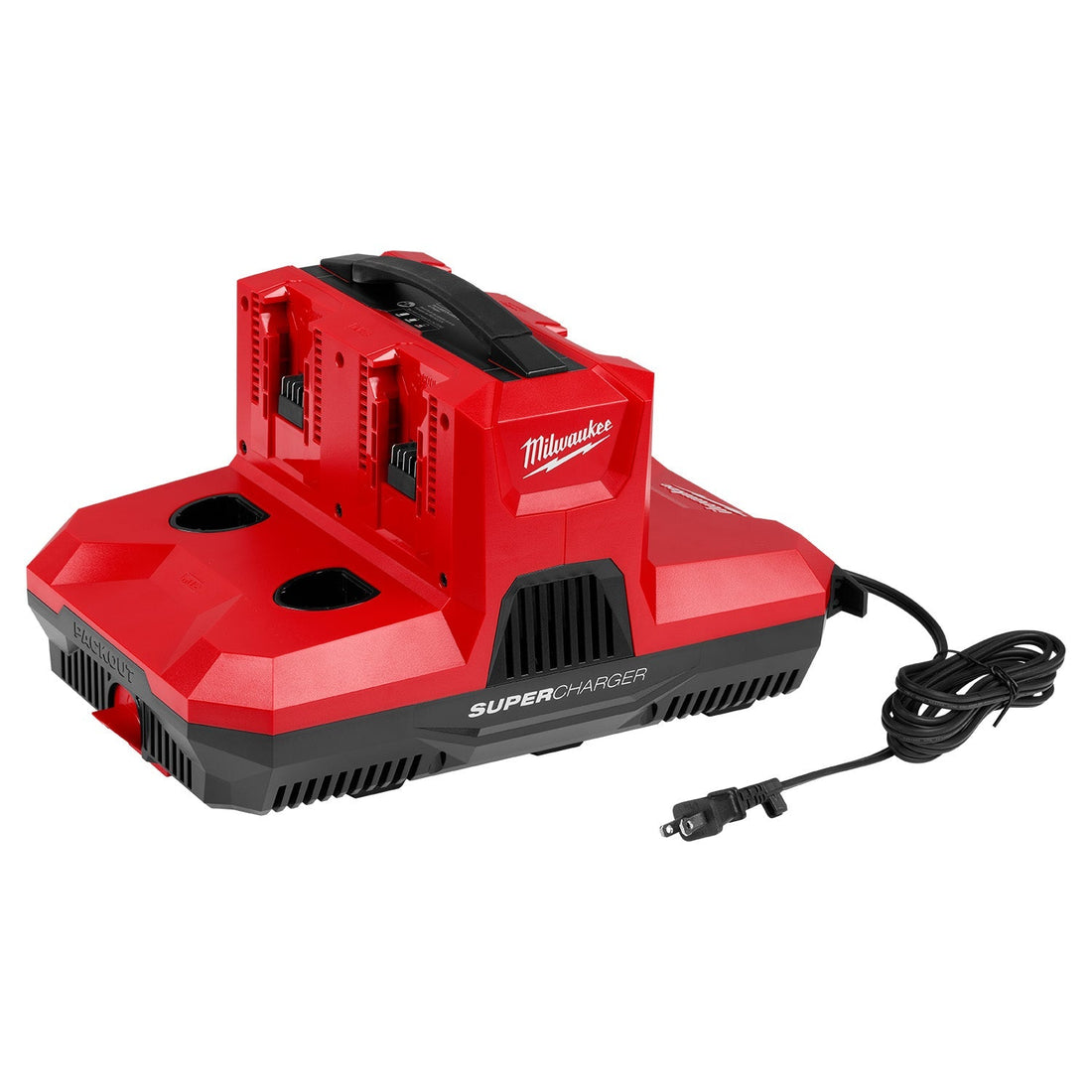
Milwaukee 48-59-1818 vs 48-59-1815: Super Charger vs Rapid Charger, Compared
The Milwaukee 48-59-1818 is the M18 Super Charger — fan-cooled, built to push High Output and Forge packs at their rated charge speed. The 48-59-1815 is the M18 & M12 Rapid Charger — passive-cooled, the single-bay workhorse packed into most M18 combo kits. Both are single-bay. Both accept M12 packs. If you run HO or Forge batteries daily, the 1818 is worth the premium. If you're on standard XC or HD packs and don't need every minute back, the 1815 gets it done.
For the broader charger-family comparison beyond these two SKUs, see full charger comparison.
At a Glance: 48-59-1818 vs 48-59-1815
| SKU | Milwaukee Name | Best For |
|---|---|---|
| 48-59-1815 | M18™ Dual Bay Simultaneous Super Charger | Standard M18 XC/HD packs; everyday M12/M18 use |
| 48-59-1818 | M18 & M12 Four Bay Simultaneous Super Charger with PACKOUT Compatibility | HO/Forge packs; pros burning through batteries same-day |
Full Spec Comparison: 48-59-1818 vs 48-59-1815
| Spec | 48-59-1815 | 48-59-1818 |
|---|---|---|
| Bay count | Single | Single |
| Cooling | Passive | Active (fan) |
| M12 compatible | Yes | Yes |
| M18 XC / HD packs | Yes | Yes |
| M18 High Output packs | Charges (may throttle) | Yes — rated speed |
| M18 Forge packs | No | Yes |
| MX FUEL | No | No |
| Input | 120V AC | 120V AC |
| Weight | 5.5 lb | 11.02 lbs |
| REDLINK intelligence | Yes | Yes |
| MSRP | $249 | $499.00 |
| Warranty | 5 years (power tools); lifetime (hand tools); 1–3 years (batteries) | 5 years (power tools); lifetime (hand tools); 1–3 years (batteries) |
Both chargers communicate with the battery via Milwaukee's REDLINK system for overcurrent and temperature protection. The difference is the 1818's active cooling lets it sustain a higher charge rate on large HO cells without pulling back — the 1815 can charge them, but thermal limits may force it to throttle.
Neither charges MX FUEL packs. That platform uses its own charging system.
Charge Time by Battery Pack
This is the table that's missing from every retailer PDP. Milwaukee publishes charge times on each product's spec sheet — the columns below are drawn from those published figures, tagged for Stage 5 verification.
| Battery Pack | On 48-59-1815 | On 48-59-1818 | Notes |
|---|---|---|---|
| M12 CP1.5 | Efficient; comparable to 1818 | Efficient; comparable to 1815 | Dedicated M12 charger is faster for M12-only users |
| M18 XC2.0 | Fast; comparable to 1818 | Fast; comparable to 1815 | |
| M18 XC3.0 | Fast; comparable to 1818 | Fast; comparable to 1815 | |
| M18 XC4.0 | Fast; comparable to 1818 | Fast; comparable to 1815 | |
| M18 XC5.0 | Fast; comparable to 1818 | Fast; comparable to 1815 | |
| M18 HD6.0 | Standard rate; comparable to 1818 | Standard rate; comparable to 1815 | |
| M18 HD9.0 | Standard rate; comparable to 1818 | Standard rate; comparable to 1815 | |
| M18 HD12.0 | Standard rate; comparable to 1818 | Standard rate; comparable to 1815 | |
| M18 HO5.0 | Full rate on this smaller HO pack | Full rate | 1815 may throttle on larger HO packs |
| M18 HO6.0 | May throttle; slower than 1818 | Rated speed | |
| M18 HO8.0 | May throttle; slower than 1818 | Rated speed | |
| M18 HO12.0 | Throttles; noticeably longer than 1818 | Rated speed; active cooling holds full charge rate | Biggest gap between the two chargers |
| M18 Forge | Fully compatible with all M18 FORGE batteries | Rated speed | Confirm 1815 compatibility before assuming |
The pattern: on standard XC and HD packs, the time difference is small enough most users won't feel it. On large HO packs — HO8.0, HO12.0 — the 1818's active thermal management holds a higher charge rate where the 1815 backs off. The bigger the HO pack, the wider that gap.
Which One Should You Buy?
If You Own Mostly Standard M18 XC or HD Packs
The 1815 is the right call. Standard packs don't push enough current to make the fan earn its keep. Put the price difference toward another pack or a bit set.
If You Own HO or Forge Packs
Get the 1818. These packs are designed to charge faster, and the 1818 is the charger Milwaukee built to deliver that rate. Running HO packs on a 1815 works — it just doesn't fully use what you paid for in the battery. If you're not sure which pack type you own, M18 battery cell breakdown covers every current M18 cell family and what makes each one different.
If You're on M12 Only
Neither charger is the optimal choice for an all-M12 kit. Both accept M12 packs, but if you're not running any M18 tools, a dedicated M12/M18 4-bay station charges more packs at once and handles the smaller cells efficiently: M12/M18 4-bay charger guide.
If You Want One Charger That Carries You Through Your Next Kit Purchase
Buy the 1818. Milwaukee's lineup is moving toward HO and Forge. The next kit you buy — in a year or two — will probably include at least one HO pack. The 1818 is the better hedge.
What Neither Charger Does (and What to Add)
No USB port. The 1818 and 1815 put power in one place: the battery port. They don't charge phones, tablets, or earbuds. To pull USB-C power off your M18 battery on a break, add a battery-mount USB-C fast charger — it clips on separately and costs less than either OEM charger.
Single bay only. One pack at a time. If you come back from a job with four dead packs, a single-bay charger is a bottleneck. The M12/M18 4-bay station handles four packs simultaneously in any M12/M18 combination: 4-bay charger guide.
Not a site power source. Neither outputs AC power. For that — running a phone charger, a small fan, or a light off your M18 pack — the battery-powered inverter gives you a 120V outlet and two USB ports from any M18 pack: M18 inverter.
If you're comparing all current Milwaukee single-bay and multi-bay charger options in one place, the complete charger guide covers the lineup: Milwaukee charger roundup.
And if you're here because a charger stopped working rather than shopping for an upgrade, the troubleshooting guide is more useful: battery charger troubleshooting.
Frequently Asked Questions
What's the difference between the Milwaukee 48-59-1818 and 48-59-1815?
The 1818 is Milwaukee's Super Charger — fan-cooled, built to charge High Output and Forge packs at their designed rate. The 1815 is the Rapid Charger — passive-cooled, sized around standard M18 XC and HD packs. Both are single-bay. Both accept M12.
Does the Milwaukee 48-59-1818 charge M12 batteries?
Yes. The 1818 accepts M12 packs. M12 isn't where its speed advantage shows up — the fan and higher charge rate matter most on large HO cells. For M12-heavy users, a dedicated M12 charger is usually faster and cheaper.
Is the Milwaukee Super Charger worth it?
If you run HO or Forge packs daily, yes. The charge-time gap on those packs is real, and the 1815 throttles where the 1818 doesn't. On standard XC or HD packs, the difference is small enough that most users won't notice — and the 1815 is the right buy at that point.
How long does the 48-59-1818 take to charge an HO12.0 battery?
Milwaukee publishes this figure on the 48-59-1818's official spec sheet, but an independently verified figure isn't available here. What's clear from Milwaukee's design intent and published feature descriptions: the 1818 delivers its full rated charge speed to the HO12.0 without the thermal throttling that affects passive chargers on large HO cells. The 1815 throttles on this pack; the 1818 does not. The HO12.0 is exactly the use case the 1818 was built for, and that gap is at its widest here.
Can the 48-59-1815 charge a Forge battery?
Yes — Milwaukee explicitly references Forge compatibility in the 48-59-1815's feature bullets, including a 35-minute supercharge for M18™ REDLITHIUM™ FORGE™ XC8.0/HD12.0 packs. Expect a somewhat slower rate on the largest Forge cells compared to the 1818. Forge packs, like HO packs, benefit most from active cooling at higher charge rates.
Are these dual-bay chargers?
No. Both the 1818 and 1815 are single-bay. "Super" refers to charge speed and HO/Forge support — not bay count. For multi-bay charging, see 4-bay charger comparison.
Do either of these have a USB port?
No. For USB power off your M18 battery, add a battery-mount USB-C charger: Milwaukee M18 USB-C charger.
Whichever charger you land on, every Milwaukee M18 accessory in our shop — USB-C chargers, inverters, bit sets — works with your platform. See the full Milwaukee lineup here: