
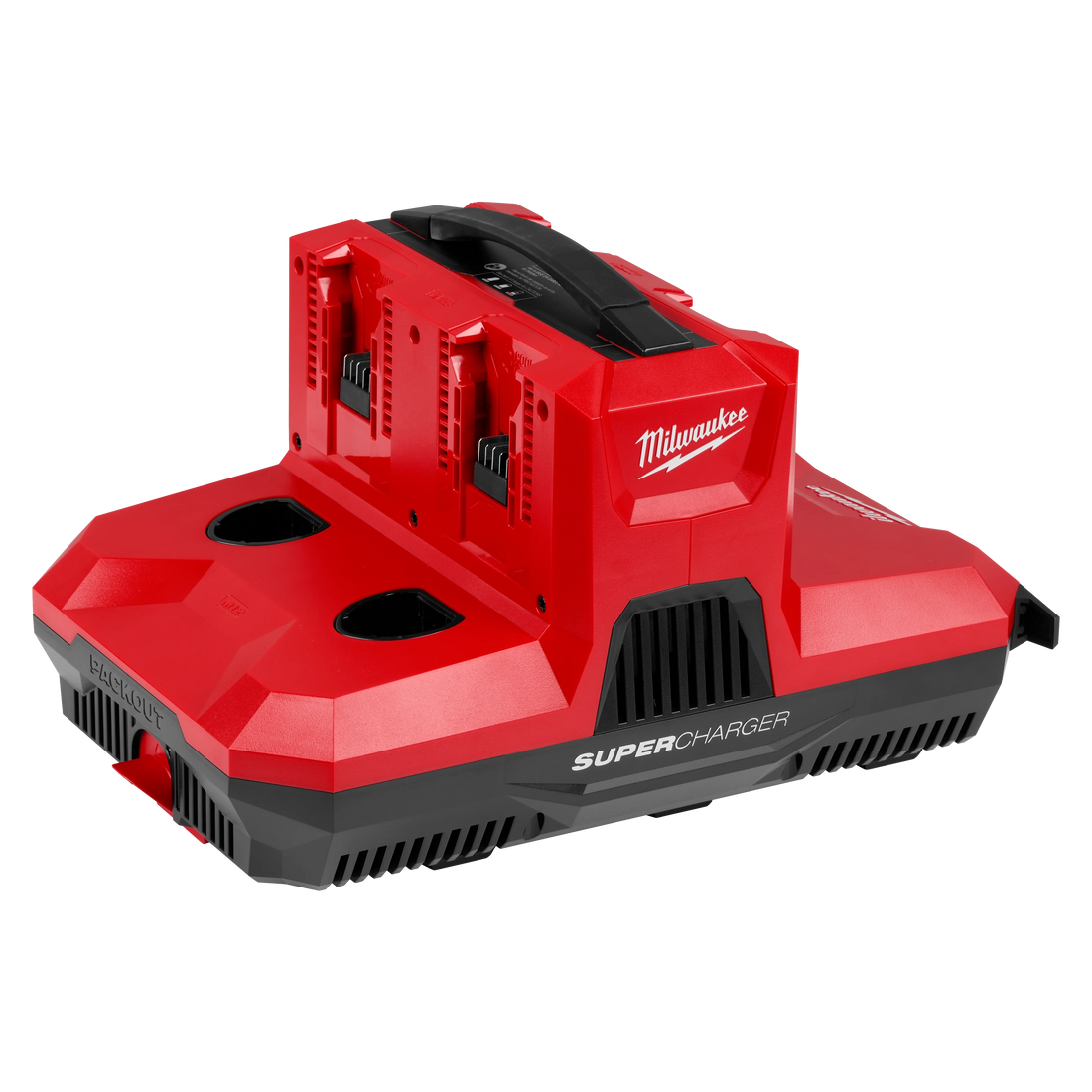
Milwaukee M12/M18 4-Bay Charger: What Fits & How Fast
Milwaukee makes one charger that handles both M12 and M18 batteries in the same unit: the M12 and M18 Multi-Voltage Charger (SKU: 48-59-1204). It charges up to four batteries, but sequentially — one bay at a time, not all four at once. You can mix M12 and M18 packs in the same session. They don't charge in parallel. That's the short answer. Here's everything else you need to decide if it's right for your kit.
Which Milwaukee charger actually charges M12 and M18 in the same unit?
The M12/M18 Multi-Voltage 4-Bay Charger — what it is
Milwaukee's multi-voltage charger is the only native Milwaukee unit that accepts both platforms without a separate adapter or a second charger on the bench. It's a 4-bay sequential charger — four physical slots, each capable of reading either an M12 or M18 REDLITHIUM pack.
The current flagship in this category is the Milwaukee M18™ & M12™ Four Bay Simultaneous Super Charger w/ PACKOUT™ Compatibility (SKU: 48-59-1818) — a single unit with explicit M12 and M18 compatibility, featuring 2 M18-only bays and 2 hybrid M18/M12 bays.
If you landed here wondering whether you need one charger or two — the multi-voltage unit is Milwaukee's answer to that exact question.
Sequential vs. simultaneous — why it matters for your workflow
Simultaneous charging means every battery in every bay charges at the same time, in parallel. Sequential charging means the charger works through one battery per bay before moving to the next.
Milwaukee's multi-voltage 4-bay is sequential.
In practice, this matters depending on how you use it:
- Overnight charging: Load all four bays before you leave the shop. By morning, all packs are full. Sequential timing is irrelevant — you have the whole night.
- Mid-day top-up: If you need all four packs charged in 90 minutes during lunch, sequential charging may not get you there. The charger prioritizes the lowest-charge battery first, works through the queue, and delivers full packs in order — not all at once.
Plan accordingly. Sequential isn't a flaw — it reduces outlet draw and is easier on the electronics. But your fourth battery waits while bays one through three finish.
For a deeper look at how Milwaukee charger speeds compare across their lineup, see the comparison of Milwaukee Super Charger vs. Rapid Charger.
Which batteries actually fit — and which don't?

All current Milwaukee M12 and M18 REDLITHIUM battery families are compatible. Here's the breakdown:
| Battery Family | Platform | Fits the 4-Bay? | Charges at Full Rate? |
|---|---|---|---|
| M12 REDLITHIUM Compact (1.5Ah, 2.0Ah) | M12 | ✅ Yes | ✅ Yes |
| M12 REDLITHIUM XC (3.0Ah, 4.0Ah, 6.0Ah) | M12 | ✅ Yes | ✅ Yes |
| M12 REDLITHIUM High Output | M12 | ✅ Yes | ✅ Yes |
| M18 REDLITHIUM Compact (2.0Ah) | M18 | ✅ Yes | ✅ Yes |
| M18 REDLITHIUM XC (4.0Ah, 5.0Ah) | M18 | ✅ Yes | ✅ Yes |
| M18 REDLITHIUM High Output (6.0Ah, 8.0Ah, 9.0Ah, 12.0Ah) | M18 | ✅ Yes | ✅ Yes |
| M18 REDLITHIUM FORGE | M18 | ✅ Yes (48-59-1818) | ✅ Elevated rate (48-59-1818 only) |
| M12 NiCd (legacy, pre-REDLITHIUM) | M12 | ❌ No | N/A |
A few things worth spelling out:
M12 FUEL vs. standard M12 batteries: FUEL refers to the tool, not the battery. An M12 FUEL tool runs the same M12 REDLITHIUM pack as a standard M12 tool. Charger compatibility is identical.
FORGE batteries: FORGE packs support an elevated charge rate with compatible chargers. The newer M18™ & M12™ Four Bay Simultaneous Super Charger (48-59-1818) supports FORGE's high-rate charging — reaching 80% in 35 minutes for FORGE XC8.0 and HD12.0 packs — while the older M18™ & M12™ Multi-Voltage Charger (48-59-1812) caps FORGE batteries at standard output only. If fast FORGE charge cycles matter to your workflow, the 48-59-1818 is the right unit. See the detailed breakdown of the FORGE battery family for more information.
Cold weather: All REDLITHIUM packs have built-in temperature management that delays charging until the cell is in range. See our guide to charging lithium-ion batteries in cold weather if you're charging in a cold van or garage in winter.
How fast does it actually charge each bay?
These are Milwaukee's published spec estimates — actual times vary with temperature, battery state, and age.
| Battery | Ah | Milwaukee Claimed Charge Time |
|---|---|---|
| M18 Compact | 2.0Ah | Charges relatively quickly; consult Milwaukee's spec sheet for the exact figure |
| M18 XC | 5.0Ah | 60 minutes (with M18 Super Charger) |
| M18 High Output | 12.0Ah | 83–130 minutes (varies by charger type; RapidCharger on XC8.0 = 83 min, HD12.0 = 130 min) |
| M12 Compact | 1.5Ah | Charges in a short time relative to capacity; see Milwaukee's spec sheet for exact figures |
| M12 XC | 6.0Ah | Charge time scales with capacity; consult Milwaukee's spec sheet for the exact figure |
Because the charger is sequential, total time for a full four-bay load is additive — not the longest single charge time, but the sum of all four. Budget accordingly for mid-shift charging.
Do you actually need 4 bays — or is a 2-bay enough?
Be honest with yourself here.
A 4-bay charger makes sense if you:
- Own four or more batteries across M12 and M18
- Run both platforms on the same job (M12 for inspection cameras, compact drills, or heated gear; M18 for larger drills, saws, or impact wrenches)
- Are a crew lead charging packs for multiple workers overnight
- Want one charger on the bench instead of two separate units
Stick with a 2-bay if you:
- Own one or two tools on a single platform
- Are a DIYer who charges between weekends — single-bay or 2-bay gets the job done without the footprint
The 4-bay unit is a fleet management tool. Its physical footprint reflects that — it's a substantial bench piece, not a compact unit. If counter space is tight and you only run M18, a single-platform rapid charger may serve you better.
Where the 4-bay charger fits in a complete M18 battery ecosystem

The charger is the hub, but a fully charged M18 battery does more than run tools.
With a USB-C fast charger for Milwaukee M18 batteries clipped onto a charged pack, you've got fast charging for phones and tablets on the jobsite — no outlet needed. If you need to run a small appliance, corded lamp, or laptop, the power inverter for Milwaukee M18 batteries converts that M18 pack to a standard 120V outlet with two USB ports built in.
For a look at how long a pack actually lasts under inverter load, see our breakdown of power tool battery runtime with inverters.
The 4-bay charger keeps your battery fleet ready. These accessories turn those same packs into portable power wherever the job takes you.
Common questions about Milwaukee's 4-bay charger
Does the Milwaukee 4-bay charger charge M12 and M18 batteries at the same time? No. The M12/M18 Multi-Voltage charger charges sequentially — one bay at a time. You can load both M12 and M18 packs in different bays, but they queue up rather than charging in parallel. The charger moves to the next bay when the current one is finished.
What Milwaukee charger charges both M12 and M18? The Milwaukee M18™ & M12™ Four Bay Simultaneous Super Charger (48-59-1818) accepts both platforms in the same unit, with 2 M18-only bays and 2 hybrid M18/M12 bays. It's the right pick if you regularly run tools from both platforms.
How long does it take to charge an M18 battery in the 4-bay charger? Charge times vary by battery capacity — smaller packs finish considerably faster than large High Output packs, which can take well over an hour. Consult Milwaukee's spec page for the 48-59-1818 for exact times by Ah rating. Note that sequential charging means total time for a full four-bay load is longer than any single battery's charge time.
Can I use a Milwaukee M18 FORGE battery with the 4-bay charger? Yes — M18 FORGE batteries are fully compatible with the M18™ & M12™ Four Bay Simultaneous Super Charger (48-59-1818) and charge at the elevated FORGE rate, reaching 80% in 35 minutes for FORGE XC8.0 and HD12.0 packs. Note that the older M18™ & M12™ Multi-Voltage Charger (48-59-1812) is not compatible with FORGE batteries at elevated rate. If FORGE elevated charging matters to you, the 48-59-1818 is the correct unit.
Does the Milwaukee 4-bay charger work with all M12 battery sizes? Yes — the multi-voltage 4-bay accepts all current M12 REDLITHIUM battery sizes, including the M12 REDLITHIUM HIGH OUTPUT CP2.5 (48-11-2425) and M12 REDLITHIUM HIGH OUTPUT XC5.0 (48-11-2450). Legacy NiCd M12 batteries are not compatible.
Is the Milwaukee 4-bay charger worth it for a DIYer? For most DIYers with one or two batteries, a standard single- or 2-bay charger is sufficient. The 4-bay makes practical sense once you're managing four or more packs — that's typically tradespeople running M12 and M18 tools together, or crew leads charging batteries overnight for multiple workers.
What's the difference between sequential and simultaneous charging? Simultaneous charging powers every bay at once — all batteries charge in parallel. Sequential completes one battery at a time and moves to the next when done. Sequential takes longer total when all bays are full, but draws less from the outlet and puts less strain on the charging electronics.
Does the Milwaukee 4-bay charger have a warranty? The Milwaukee M18™ & M12™ Four Bay Simultaneous Super Charger is covered by a 5-year limited warranty covering defects in material and workmanship, with repair-or-replace coverage.
Your Milwaukee batteries are the investment. The charger and the accessories around them are how you protect and extend that investment. Browse the full Milwaukee accessory lineup — USB adapters, power inverters, and more — at Milwaukee tools and accessories.
While your packs are cycling through the charger, it's worth adding the USB-C fast charger for Milwaukee M18 batteries and power inverter for Milwaukee M18 batteries to the kit — so a charged M18 battery keeps you productive even when there's no outlet in sight.