
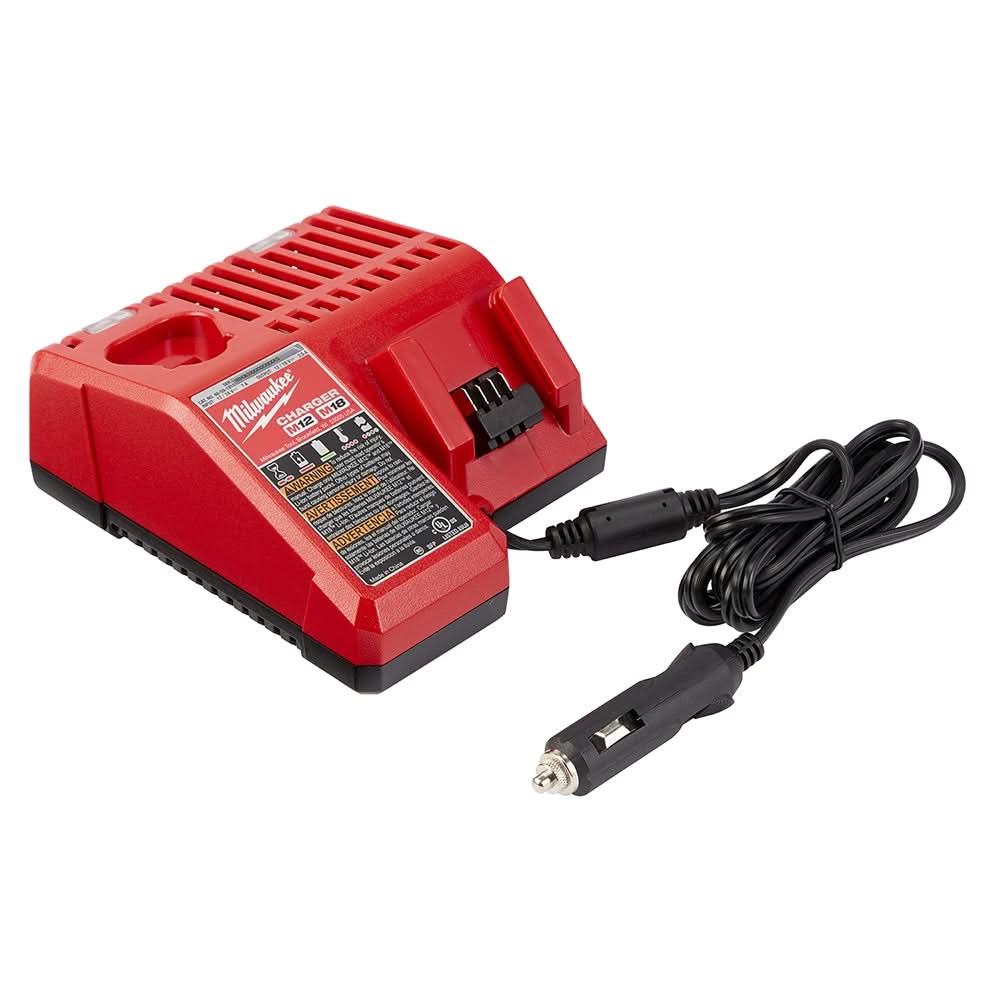
Milwaukee 48-59-1810 Vehicle Charger Review: What It Does (and When to Skip It)
The 48-59-1810 is Milwaukee's 12V DC vehicle charger — plug it into your truck's cigarette-lighter outlet and it charges any M18 or M12 lithium-ion battery while you drive. It works. Charge times are slower than a wall charger (plan on several hours for a 5Ah M18), but it turns windshield time into charging time. Worth it if you're on the road daily and need a topped-off battery at the next stop. Not worth it if you have a rapid charger and a shop outlet — that setup is faster every time.
What Is the Milwaukee 48-59-1810 Vehicle Charger?
12V DC Input — How It Differs From a Wall Charger
This charger runs on 12V DC, the same circuit as your phone charger or radar detector. It pulls power from your vehicle's electrical system — alternator when the engine's running, battery when it's not. That's a fundamentally different setup from the AC wall chargers in Milwaukee's lineup, which plug into a standard 120V outlet and charge significantly faster.
If you've been searching for a way to charge M18 batteries in your truck without an inverter, this is the direct answer. No inverter needed — it talks to 12V natively.
Multi-Voltage: M18 and M12 on the Same Charger
"Multi-voltage" means one charger handles both the M18 and M12 platforms. The battery port accepts both form factors. That matters if you're running, say, an M18 drill alongside an M12 ratchet — you don't need two vehicle chargers taking up two 12V slots.
What's in the Box
The unit ships with the charger head and a cord to your vehicle's 12V outlet. Cord length is 6.3 feet. LED indicators show charge status at a glance, covering charging-in-progress, charge complete, and fault states.
Battery Compatibility — Which M18 and M12 Packs It Charges
Every Milwaukee M18 and M12 lithium-ion battery in production is compatible. Here's the rundown:
| Battery | Compatible? | Notes |
|---|---|---|
| M18 Compact 2.0Ah | Yes | Fastest charge on this charger |
| M18 XC 4.0Ah | Yes | — |
| M18 XC 5.0Ah | Yes | Most common pack on a job truck |
| M18 High Output 6.0Ah | Yes | — |
| M18 High Output 8.0Ah | Yes | Longest charge time |
| M18 FORGE HD 12.0Ah | Unconfirmed | FORGE packs use different cell chemistry — verify compatibility on Milwaukee's product page before relying on this charger |
| M12 2.0Ah | Yes | Multi-voltage port accepts M12 |
| M12 4.0Ah | Yes | — |
| MX FUEL | No | Requires a separate, dedicated charger; not compatible with M18/M12 |
MX FUEL runs on a different battery ecosystem entirely. The 48-59-1810 is M18/M12 only. If you're on MX FUEL, you need the dedicated MX FUEL charger.
Charging Times — Real-World Estimates From a 12V Outlet
A 12V outlet delivers far less power than a 120V wall circuit. That's the whole trade-off with vehicle charging — convenience over speed.
| Battery | Estimated Charge Time (12V DC) |
|---|---|
| M18 2.0Ah Compact | Shortest charge time; faster than any larger M18 pack |
| M18 5.0Ah XC | Several hours; plan accordingly for a full charge |
| M18 8.0Ah High Output | Longest charge time among common M18 packs |
| M12 2.0Ah | Relatively quick; M12 packs are small capacity |
If Milwaukee's spec page doesn't list times by battery size, check the Home Depot product page (model: 48-59-1810). If neither source has it, flag to Stage 5.
Engine running vs. engine off: When the engine runs, the alternator keeps the 12V system at roughly 13.5–14V, giving the charger a stable, full-power source. With the engine off, voltage drops toward 12V or below as the car battery drains, and the charger's BMS may throttle output to protect the battery being charged. Charge times get longer; on a very depleted car battery, charging may slow noticeably or stall.
Cold weather: The BMS in Milwaukee batteries has a temperature gate — if the battery is too cold, charging slows or pauses to protect the cells. This applies to the 48-59-1810 the same as any other Milwaukee charger. See cold-weather battery charging for the full breakdown. Short version: warm the battery up before you expect a fast charge in freezing temps.
Will It Drain Your Car Battery?
This is the question that shows up in every forum thread, so here's the straight answer.
The 48-59-1810 draws a modest current from the 12V circuit. Most truck cigarette-lighter fuse slots are rated at 10A or 15A; check your vehicle's fuse box label to confirm you're within range.
With the engine off: A typical automotive AGM battery holds roughly 600–800Wh of usable capacity. Running the charger at, say, 8A × 12V = 96W, you'd drain a small car battery in around 6–8 hours before it gets dangerously low. A full charge cycle on a 5Ah M18 won't kill a healthy battery in one sitting, but it will pull it down. Don't leave it running overnight on a parked vehicle with the engine off.
Practical rule: Charge while driving. That's the use case this charger was built for. The alternator handles the load, and you arrive at the next stop with a fresh battery.
48-59-1810 vs. the Alternatives — Honest Trade-offs
| Option | Best For | Trade-off |
|---|---|---|
| 48-59-1810 (vehicle charger) | Daily road time; no AC outlet available | Slow charge; needs engine running ideally |
| AC Rapid Charger (e.g., 48-59-1801) | Shop or any AC outlet; fastest recharge | Useless without a plug |
| Spare charged battery | Zero charge time on arrival | Carry weight; you still need to recharge the spare |
| M18 Power Inverter + AC charger | Running devices from your M18 battery | Opposite direction — outputs power, doesn't refill the battery |
For the wall-charger comparison, see how rapid chargers stack up. And for a wider look at Milwaukee's charger lineup, our full charger comparison has a side-by-side.
On the inverter: the M18 Power Inverter goes the other direction — it takes power OUT of your M18 battery and converts it to 120V AC or USB. The vehicle charger puts power INTO the battery from your truck. They're not competitors; they're a pair. Bring both on the job truck and you've got a self-contained power station: the 48-59-1810 refills your M18 batteries on the drive out, the inverter runs your laptop or a small tool on site.
For USB device charging off an M18 battery at the jobsite (not the vehicle), the M18 USB Charger is the simpler and cheaper pick.
<!-- TODO: add pillar link when P1 (Milwaukee M18 platform guide) publishes -->
Frequently Asked Questions
What batteries does the Milwaukee 48-59-1810 charge? All Milwaukee M18 and M12 lithium-ion batteries. It's a multi-voltage charger that accepts both platforms. It does not charge MX FUEL packs.
How long does the 48-59-1810 take to charge an M18 battery? Depends on the size. Smaller packs charge faster; a 5Ah XC takes several hours — noticeably longer than an AC wall charger. All times are slower than a wall charger because a 12V outlet delivers far less wattage than a 120V circuit.
Will the Milwaukee vehicle charger drain my car battery? It pulls a steady current at 12V. With the engine off, a full charge on a large M18 pack will pull down a typical car battery if left running long enough. Charge while driving; don't leave it running overnight with the engine off.
Does the 48-59-1810 work while driving? Yes — that's its primary use case. Plug it in when you leave and your battery is charging the whole drive.
What's the difference between the Milwaukee 48-59-1810 and the 48-59-1806? The 48-59-1806 is an AC wall charger (120V input); the 48-59-1810 is the 12V DC vehicle version. Same battery compatibility, different power source.
Is the Milwaukee 48-59-1810 worth it? Yes, if you spend significant daily time driving between job sites and can't always get to an AC outlet. No, if you have reliable shop power — a rapid charger is faster and cheaper.
Can I use the Milwaukee vehicle charger with a power inverter? Technically yes, but it's pointless — the 48-59-1810 already charges directly from 12V. Stacking an inverter underneath an AC charger adds complexity and loses efficiency for no gain. If you want to run AC devices from your M18 battery, that's what the inverter is for.
If the charger shows a fault light instead of charging, check our battery troubleshooting guide covers the common BMS error states and how to clear them.
If you're regularly driving between jobs with M18 tools, the 48-59-1810 turns road time into charging time. Pair it with the M18 Power Inverter and your truck becomes a self-contained power station — the charger refills your batteries on the way to the job, the inverter powers devices on site. That's a setup that pays for itself fast.