
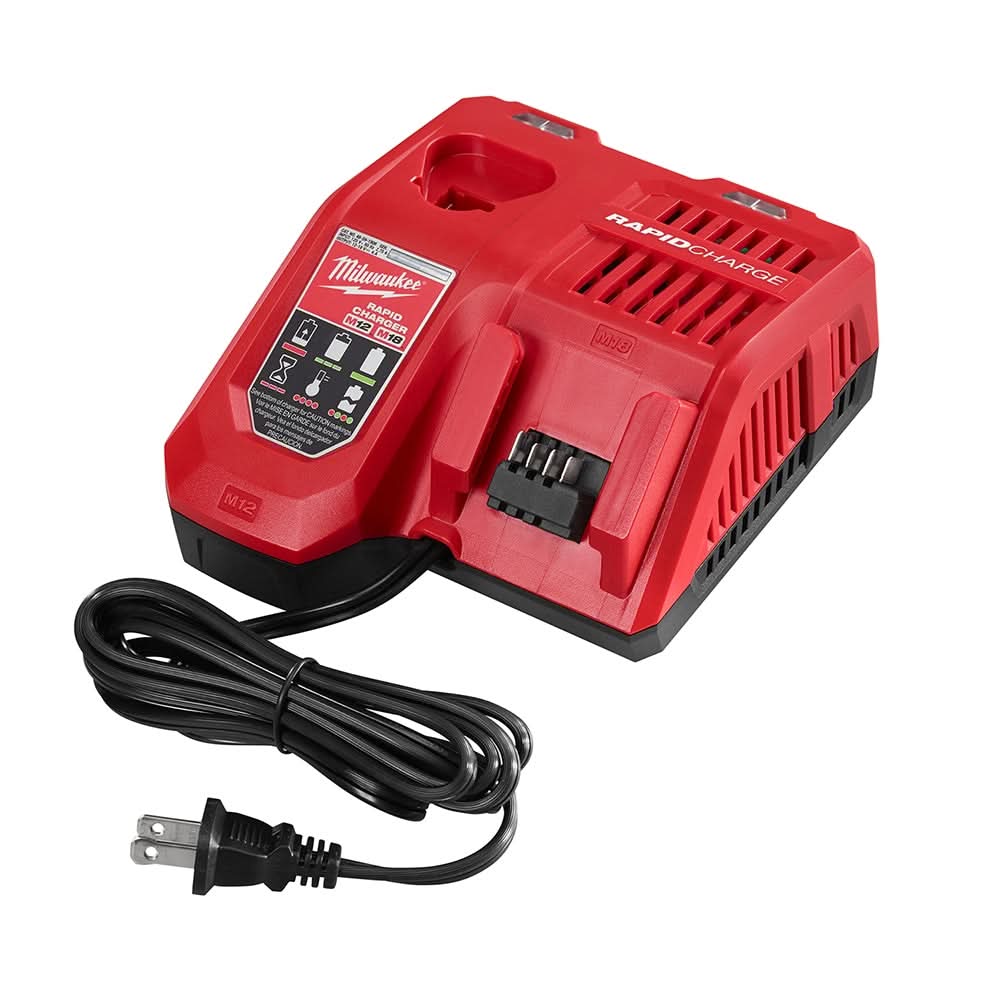
Can You Leave Power Tool Batteries on the Charger?
Yes — for daily use and overnight, leaving a Milwaukee M12, M18, or DeWalt 20V MAX battery on the charger is fine. Every modern charger on these platforms communicates with the battery's built-in management system, stops active charging when the pack is full, and drops into a low-current maintenance float. Leaving a charged pack on the charger between shifts won't kill it. Two situations change that answer: charging a battery that's still hot from hard use, and storing a battery on the charger for more than a month. Here's exactly what changes, and why.
How Modern Charger Auto-Shutoff Actually Works
The BMS–charger handshake
Every Milwaukee and DeWalt battery has a Battery Management System (BMS) built into the pack. The BMS monitors cell voltage, temperature, and state of charge in real time. When the pack hits full charge, it signals the charger to stop pushing current. The charger doesn't just flip off — it drops to a low float current that compensates for natural self-discharge. That's maintenance mode — Milwaukee refers to it as "maintenance charging" on the 48-59-1812 charger (indicated by a flashing green light) and uses a continuous green on the 48-59-1815; DeWalt chargers similarly signal the transition with an LED indicator once the pack is full.
This isn't black magic or a marketing claim. It's a design requirement — without it, a contractor leaving six packs on a rack overnight would be replacing batteries every season.
Milwaukee charger behavior

M12 and M18 chargers — standard two-bay, rapid, and the 6-pack sequential — all use the same shutoff principle. The pack signals full; active charging stops; the charger holds at float. No variation between charger tiers there.
DeWalt 20V MAX charger behavior

Same principle. The DCB115, DCB118, and DCB104 multi-port all communicate per-port with the pack's BMS. Each port manages its own pack independently.
The Two Situations Where "Leaving It On" Causes Damage
1. Hot battery from heavy use
A battery that's been running a hammer drill through concrete or a circular saw through LVL beams for 45 straight minutes is hot. Charging into hot cells stresses the chemistry and speeds up degradation — not dramatically on one charge, but the cumulative effect is real.
The fix: let the pack sit on the bench for 15–20 minutes before putting it on the charger. A warm battery is fine. If you can't hold your hand on the casing comfortably, it needs more time. Milwaukee's guidance is to allow the battery to cool until normal function resumes — the manufacturer doesn't publish a specific duration, so surface temperature is your cue.
This is the most common "I destroyed a battery" scenario that gets blamed on overnight charging, when the real cause was putting a scorching pack straight onto the charger after a brutal run.
2. Long-term storage at 100% charge
Here's the one that catches people off guard. Leaving a battery on the charger between Monday's job and Wednesday's job? No problem. Leaving it on the charger for six weeks while a project stalls out? That's where you accelerate capacity fade.
Lithium-ion cells degrade faster when stored at full charge than at a partial state. The charger's maintenance float keeps the pack near 100%. Over 30-plus days, that's exactly where you don't want it. Pull it off, run it down to roughly half, and store it at room temperature instead.
What to Do If You Won't Use the Battery for a Month or More
Three steps:
1. Don't store it on the charger. The maintenance float holds it at or near 100% — that's the problem. 2. Run it down partway. Use the tool normally until you're around half charge (most Milwaukee packs show fuel gauge LEDs; stop when you're around the halfway mark). You don't need precision here — close to half is better than full or dead. 3. Store at room temperature. Not in the truck, not in an unheated garage through January, not in a hot car in August. Room temperature extends cell life.
Milwaukee does not publish a specific target charge level for storage. Worth noting: DeWalt's guidance for very extended storage — periods longer than six months — is to fully charge the battery before putting it away. For the shorter storage windows covered here, keeping the pack at a partial charge and off the charger is the right call.
For more on long-term battery care, see long-term storage guide.
Does Charger Type or Number of Bays Change Anything?
Short answer: for overnight safety, no. The shutdown behavior is the same regardless of charger. But there are practical differences worth knowing.
| Charger | How it handles multiple packs | Overnight with a full rack? |
|---|---|---|
| Milwaukee standard 1–2 bay | Each bay independent; maintenance float when done | Fine |
| Milwaukee 48-59-1806 Six-Pack | Sequential — charges one pack at a time, cycles through all 6 bays | Fine; packs 2–6 wait their turn, then hit maintenance |
| DeWalt DCB104 (4-port) | Simultaneous — all four ports charge at once | Fine; each port manages its own pack independently |
The one practical note on the sequential six-pack: charging six dead packs takes longer than two, since they're queued. If you're running a crew and need all six ready by 6 a.m., factor in how many are depleted when you plug in the night before. One dead pack on a two-bay charger is fast. Six depleted packs on a sequential rack needs more lead time.
For a closer look at multi-bay charger options, see Milwaukee multi-bay chargers and Super Charger vs. Rapid Charger comparison.
FAQ
Can you overcharge a lithium power tool battery? No. Milwaukee M18/M12 and DeWalt 20V MAX chargers stop active charging when the pack is full — the BMS signals the charger to cut current. There's no "overcharge" the way you might picture it. What does happen is capacity fade from extended storage at 100%, which is a slower, different problem.
How do I know when the charger switches to maintenance mode? When active charging is done, Milwaukee chargers signal the transition to maintenance mode with an LED indicator — typically a green light, though the exact behavior (solid vs. flashing) varies by model. DeWalt chargers signal the same state with a green LED as well. Check the indicator legend printed on your charger or in its manual for the exact pattern.
Is it bad to leave Milwaukee M18 batteries on the charger overnight? No. Overnight between shifts is exactly what Milwaukee's chargers are designed for. The exception is a battery that's been sitting on a charger untouched for weeks or months — that's where the 100% storage problem kicks in.
Is it bad to leave DeWalt 20V batteries on the charger overnight? Same answer — fine for overnight and multi-day between-use storage. Pull them off if a job gets delayed and they're going to sit for more than a few weeks.
How long can a battery sit on the charger? Days to a couple of weeks, no issue. Past about 30 days at 100% charge, you're accelerating capacity loss. Store partially charged off the charger for anything longer.
Should I let my battery cool before charging? Yes, if it's hot from hard use. Warm is fine. Hot — where you can't hold your hand on the pack comfortably — means it needs time on the bench first. Neither Milwaukee nor DeWalt publishes a specific cooldown duration — let the pack's surface temperature be your guide.
What temperature is too cold to charge a power tool battery? Milwaukee and DeWalt chargers include temperature protection that prevents charging below a threshold to protect cold cells — Milwaukee's cutoff is 40°F (5°C), and DeWalt's is +40°F (+4.5°C). For a full breakdown on cold-weather charging, see cold-weather charging guide.
If your charger is throwing fits in the cold, check Milwaukee battery troubleshooting or DeWalt charging issues — temperature lockout is one of the most common culprits.
Keep the Habit Simple With a Proper Charging Setup
The easiest way to make good charging habits automatic is getting packs and chargers off the floor and onto the wall. When your charger has a dedicated spot and your packs aren't scattered across the bench, you'll naturally let them cool before plugging in and pull them off before a long storage stretch.
The wall-mount bracket for M12/M18 chargers mounts a single M12 or M18 charger cleanly to the wall. If you're running two chargers, the dual charger wall bracket holds both at an angle that works well in trucks and tight shop walls. For a full charging station setup — two chargers up top plus battery storage below — the 3-in-1 charging station mount does it all on one rack.
Browse the full Milwaukee accessory lineup at Milwaukee tools and accessories.