
OLFA vs Stanley Utility Knife: Which One Should You Actually Buy?
Buy OLFA if you cut a lot of cardboard, film, vinyl, or anything where a fresh razor edge on demand matters. Buy Stanley if you do heavy, side-loaded work — roofing, carpet, insulation — and want the blade you can grab at any hardware store or job-site supply trailer. The OLFA vs Stanley utility knife debate isn't really a brand war. It's a blade-system war. Understand the two systems and the decision makes itself.
The Real Difference: Snap-Off vs Trapezoidal Blades
Most comparisons describe OLFA as "Japanese and precise" and Stanley as "classic and durable," then stop there. That's the wrong lens. The brand is almost irrelevant. What matters is the blade format — and the two formats do fundamentally different things.
How OLFA's Snap-Off Segmented Blade Works
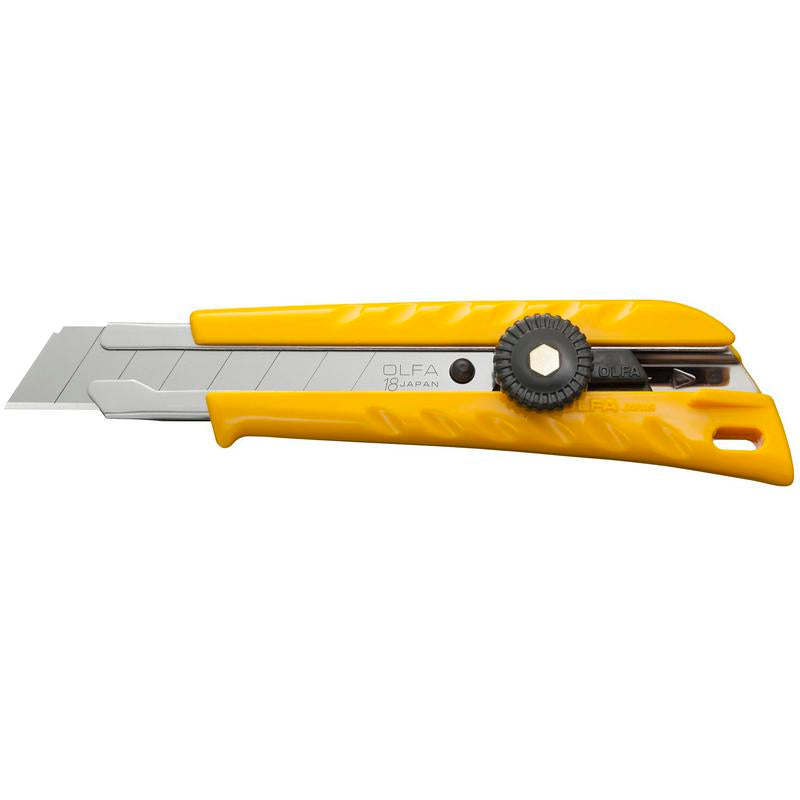
OLFA's core idea: make the blade cheap enough and segmented enough that you never have to work with a dull edge. The blade is scored at regular intervals — each segment cut at a precise diagonal — so when the front segment dulls, you score it off with the built-in snapper or a pair of pliers and you're working with a fresh edge in about three seconds. No new blade, no tool swap, no fumbling.
OLFA makes snap-off blades in three widths: 9mm (light-duty, tight curves), 18mm (the most common — general cutting), and 25mm (heavy material, wide flat cuts). Blade steel is carbon tool steel or tungsten tool steel depending on the model. The thin, hard blade holds a genuinely sharp edge and gives you fine feedback on delicate material.
The trade-off: that thinness is also the failure mode. Apply lateral force — prying, levering, cutting into a notch sideways — and the blade snaps mid-segment. For warehouse work and finish trimming this is a non-issue. For roofing and flooring, it's a liability.
How Stanley's Trapezoidal Replaceable Blade Works
Stanley's trapezoidal knife takes a whole-blade swap: the blade wears down, you pop the body open, drop in a new blade, done. The trapezoidal shape — wider at the base, narrowing toward the tip — is an industry standard. Same profile used by Milwaukee, DeWalt, Irwin, Husky, and dozens of others. Replacement blades are at every hardware store, every big-box, most job-site supply trailers.
The blade is thicker and stiffer than a snap-off segment. It handles side load, prying, scoring deep into rigid materials. It won't snap when you're trimming carpet against a tack strip or working a blade through roofing felt. Many Stanley models include on-board blade storage in the handle — convenient on a crew.
Why Blade Geometry — Not Brand — Drives Everything
Once you understand those two systems, most downstream questions answer themselves: which wins for your task, whether the blades interchange, and when the cheaper knife is the right call.
Do OLFA and Stanley Blades Interchange?
No. Not at all.
OLFA snap-off blades (9mm, 18mm, 25mm) and Stanley trapezoidal blades are different physical formats. You can't put an OLFA snap-off blade in a Stanley body, and a Stanley trapezoidal blade won't fit an OLFA snap-off knife.
Here's the upside of each format's situation:
- Stanley trapezoidal: this is the *industry-standard* profile. Milwaukee, DeWalt, Irwin, Husky, and most other brands use the same shape. Own a Stanley-format knife and any of those replacement blades fit.
- OLFA snap-off 18mm: this width is also a common standard. Tajima, Fiskars, and other brands make 18mm snap-off blades that fit OLFA bodies. Same for 9mm.
So neither system locks you to one brand's *blades* — but the two *formats* don't cross. Pick your format first, then pick your handle.
Which Cuts Better? OLFA vs Stanley by Task
| Task | Winner | Why |
|---|---|---|
| Cardboard / boxes | OLFA | Razor-thin snap-off slices cleanly; snap refreshes the edge after heavy unboxing sessions |
| Film, vinyl, paper | OLFA | Thin blade, precise control; minimal drag |
| Drywall (scoring paper face) | OLFA | Scores the face cleanly in one pass |
| Drywall (cutting through) | Stanley | Stiffer blade handles repeated side-load without snapping |
| Carpet | Stanley | Side-load against tack strips, thick backing — trapezoidal blade holds |
| Roofing shingles | Stanley | Heavy material, lateral pressure — this is what trapezoidal was built for |
| Insulation | Stanley | Long compression strokes; stiffer blade easier to control |
| Rope / strapping | Stanley | No lateral snap risk |
| Precision trim / finishing | OLFA | Fresh edge on demand, thin blade for tight spots |
| EPDM / rubber | Stanley | Thick, tough material requires stiff blade and controlled pressure |
For anyone cutting mostly boxes at a warehouse or loading dock: OLFA, no question. For a roofing, flooring, or framing crew: Stanley trapezoidal, no question. If you do both — get both. Each knife runs under $20 and earns its spot in the bag.
Durability: Which Blade Holds Up Better?
Both brands offer plastic-body economy models and rubber-overmold ergonomic versions. For handle durability, the model tier matters more than the brand.
Where they differ is the blade itself:
OLFA blade flex / breakage: The snap-off blade is thin and hard. On straight, forward cuts it's excellent. Under lateral force — prying, angled pressure, working a blade into a notch — it will snap a segment. This isn't a defect, it's the design. But if your cuts involve regular side load, it's a real problem.
Stanley trapezoidal blade: Stiffer, handles side load. The blade doesn't snap, but it dulls, and the whole blade needs swapping when it does.
For wet conditions or exterior work: both blades will surface-rust if left exposed. Neither is a marine tool. OLFA's blade-lock models — some of which seal the blade holder for wet-site use — give better moisture protection than most economy trapezoidal knives.
Replacement Blade Cost & Availability
Snap-off economics: When the front segment dulls, you snap it off — essentially no blade cost, just a few seconds. One OLFA blade has multiple usable segments, so each blade stretches further than it looks. A replacement pack of OLFA 18mm blades is inexpensive and widely available at hardware stores and home-improvement chains.
Trapezoidal economics: When a Stanley blade is done, you swap the whole thing. Replacement packs run $3.97 for a 5-pack (model 11-921). Not expensive, but you're consuming the full blade, not a segment.
Availability:
- Stanley trapezoidal: sold everywhere — hardware stores, big-box, many dollar stores carry them.
- OLFA 18mm snap-off: stocked at most hardware stores and all home-improvement chains; less likely at every gas station or corner store, but not hard to find.
Which OLFA and Stanley Models Should You Buy?
OLFA:
For most people, the OLFA L-1 or LA-X — both current 18mm heavy-duty models — is the right call. Rubber grip, blade lock, runs the 18mm standard. If you're doing precision work — signage, thin film, graphics — the OLFA A-1 Slide-Lock 9mm is sharper and easier to control in tight spots.
Avoid budget snap-off knockoffs. The blade lock on cheap snap-off bodies often fails, and a loose snap-off blade is a genuine hazard.
Stanley:
The Stanley 99E (model 10-099, currently in production) is the classic trapezoidal knife. Get the retractable version if you're carrying it in a pouch or pocket. The Stanley FATMAX 10-778 (a 6-5/8 in. retractable model) adds a rubber grip and on-board blade storage for a few dollars more — worth it for daily trade use.
Both run the same trapezoidal blade. The 99E has been a standard job-site knife for decades; the FatMax is the upgrade for people who use one every day.
Price: When the Cheaper One Is the Right Call
Entry-level OLFA snap-off knives run $6.97. Entry-level Stanley trapezoidal (99E or equivalent) runs $6.97. Both are inexpensive enough that owning one of each isn't a real financial decision.
Where value math matters is in blades over time. If you cut a lot, OLFA's segment system is more economical — you're not discarding a good blade because one edge is dull. If you cut occasionally and prioritize finding blades anywhere, Stanley wins that argument.
The Verdict — Who Each Knife Is For
Buy OLFA if:
- You cut cardboard, film, vinyl, wallpaper, or any material where a razor-fresh edge matters
- You want edge renewal without stopping to swap blades
- You're doing finish work, signage, upholstery, or precision trimming
Buy Stanley (or any trapezoidal knife) if:
- Your cutting involves side load — roofing, carpet, insulation, rigid foam, heavy strapping
- You want replacement blades available anywhere
- You're on a crew and replacing or sharing knives regularly
Buy both if:
- Your work covers the full range — one lives in the shop, one rides in the bag
Neither knife is "better." The question is what you're cutting.
FAQ
Do OLFA blades fit a Stanley utility knife?
No. OLFA snap-off blades — 9mm, 18mm, or 25mm segmented — and Stanley trapezoidal blades are different physical formats and are not interchangeable. They require different knife bodies.
Are OLFA knives better than Stanley?
Not better — different. OLFA wins for thin, precise, clean cuts where edge freshness matters. Stanley wins for heavy, side-loaded cutting and universal blade availability. Using the wrong format for the job is how people end up frustrated with one brand or the other.
What is a snap-off knife best for?
Cardboard, film, vinyl, wallpaper, drywall paper facing, precision trimming, and any application where a constantly-fresh razor edge matters more than lateral strength. Warehouse workers, sign-makers, and finish carpenters reach for snap-off knives most often.
Why do OLFA blades snap so easily?
They're designed to. The segmented blade is thin and hard — it holds an exceptional edge, but that same hardness means it snaps under sideways or prying force. Snapping a segment is the intended "refresh" mechanism. If you're applying lateral pressure regularly, a stiffer trapezoidal blade is the right tool.
What utility knife do professionals use?
Both, depending on the trade. Roofers, flooring installers, and insulation contractors lean heavily toward trapezoidal knives. Electricians trimming wire loom, carpenters doing finish work, and anyone doing precision or high-volume cutting often prefer OLFA snap-off. Neither is more "professional" — it's task-dependent.
Is OLFA worth the money?
For high-volume precise cutting, yes. The segment renewal system saves real time and the edge quality is noticeably better. For occasional heavy cutting, a Stanley trapezoidal knife is cheaper, tougher under load, and easier to resupply — OLFA is overkill for that application.
Can you sharpen utility knife blades?
You can touch them up on a strop or fine stone, but neither system is designed for that. OLFA blades are built to snap to a fresh segment; Stanley blades are built to be swapped. At the price of replacement blades, sharpening is rarely worth the time.
The OLFA vs Stanley argument ends the moment you ask what you're cutting. Snap-off for clean, precise work — trapezoidal for heavy, side-loaded trade use. Both blade formats have their own replacement ecosystem, so neither traps you with one brand's supply chain.
For a task-specific deep dive into drywall cutting — blade angle, score depth, and when a hook blade beats a straight blade — see our drywall cutting guide. And if you're weighing Milwaukee's FASTBACK against the Stanley FatMax specifically, that comparison is covered in our FASTBACK vs FatMax breakdown.