
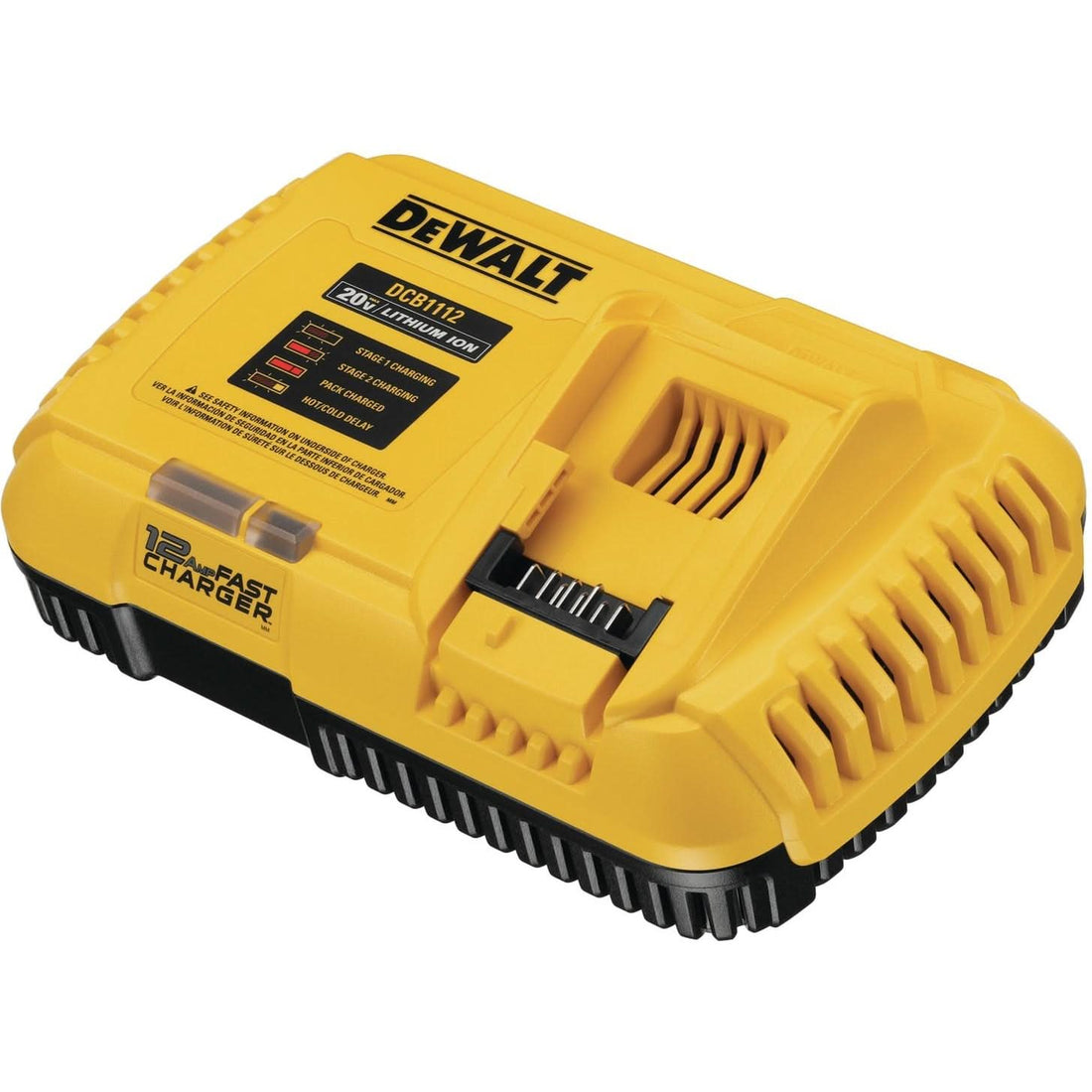
DeWalt DCB1112 vs DCB118 vs DCB1404: Which 20V MAX Charger Should You Buy?
Short version: The DCB1112 is DeWalt's current 12-amp fast charger — it directly replaced the DCB118 with the same 12A rate, the same fan-cooled housing, and a minor cosmetic refresh. If you already own a DCB118, keep it; if you're buying new, get the DCB1112. The DCB1404 is a completely different animal: 4 amps, no fan, quieter, cheaper, and roughly 3× slower on the same pack. Own a 6Ah, 9Ah, 12Ah, or 15Ah FLEXVOLT pack? Get the DCB1112. Running only 1.5–5Ah packs and charging overnight? The DCB1404 saves you real money with zero loss in performance for your use case.
DeWalt DCB1112 vs DCB118 vs DCB1404: The One-Glance Spec Table
Side-by-side: DCB1112 vs DCB118 vs DCB1404
| DCB1112 | DCB118 | DCB1404 | |
|---|---|---|---|
| Charge rate | 12A fast | 12A fast | 4A standard |
| Fan-cooled | Yes | Yes | No |
| Charges 20V MAX | All packs | All packs | All packs |
| Charges FLEXVOLT | Yes | Yes | Yes |
| USB output | No | No | No |
| Current at retail | ✓ Active | Discontinued | ✓ Active |
| Replaces | DCB118 | — | DCB1104 |
| Price tier | Mid-high | Clearance / used market | Lower |
*DCB1404 passive cooling (no fan): it runs silently with no moving parts and stays warm to the touch during extended charge cycles.*
Is the DeWalt DCB1112 the Same as the DCB118?
Effectively, yes.
What actually changed
DeWalt refreshed the SKU, not the technology. The DCB1112 arrived with a reshaped housing and a new LED indicator layout. The charge electronics stayed in the same 12A class. Set the two units side by side and the housing looks different — different LED ring, slightly different proportions. Pull up both spec sheets and the charge rate is identical.
Cord length and plug type are unchanged. Same mounting footprint for anyone using a wall bracket or charger shelf in the van.
Do the DCB1112 and DCB118 charge at the same speed?
On the same pack, the DCB1112 and DCB118 post identical charge times — same 12A rate, same current delivery. The swap from DCB118 to DCB1112 didn't change anything at the pack level.
If your DCB118 is suddenly charging slowly, the charger almost certainly isn't the problem — check the pack. This troubleshooting guide walks through what actually causes slow or failed charges on the DeWalt platform.
Why did DeWalt rename the DCB118 to DCB1112?
Routine SKU lifecycle. DeWalt updates housing designs and resets model numbers every few years. The DCB118 moved to "discontinued" and the DCB1112 took its shelf slot. The underlying technology — 12A, fan-cooled, full 20V MAX and FLEXVOLT compatibility — stayed the same.
Nothing broke. Nothing meaningfully improved. The nameplate changed.
DCB1112 vs DCB1404: Fast Charger vs Standard — What's the Real Difference?
This is where the decision actually lives for most buyers.
Charge times across pack sizes
| Pack | DCB1112 (12A fast) | DCB1404 (4A standard) |
|---|---|---|
| 2Ah (DCB203) | Very fast | 32 minutes |
| 5Ah (DCB205) | Fast | Considerably longer |
| 9Ah (DCB609) | ~1.5 hr full; under 45 min to 80% | Several hours |
| 12Ah FLEXVOLT (DCB612) | Faster than standard | Extended — plan around it |
*DCB1404 2Ah and DCB1112 9Ah charge times from DeWalt spec sheets; other cells indicate relative charge speed.*
The gap grows with pack size. On a 2Ah compact the difference is manageable — the DCB1404 catches up while you're grabbing coffee. On a 12Ah FLEXVOLT, the 4A charger is running for hours. If that pack powers your miter saw on a production job, you're planning your whole morning around your charger. That's the wrong way around.
Fan noise, heat, and indoor use
The DCB1112 runs a fan — you'll hear it. Not loud, but present. In a busy shop it disappears. In a finished space, a quiet office, or charging overnight in a shared area, it's noticeable.
The DCB1404 is silent. Passive cooling means it runs slightly warm to the touch on longer cycles — normal, within spec, nothing to worry about. No moving parts also means nothing to wear out. It's a polite charger for occupied spaces.
Is the DCB1112 worth the extra cost over the DCB1404?
The DCB1112 sits higher. Street pricing puts it meaningfully above the DCB1404.
For anyone running 6Ah packs and larger, that premium pays back fast. Two full charges in a workday is realistic with the DCB1112 on a 9Ah pack — it's a stretch on the DCB1404. If your work depends on full packs between jobs, the fast charger isn't a luxury.
If your biggest pack is a 5Ah and your charger runs overnight, the DCB1404 does the same job for less money and does it quietly. Spending up for speed you'll never use is just spending up.
DCB118 vs DCB1404: Should You Buy Old Stock or the Current Charger?
Is buying a DCB118 today worth it?

DCB118 units are still floating around on Amazon, eBay, and distributor clearance channels — kit returns, contractor fleet liquidations, old stock. They charge fine.
Whether it makes sense comes down to price. If a DCB118 lands at a meaningful discount versus a new DCB1112, that's legitimate — 12A performance at a clearance price. If it's anywhere near current DCB1112 retail, pass. You'd be paying active-product prices for a discontinued SKU with no warranty path.
The real downside: if a secondhand DCB118 fails, you're sourcing another one on the secondary market. That matters less for a shop backup, more if it's your primary charger.
When the DCB1404 beats hunting down a DCB118
If you run 1.5Ah–5Ah packs and you're not time-constrained on charge cycles, the fast-charge capability of the DCB118 (or DCB1112) is a spec you're paying for and never using. The DCB1404 is smaller, silent, runs cool, and doesn't need to be near an outlet you care about hogging for hours. For a home shop, a light-use kit, or a secondary charger for compact packs — it's the honest choice over hunting down discounted old stock.
What Do All Three DeWalt Chargers Actually Charge — and What Don't They?
Every 20V MAX pack and every FLEXVOLT pack
The DCB1112, DCB118, and DCB1404 all accept every DeWalt 20V MAX battery in the DCB2xx family and every FLEXVOLT pack in the DCB6xx family — from the 1.5Ah compact through the 15Ah FLEXVOLT. DeWalt documents this compatibility range across the charger lineup.
FLEXVOLT packs step down to 20V when seated in a 20V tool, step up to 60V or 120V when the tool calls for it. These chargers talk to the pack and charge it regardless of what voltage it was running at. For the full charger-to-pack compatibility map across DeWalt's lineup, see our compatibility guide.
Can you charge a phone with the DCB1112, DCB118, or DCB1404?
No — none of them. No USB port on any of the three. That's not a flaw — they're battery chargers. But if you need to top off a phone, tablet, or USB-C laptop during the day, you need something separate.
A USB-C battery adapter that clips directly onto your 20V MAX pack handles exactly that: up to 65W USB-C output, plus a USB-A port for anything else. You're already carrying the pack — might as well carry the adapter too.
Not sure whether a USB adapter or a full inverter is the right move for your setup? Compare your options.
These chargers are not inverters
For running actual AC devices — a radio, a phone charger, a laptop brick — off your DeWalt packs, that's what the 150W power inverter is built for. 120V outlet, two USB ports. These three chargers don't touch that use case at all.
How to Choose Between the DCB1112, DCB118, and DCB1404 in 60 Seconds
You own a 6Ah or larger pack → get the DCB1112. The 12A rate is built for high-capacity packs. On a 9Ah or 12Ah FLEXVOLT, the difference between the DCB1112 and DCB1404 is measured in hours. That gap disrupts a real workday.
Your biggest pack is 5Ah and you charge overnight → get the DCB1404. You're not using the speed, you don't want the fan noise, and the price difference is real money. Simple.
You already own a DCB118 → keep it. It's the same charger under a different name. Don't buy a DCB1112 to "upgrade" — there's nothing to upgrade to. Put that money toward a USB-C battery adapter instead and fill the gap these chargers all leave open.
Your phone runs down before your tools do → add the USB-C battery adapter. The DCB1112, DCB118, and DCB1404 all leave that gap open. The adapter is cheaper than a separate battery bank and uses the power you're already carrying.
For a shop-mounted charging setup, our Toughsystem 2.0 review covers the wall-mount angle. And for the full DeWalt 20V accessory lineup, explore our DeWalt collection.
FAQ
Is the DeWalt DCB1112 the same as the DCB118? Effectively yes. The DCB1112 replaced the DCB118 at retail with the same 12-amp charge rate, the same fan-cooled design, and the same 20V MAX plus FLEXVOLT compatibility. The housing and LED layout were updated; the electronics are the same class. If you already own a DCB118, it does the same job — there's no reason to replace it.
What's the difference between the DCB1404 and the DCB1112? The DCB1404 is a 4-amp standard charger; the DCB1112 is a 12-amp fast charger. On a 5Ah pack the DCB1112 is roughly 3× faster. The DCB1404 is smaller, passively cooled, quieter, and cheaper. For compact packs charged overnight, the DCB1404 is the practical choice. For high-capacity packs or fast turnaround between jobs, the DCB1112 is worth the premium. Full breakdown here.
Does the DCB1112 charge FLEXVOLT batteries? Yes. The DCB1112 accepts every FLEXVOLT pack alongside all 20V MAX packs. On large FLEXVOLT packs — 9Ah, 12Ah, 15Ah — the 12A charge rate is where the DCB1112 earns its price over the DCB1404. See our compatibility guide for the full picture.
Is the DCB118 discontinued? Yes. DeWalt replaced it with the DCB1112 at retail. Units still turn up through Amazon, eBay, and distributors clearing old inventory. They work fine — but at retail-equivalent pricing, there's no reason to choose a discontinued SKU over a current one with warranty support.
Can I charge my phone with a DeWalt charger? No. None of the DCB1112, DCB118, or DCB1404 have USB ports. To charge phones or USB-C devices from a 20V MAX pack, you need a USB-C battery adapter.
How long does a 12Ah FLEXVOLT take on the DCB1112? The DCB1112's 12-amp rate handles a 12Ah FLEXVOLT pack significantly faster than a 4A standard charger. For the current published charge time, check the DCB1112 product page on DeWalt.com.
Which charger comes in most DeWalt kits? Every active combo kit on DeWalt.com includes a charger — most current kits ship with the DCB1112 or a standard 4A charger depending on the kit tier.
DeWalt's 20V MAX platform runs deep — the right charger is one piece of it. For USB power, AC power, and accessories that actually use the battery you're already carrying, browse the full DeWalt lineup.
The one gap all three of these chargers leave open: USB-C output from the pack you're already carrying. The USB-C battery adapter fills it — whether you end up with the DCB1112, the DCB1404, or the DCB118 you already own.