
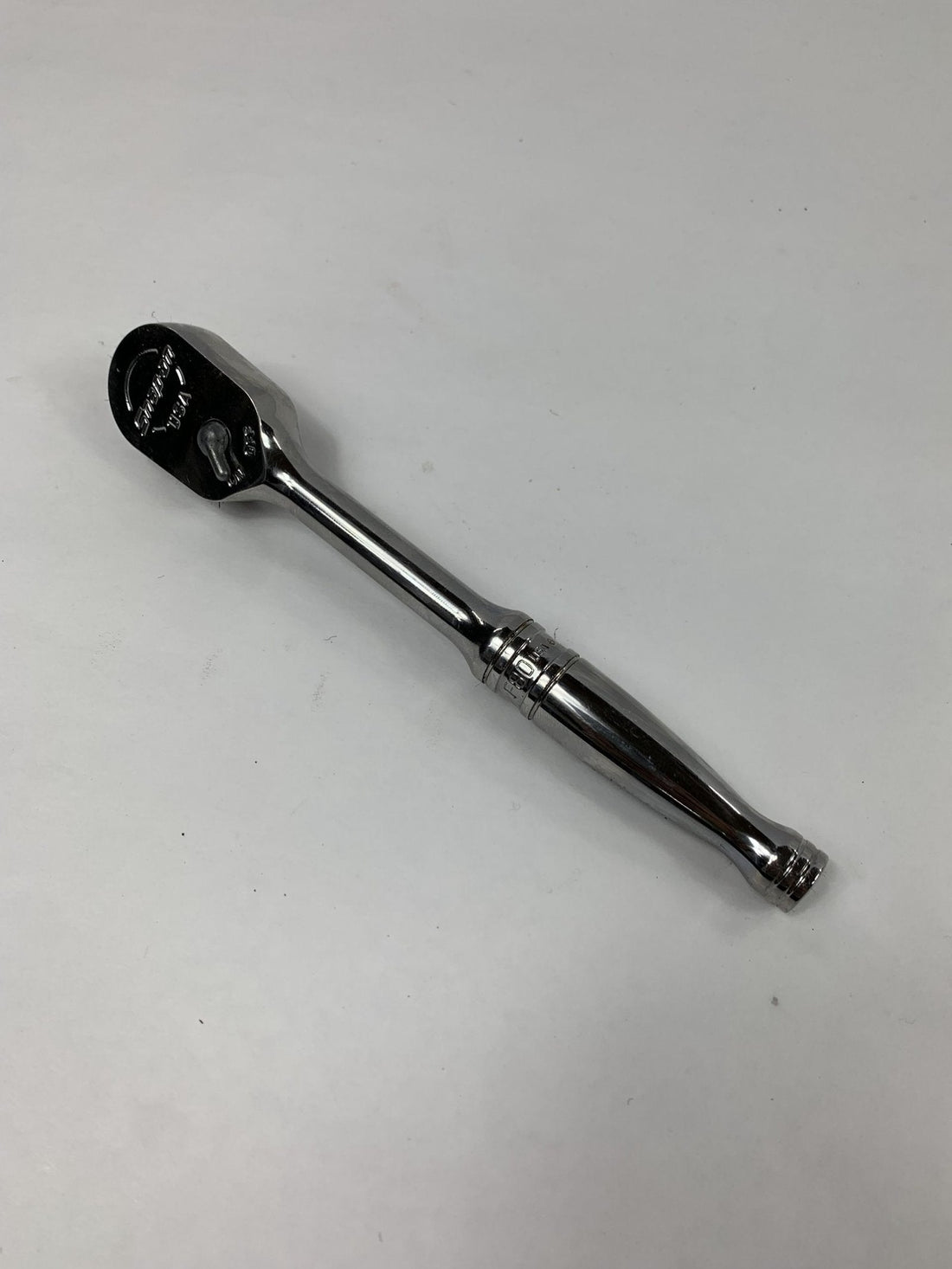
Proto vs Snap-On Ratchet: Which One's Actually Worth Buying?
For most buyers, the proto vs snap-on ratchet decision is straightforward: Proto is the smart money. You get a near-Snap-on ratchet — comparable mechanism, lifetime warranty, same ANSI-standard square drives — for roughly a third of the price. Snap-on earns its premium, but what it mostly buys you is truck-side service, rebuild-kit access, mirror-chrome finish, and resale value — not a tool that turns fasteners meaningfully better. Proto is Stanley Black & Decker's industrial MRO brand; Snap-on is its own independent company, sold exclusively through franchise dealer trucks. That distribution model drives every dollar of the price gap.
Here's how they actually compare.
Proto vs Snap-on Ratchet at a Glance
| Feature | Proto (J5449XL) | Snap-on (FHLD80) |
|---|---|---|
| Drive sizes | 1/4", 3/8", 1/2" | 1/4", 3/8", 1/2" |
| Mechanism positions | 45 | 80 (Dual 80) |
| Swing arc | see product page | 4.5° |
| Head style | Pear head | Dual 80 pear head |
| Finish | Chrome industrial | Mirror-chrome |
| Country of origin | Varies by SKU | USA (hand tools) |
| Warranty | Lifetime | Lifetime |
| Service path | Distributor / SBD | Dealer truck + rebuild kits |
| Street price (3/8") | ~$40–90 | $162.50 |
Who Makes Proto — and Who Makes Snap-on?
Proto is a Stanley Black & Decker brand — not the SBD consumer line. Proto is SBD's professional industrial and MRO (maintenance, repair, operations) tool brand, built for facility maintenance, distribution centers, and heavy manufacturing. Same parent company as DeWalt, but Proto lives in the industrial-distributor world, not the hardware-store aisle.
Snap-on is its own publicly traded company, structured around one of the more unusual distribution models in the tool business: franchise dealer trucks. Your local Snap-on dealer drives to shops on a weekly route, extends in-house credit, and handles warranty work on the spot. That relationship is part of the product.
Where you buy each matters. Proto ends up at Zoro, MSC Industrial, Grainger, and Fastenal — the same channels industrial shops already use. No dealer calling on you weekly, no soft upsell, but also no one coming to your bay when something needs warranty attention. For a lot of buyers, that trade is worth it.
How Does the Mechanism Compare? Tooth Count and Swing Arc
More teeth in a ratchet means a smaller swing arc — the minimum angle the handle has to travel before the ratchet engages the next tooth. In a tight engine bay or a recessed panel, that number is the difference between making progress and fighting the tool.
Snap-on's current flagship 3/8" mechanism is their Dual 80 Technology: 80 positions, 4.5° swing arc. Their older or lower-tier ratchets run 72-tooth, which comes out to roughly 5°. The Dual 80 is genuinely excellent in tight spots.
Proto's J5449XL uses a 45-tooth mechanism. Proto also makes higher-tooth-count "Duo" models — the current lineup is at protoindustrial.com by SKU, and specs vary.
Practically speaking: for most work — suspension, basic engine-bay jobs, general mechanical — a 72-tooth ratchet is fine. The difference between 72 and 80 positions shows up in genuinely confined fasteners and recessed bolts where your swing arc is under 10 degrees. Useful if that's your world. Not a reason to pay three times more if it isn't.
Price — What Snap-on's Premium Actually Costs You
A Snap-on 3/8" ratchet runs $162.50 at street price. A comparable Proto 3/8" — same drive size, lifetime warranty, quality mechanism — is available through industrial distributors for considerably less.
You could buy multiple Proto ratchets and a solid socket set for the price of one Snap-on.
The premium isn't arbitrary. Snap-on's tolerances are tight, the mirror-chrome finish is noticeably nicer, and the dealer infrastructure — trucks, credit terms, on-site service — costs real money to run. You're paying for that infrastructure whether you personally use it or not.
For a mobile flat-rate tech with a dealer on their route every week, that infrastructure has genuine value. For someone turning wrenches in their garage, or running a small independent shop, you're subsidizing a service that won't touch your business.
Warranty and Service — The Difference That Matters Most
Both Proto and Snap-on carry lifetime warranties on hand tools — though the specific terms and claim procedures vary, and it's worth reviewing each brand's warranty statement before purchase. The paper coverage is similar. The claim process is not.
Snap-on: The dealer comes to you. Broke a ratchet on a Tuesday? The truck's back by the following week, and you either get a replacement or the dealer sends it out for rebuild. Snap-on also sells rebuild kits for their ratchets — available at shop.snapon.com across TQ Series, QD Series, and Body Kits categories, with a full model-to-kit cross-reference in the official PDF — so a shop that maintains its own tools can. For flat-rate service where a broken tool costs billed hours, that speed matters.
Proto: Claims run through SBD's industrial distributor network. You're shipping the tool or dropping it at a Zoro or Grainger outlet. The warranty is real and gets honored — it just doesn't happen on-site. For a DIYer or small shop that can wait a few days, that's a non-issue. For a high-volume service bay, it's slower than a truck showing up.
Neither warranty is weak. The question is whether Snap-on's truck-side service model is worth the 2–3x price delta given how you actually work.
Will Your Sockets Fit Either One?
Yes — no compatibility issues. Both Proto and Snap-on use ANSI-standard square drives in 1/4", 3/8", and 1/2". A 3/8" socket fits any 3/8" drive ratchet, full stop — GearWrench, Tekton, Craftsman, Snap-on, Proto, all of them. The square-drive standard is universal across brands.
One thing to keep straight: standard hand-tool sockets are not rated for impact wrenches, regardless of brand. For anything going on a cordless or pneumatic impact, use impact-rated sockets (black-oxide finish, thicker walls, designed for shock loads). That applies whether you're running a Snap-on ratchet or a Proto.
So Which Should You Buy?
Weekend DIY and garage hobbyist: Proto. A quality ratchet with a lifetime warranty for $40–90 is a legitimate tool, not a compromise. The distributor warranty path works fine. Buy Proto, spend the difference on sockets.
Mobile tech or flat-rate shop pro: This is where Snap-on's argument is strongest. If you have a dealer relationship, you'll use the truck service, and downtime costs you billable labor — the premium is defensible. That said, a lot of professional mechanics run Proto and comparable tools every day without problems. This is a "does the service ecosystem have value to *you*" call, not a rite of passage.
Industrial and MRO buyer: Proto is almost certainly the right call. It's engineered for exactly this world, sold through the distributors your shop already works with, and the price lets you stock spares in the tool crib without a budget fight. The institutional distributor warranty path is exactly where Proto's service model performs best.
Frequently Asked Questions
Is Proto as good as Snap-on? For function and durability, they're close. Proto is SBD's professional-grade industrial brand — not a consumer tool. Snap-on's edge is finish quality, feel in the hand, and the dealer-service ecosystem. As a ratchet that turns fasteners reliably, Proto is very competitive.
Who makes Proto tools? Stanley Black & Decker. Proto is SBD's professional industrial and MRO hand-tool brand, separate from their consumer and contractor lines.
Are Proto ratchets made in the USA? Many Proto hand tools are US-made, but it varies by SKU. Country of origin is listed on the individual product page at protoindustrial.com and on the packaging. Check the specific model you're buying before placing your order.
Is a Snap-on ratchet worth the money? If you have a dealer relationship, use the truck-side service and rebuild-kit access, and care about top-tier finish or resale value — yes, there's a real case. If you just need a quality ratchet that'll hold up for years, Proto gets you there for a lot less.
Does Proto have a lifetime warranty? Yes — Proto hand tools carry a lifetime warranty; the full terms and claim process are detailed at protoindustrial.com. Claims go through SBD's industrial distributor network, not a dealer truck.
Can you use Snap-on sockets on a Proto ratchet? Yes, without any adapter. Both use ANSI-standard square drives. A 3/8" socket is a 3/8" socket — Snap-on, Proto, GearWrench, Tekton, all cross-compatible by drive size.
Where can I buy Proto tools? Industrial distributors: Zoro, MSC Industrial, Grainger, Fastenal. Also direct at protoindustrial.com. Proto is not stocked at most retail hardware chains, and there's no dealer truck — you're ordering online or through a distributor.
If GearWrench is also in the conversation — and at Proto's price point it should be — how Snap-on vs. GearWrench ratchets compare covers how Snap-on stacks up against GearWrench's 120XP directly. For the full ratchet-comparison picture, the Milwaukee vs. GearWrench breakdown rounds out the set. Once you've picked a ratchet, our 6-point vs. 12-point socket guide is worth a few minutes — it's the one socket-spec decision that actually affects whether you round fasteners on an old rusted bolt.