
Klein vs IDEAL Wire Strippers: Which One Actually Belongs in Your Pouch
Klein vs IDEAL wire strippers — pick the tool type before the brand. For everyday NM-B and THHN work, Klein's Klein-Kurve (11061) and IDEAL's Reflex Super T-Stripper (45-616) are the two manual combos worth weighing — Klein wins on the built-in cut/loop/crimp jaws, IDEAL on a cleaner, lower-effort strip. For high-volume repetitive stripping, Klein's Katapult (11063W) and IDEAL's Stripmaster (45-092) are the pair to compare. Match the tool's AWG range to the wire you cut most, then decide. Everything below is organized by that choice.
The Short Answer: Which Stripper for Which Electrician
Best all-round manual combo
Klein 11061 if you want one tool that strips, cuts, loops, and crimps. IDEAL 45-616 if strip cleanliness and spring-loaded return matter more than the extras.
Best fast/self-adjusting
IDEAL 45-092 Stripmaster for straight repetitive pulls where speed is everything. Klein 11063W Katapult if you need self-adjusting with a wider gauge spread and don't mind a little more force.
Best for tight AWG-range specialists (data/low-voltage)
Neither of the above — you want a dedicated data-cable or low-voltage stripper whose gauge range is tuned to 22–28 AWG. Both brands make them; that's a different post.
Match the Stripper to Your Wire First
Before brand loyalty enters the picture, nail down what wire you actually cut. The spec tables mean nothing if the tool's AWG range misses your bread-and-butter conductor.
What gauges you actually cut — NM-B vs THHN vs low-voltage/data
Residential electricians running NM-B (Romex) work mostly in 14, 12, and 10 AWG solid copper — confirmed conductor gauges per Southwire NM-B specs and NEC ampacity tables. That's the center of the range for every model in this comparison.
THHN in conduit adds stranded wire to the mix. Not all stripper models rate stranded and solid the same way — the Klein 11061, for instance, lists separate solid and stranded ranges. If you pull commercial THHN all day, confirm the stranded range fits before buying.
Low-voltage and data work (CAT6, alarm wire, speaker cable, coax) usually runs 22–26 AWG. None of the four models in this comparison are optimized for that range. Use the right tool.
Solid vs stranded — why it changes the tool that works
Solid copper is stiffer and holds its dimension precisely. Most fixed-notch manual strippers (Klein-Kurve, IDEAL T-Stripper) cut solid cleanly in their rated notches.
Stranded wire compresses under the blade. Too aggressive a notch nicks or severs strands. Too loose and the insulation doesn't release cleanly. A manual stripper with a rated stranded range has slightly wider notches for the same AWG to account for this. Self-adjusting and automatic tools clamp to the insulation OD rather than the conductor, which generally handles stranded better — but at a higher price.
AWG compatibility at a glance
| Model | Type | Solid AWG range | Stranded AWG range |
|---|---|---|---|
| Klein 11061 (Klein-Kurve) | Manual combo | 10–20 AWG | 12–22 AWG |
| Klein 11063W (Katapult) | Self-adjusting | 8–20 AWG | 10–22 AWG |
| Klein 11045 | Manual combo | 10–18 AWG | Not rated (solid only) |
| Klein 11055 | Manual | 10–18 AWG | 12–20 AWG |
| IDEAL 45-616 (Reflex Super T) | Spring-return manual | Covers residential NM-B/THHN gauges | — |
| IDEAL 45-092 (Stripmaster) | Automatic | 10–22 AWG | 10–22 AWG |
| IDEAL 45-120 (T-Stripper) | Manual | 10–18 AWG | 12–20 AWG |
Klein's Wire-Stripper Lineup, Honestly
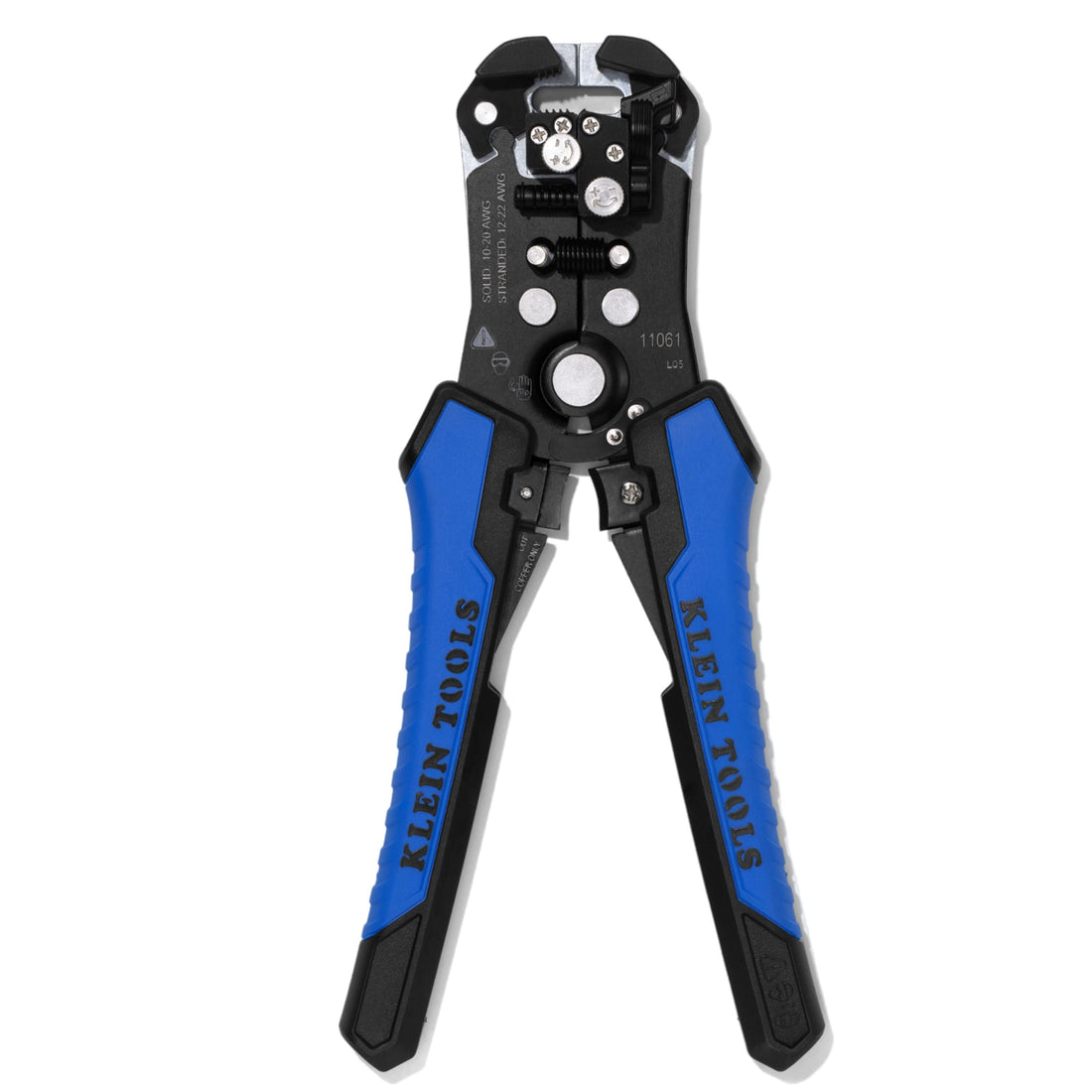
Klein-Kurve 11061
This is Klein's signature wire stripper — the one that's been in residential pouches for decades. The heavy hitter is everything it packs onto one tool: stripping notches for solid and stranded wire, a wire-cutter section, a bolt-shear hole, looping holes sized for hook-and-eye screws, and a crimper for non-insulated connectors.
The Klein-Kurve handle (that ergonomic teardrop shape) is legitimately more comfortable than straight-handled strippers during a long day. The handles are plastic with TPE overmold and grooved grips — not the branded Cushion-Grip™ found on other Klein models, but effective for all-day use.
The strip action itself requires a deliberate squeeze-and-pull. It's not the lightest tool to operate, especially repetitively. But for a journeyman running varied tasks — strip, cut, loop for a switch leg, crimp a ring terminal — the 11061 does it all without reaching for a second tool.
Klein Katapult 11063W

Self-adjusting stripper. Squeeze the handles and the jaws automatically find the right notch for whatever conductor you're holding — solid or stranded. No picking a notch manually.
The Katapult's sweet spot is residential rough-in where you're moving fast across a range of gauges. Its AWG self-adjusting range — 8–20 AWG for solid wire and 10–22 AWG for stranded — is wide enough to handle NM-B work without resetting. The jaws can occasionally slip on very fine stranded conductors at the edges of the range — that's a real-world limitation, not a flaw, just the physics of a self-adjusting mechanism.
Klein 11045 and 11055
The 11045 is the stripped-down version of the 11061 — fewer extras, lower price. It covers 10–18 AWG solid with fixed notches — solid only, no stranded rating, and a narrower reach than the 11061's 10–20 AWG solid and 12–22 AWG stranded. Good call if you already carry a dedicated crimper and don't need the loop holes.
The 11055 covers solid 10–18 AWG and stranded 12–20 AWG, and is worth checking if you need stranded capability in that gauge window or regularly work finer gauges than 12/14 AWG.
IDEAL's Wire-Stripper Lineup, Honestly
Reflex Super T-Stripper 45-616
IDEAL's answer to the Klein-Kurve class. The Reflex name refers to the spring-loaded handle — release the squeeze and it opens automatically, which matters at the end of a three-hour stripping session.
What the 45-616 does better than the Klein-Kurve: the strip is noticeably cleaner. The notch geometry and blade quality leave less of a nick in the conductor insulation stub and a cleaner cut edge. On THHN you can feel the difference. The 45-616 is also designed to deliver consistent strip lengths — a real advantage in terminal work where uniform conductor exposure matters.
What it doesn't have: no looping holes, no bolt-shear hole, no crimper. It's a stripper, with a cutter. If you need those combo features, the 45-616 isn't your all-in-one.
Stripmaster 45-092
This is IDEAL's automatic stripper — single pull, done. You set the strip length, insert the wire, pull, and the insulation is off. On a production panel or in a conduit run where you're stripping 50+ conductors, the Stripmaster is meaningfully faster than any manual tool.
The 45-092 handles 10–22 AWG in both solid and stranded wire. Like all automatics, gauge changes require adjustment. If you're jumping between 12 and 10 AWG frequently, that adjustment time eats into the speed advantage. For single-gauge production runs: nothing's faster.
IDEAL 45-120 T-Stripper
The base-level T-Stripper. No spring return (unlike the Reflex 45-616), no extras. It covers 10–18 AWG solid and 12–20 AWG stranded wire. This is the budget entry point into the IDEAL lineup — worth considering if you're outfitting an apprentice or want a dedicated backup.
Head-to-Head: Klein-Kurve 11061 vs IDEAL Reflex T (The Manual-Combo Fight)
Strip quality and effort
Give the edge here to IDEAL. The 45-616's blade leaves a cleaner strip on both solid NM-B and stranded THHN. The spring return reduces fatigue on high-rep days. Klein's 11061 strips acceptably well — not sloppy — but requires a bit more deliberate squeeze.
If your standard is "strip it clean and move on," both tools pass. If you're stripping 200 conductors in a pull and your hand is complaining by noon, the IDEAL's spring return matters.
Cut/loop/crimp extras
Klein wins this decisively. The 11061 has the looping holes, bolt-shear, and crimper. The 45-616 does not. If you use a single tool for all three tasks — common on service work and residential panels — Klein is the choice.
Durability and feel
Both are professional-grade. Klein's Klein-Kurve handle is broadly considered more ergonomic for large hands. IDEAL's handle is slimmer, preferred by some for precision control. Both have good reputations for jaw longevity in professional service — no credible evidence one wears faster than the other. Both are backed by a lifetime warranty for the normal life of the product.
Verdict, manual-combo fight: Klein 11061 for varied-task work. IDEAL 45-616 for strip-focused volume work with a dedicated crimper elsewhere on your belt.
Head-to-Head: Klein Katapult vs IDEAL Stripmaster (The Fast Fight)
Speed and repeatability
IDEAL Stripmaster wins on raw per-strip speed — the automatic one-pull mechanism is faster than the Katapult's squeeze-and-pull for a single steady gauge. On a uniform NM-B rough-in where every wire is 12 AWG, the Stripmaster is the faster tool.
The Katapult is faster when the gauge varies — no manual adjustment needed between pulls. Switch between 12 and 14 AWG and the Katapult adapts automatically; the Stripmaster needs a reset.
Gauge-change hassle
Katapult: none. Self-adjusting within its rated range — grab and strip.
Stripmaster: requires resetting the adjustment wheel. Takes seconds, but adds up across a day of mixed gauges.
Where each frustrates
The Katapult can fumble the strip if you don't maintain steady pressure through the full pull — partial strips are the main complaint. The Stripmaster will occasionally slip on unusually stiff insulation or wire at the edges of its range.
Verdict, fast fight: Stripmaster for single-gauge production. Katapult for varied gauges at pace.
Price, Warranty, and Where They're Made
Street prices across both brands range from entry-level at the manual end (11045, 45-120) to significantly higher for the self-adjusting and automatic models (Katapult, Stripmaster). Check current pricing at your preferred supplier before buying — it varies by channel and shifts seasonally.
Country of origin matters to a lot of pros. Both brands include U.S.-made models in their lineup, but manufacturing location varies by SKU — verify the specific catalog number on the manufacturer's product page before buying.
Both brands back their strippers with lifetime warranties — Klein's covering the normal life of the product under normal use, IDEAL's a straight lifetime warranty.
Our Pick by Job
| Job type | Recommended |
|---|---|
| Residential rough-in (varied gauges, NM-B, one tool) | Klein 11061 Klein-Kurve |
| Residential rough-in (high volume, single gauge) | IDEAL 45-092 Stripmaster |
| Commercial THHN in conduit, clean strips | IDEAL 45-616 Reflex T |
| Mixed commercial/service with varied gauge jumps | Klein 11063W Katapult |
| Low-voltage / data (22–28 AWG) | Neither — get a dedicated low-voltage stripper |
| DIYer who wants one wire stripper forever | Klein 11061 (the extras earn their keep) |
Frequently Asked Questions
Are Klein or IDEAL wire strippers better? Neither wins outright. Klein leads on all-in-one combo features (cut, loop, crimp). IDEAL leads on strip cleanliness and the Reflex spring return. Pick by the wire gauge you cut most and the volume you work — then use the AWG table in the compatibility section above.
What's the difference between the Klein Katapult and IDEAL Stripmaster? Both handle a range of gauges without manual notch selection, but through different mechanisms. The Katapult self-adjusts to whatever wire you insert with no adjustment needed between gauges. The Stripmaster is a true automatic (one-pull mechanism) but requires resetting when you switch wire size. Katapult wins on gauge flexibility; Stripmaster wins on single-gauge speed. Confirm both tools' AWG ranges in the compatibility table before buying.
Do I want manual, self-adjusting, or automatic wire strippers? Manual combo (Klein-Kurve, IDEAL Reflex T) for varied gauges and when you need cut/loop/crimp tasks on the same tool. Self-adjusting (Katapult) for varied gauges at pace, no manual setup. Automatic (Stripmaster) for high-volume repetitive pulls at a steady gauge. Price steps up in that order, too.
Are Klein and IDEAL wire strippers made in the USA? Both brands manufacture some models in the U.S., but manufacturing location varies within each lineup — verify the specific catalog number rather than assuming. Don't rely on a retailer listing — check the manufacturer product page directly.
Which wire stripper is best for Romex (NM-B)? Any model whose AWG range covers 14, 12, and 10 AWG *solid* copper — the three conductor gauges you'll find in residential NM-B. Both the Klein 11061 and IDEAL 45-616 are designed for this range; confirm the exact bounds from the compatibility table before buying.
Will these strip stranded THHN cleanly? Check the model's stranded AWG rating specifically — some models list solid and stranded ranges separately. The Klein 11061 is one example: it strips solid 10–20 AWG but rates stranded at 12–22 AWG. The IDEAL 45-616 and Stripmaster 45-092 are both commonly used on THHN, but confirm the stranded range covers your conductor before the first pull.
If you're still working out which wire stripper belongs in your pouch, the complete wire stripper guide hub post covers the broader category — every tool type from fixed-notch to automatic, including options beyond these two brands.