
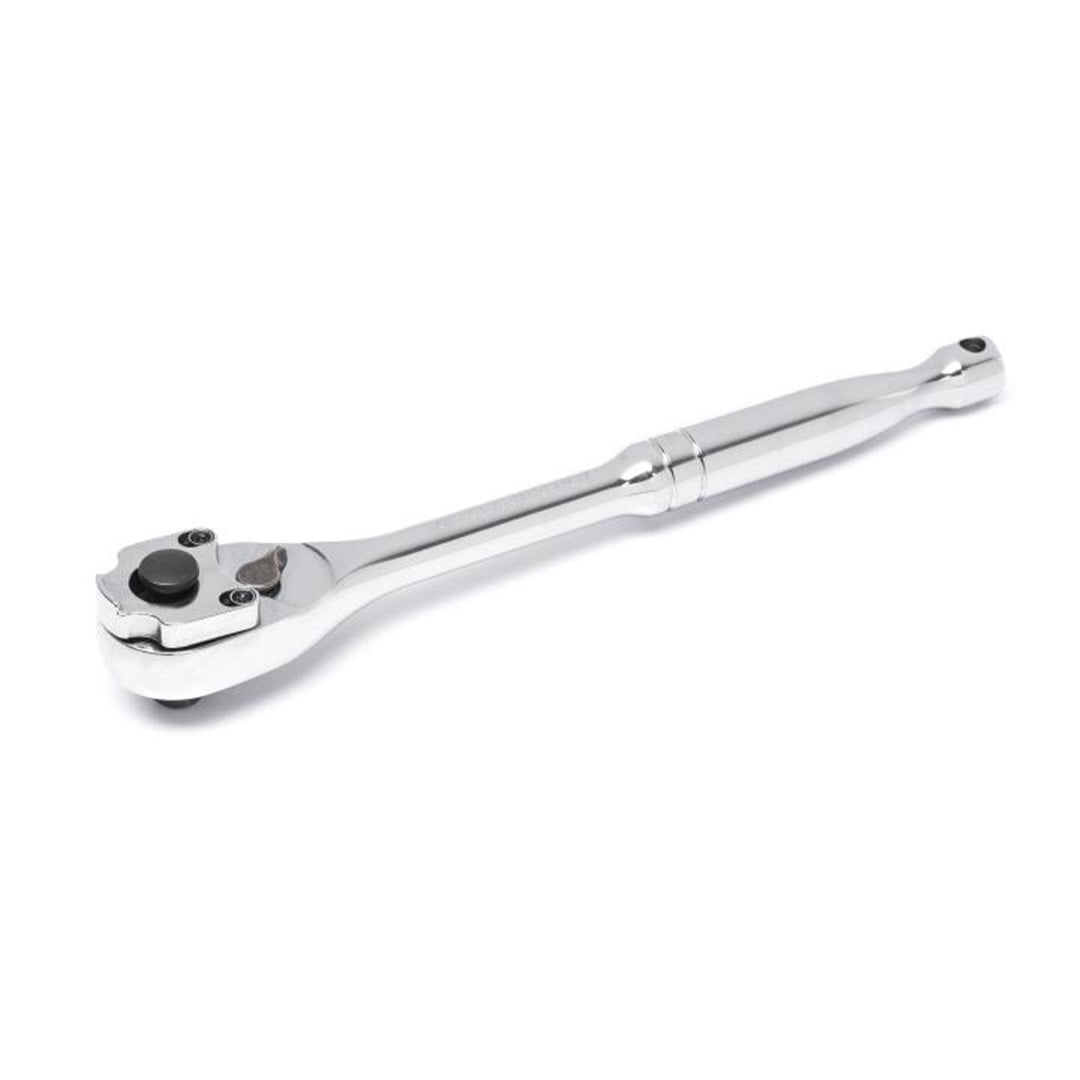
Snap-on vs GearWrench Ratchet: Which One's Actually Worth It
The Snap-on vs GearWrench ratchet question comes down to this: GearWrench gives you 90% of the on-tool performance for a fraction of the price. Snap-on earns its premium on fit, finish, serviceability, and truck-side warranty — and that math only holds if you're turning wrenches for a living. Compatibility note first: both brands run standard 1/4", 3/8", and 1/2" square drives. Your existing sockets fit either ratchet without adapters. This is a ratchet decision, not a socket decision.
Who Should Buy Which Ratchet?
Weekend DIYer / homeowner: Buy GearWrench. The 120XP at around $40 handles everything you'll encounter, and the lifetime warranty is real.
Side-gig or hobby mechanic (5–15 hours/week): Still GearWrench, most likely — unless daily tight-clearance work is pushing you toward a lower head profile.
Full-time flat-rate mechanic: Snap-on is worth the conversation. Truck-side warranty, tighter tolerances, and rebuild-on-the-spot serviceability make sense when the tool is in your hand eight hours a day.
Snap-on vs GearWrench at a Glance
| Snap-on Dual 80 | GearWrench 120XP | GearWrench Standard | |
|---|---|---|---|
| Tooth count | 80 | 120 | 84 |
| Arc swing per click | 4.5° | 3° | ~4.3° |
| Drive sizes | 1/4", 3/8", 1/2" | 1/4", 3/8", 1/2" | 1/4", 3/8", 1/2" |
| Made in | USA | Taiwan | Taiwan |
| Warranty | Lifetime, dealer truck | Lifetime, mail-in | Lifetime, mail-in |
| Approx. street price (3/8") | $175–$230 | $35–$55 | $25–$40 |
*Country of origin varies by SKU — confirm at manufacturer sites before purchase. Street prices are approximate and change frequently.*
Tooth Count and Arc Swing, Explained
What "80-tooth" vs "120-tooth" actually means
The math is simple. Divide 360 by the tooth count and you get the degrees of swing needed per click:
- 84-tooth: 360 ÷ 84 = ~4.3°
- 80-tooth: 360 ÷ 80 = 4.5°
- 120-tooth: 360 ÷ 120 = 3.0°
That 1–1.5° difference sounds like nothing. It isn't. When you're three inches from a firewall with no room to back the ratchet up, smaller swing arc is the difference between reaching a fastener and not.
Both the Snap-on Dual 80 and the GearWrench 120XP achieve their fine arc through a dual-pawl mechanism — two pawl sets engaging simultaneously, effectively halving the minimum movement needed to catch the next tooth. The "Dual" in Snap-on's name refers to exactly that.
When high tooth count matters — and when it doesn't
High tooth count earns its keep in confined work: underdash electrical, deep engine bays, exhaust systems, anything where swing clearance is measured in degrees. In those spots, 3° vs 4.5° is the difference between reaching a fastener and starting to disassemble the vehicle.
For open work — wheel bolts, benchtop assembly, most DIY tasks — you'd be hard-pressed to feel the difference between 84-tooth and 120-tooth. A 72-tooth ratchet gets the job done in 95% of situations. The premium for 120 teeth is about the other 5%.
Build, Feel, and Serviceability
Rebuild kits — can you fix it, or do you replace it?
This is the real gap between the brands.
Snap-on ratchets are built to be serviced. The head disassembles with the right tools; replacement springs, pawls, and rings are stocked by Snap-on dealers. A franchisee with a truck full of parts can rebuild your ratchet the same day. For a mechanic using the tool daily, that matters more than the initial price.
GearWrench ratchets are designed more for replacement than rebuild — repair kits exist for some models, but the brand's approach at this price point is: when it fails, the replacement cost is low enough that you're not out much. For a DIYer buying one ratchet every several years, that's a perfectly reasonable trade-off.
Sealed vs serviceable heads
Snap-on's low-profile sealed heads are built to tighter tolerances — less slop in the drive, a lower-profile knuckle that clears obstacles the GearWrench head won't. The polished finish is also more durable in abrasive environments.
GearWrench's ergonomic rubber grip has a genuine comfort advantage for extended sessions. If you're loosening 200 bolts in a day, a rubberized handle is easier on the palm than polished steel.
Price and Where They're Made
Snap-on 3/8" flagship ratchets run roughly $175–$230. GearWrench 120XP 3/8" drive sits around $35–$55. That's a 4–6× gap for comparable dual-pawl geometry.
Snap-on manufactures its ratchets in the USA for most models. GearWrench ratchets are typically made in Taiwan. Neither country-of-origin is a knock — USA manufacturing carries real labor and tooling costs that justify a price premium; Taiwan precision manufacturing at this quality level is legitimate and consistent.
The honest assessment: both are worth what they cost. Snap-on isn't overpriced — it's priced for a buyer who uses it professionally. GearWrench isn't cheap — it's efficient.
Warranty Reality — How Do You Actually Make a Claim?
Both brands offer lifetime warranties. The process is completely different.
Snap-on: You hand the broken tool to the franchisee when his truck comes around. Same-day replacement or on-site rebuild. No shipping, no wait, no being down a ratchet for a week. For a flat-rate mechanic, this is an actual financial benefit — time off the clock waiting for a warranty replacement has real cost.
GearWrench: Claims go through the retailer (if purchased recently) or via mail-in to Apex Tool Group. The warranty is honored and the process works — but you're shipping the tool out and waiting. For a DIYer, that's a minor inconvenience. For a professional, it's a week without a tool.
Do the Sockets Interchange?
Completely. Standard SAE square drives — 1/4", 3/8", 1/2" — are universal. Snap-on sockets fit a GearWrench ratchet. GearWrench sockets fit a Snap-on ratchet. Craftsman, Tekton, Husky, Proto, SK, Matco — all the same square-drive standard.
You can mix brands freely. If you already have quality sockets, the ratchet decision is independent of them. See how different socket styles compare for guidance on socket selection that applies regardless of which ratchet you're using.
One reminder that belongs here: ratchets are for loosening and tightening, not for final torque values. Don't use a ratchet to torque critical fasteners — see the guide on using torque wrenches for the breakdown on when each tool applies.
FAQ
Is Snap-on worth the money over GearWrench?
For a full-time mechanic, often yes — serviceability, dealer-truck warranty, and tighter tolerances pay off daily. For DIY or occasional use, GearWrench delivers nearly identical on-tool performance at a fraction of the price.
Are GearWrench ratchets any good?
Yes. The 120XP is a legitimate professional-grade tool — 120-tooth dual-pawl design, 3° arc swing, lifetime warranty. It doesn't try to be Snap-on; it tries to be excellent value, and it is. If you're also weighing Wera, see how Wera and GearWrench stack up for a direct head-to-head.
What's the difference between 84-tooth and 120-tooth?
Tooth count sets the minimum swing arc to engage the next tooth. At 84 teeth, you need ~4.3° of movement per click; at 120 teeth, that drops to 3°. In tight spaces, smaller arc means you can ratchet where others can't.
Do Snap-on and GearWrench sockets interchange?
Yes — standard 1/4", 3/8", and 1/2" square drives are universal across all major brands. Sockets swap freely.
Where are Snap-on and GearWrench ratchets made?
Snap-on ratchets are made in the USA, though country of origin can vary by model — verify on the specific product page before purchase. GearWrench ratchets are typically made in Taiwan, though this too can vary by SKU.
Does GearWrench have a lifetime warranty?
Yes. GearWrench offers a lifetime warranty on hand tools, with claims submitted directly to Apex Tool Group through a photo-based process — no retailer exchange or tool mail-in required.
Can you rebuild a Snap-on or GearWrench ratchet?
Snap-on ratchets are designed for serviceability — repair kits are available for most models per Snap-on's official cross-reference, with no kits available for the 71M, G71M, GS71, S71, or UR71. GearWrench repair kits are available by model, though live inventory isn't listed online — contact support to confirm availability for your specific ratchet — but at the price point, replacement is the more common path.
What tooth count is best for a ratchet?
Higher is better in tight spaces, but 72–84 tooth covers most DIY and general automotive work. Step up to 120-tooth if daily tight-clearance work is your reality. There's a theoretical trade-off at very high tooth counts (finer teeth = smaller pawl contact area), but 120T is an established design with a proven track record.
Bottom Line
GearWrench is the right call for most people. At $35–$55 for a 120XP 3/8" drive, you're getting a genuine high-performance ratchet with a fine arc swing, a lifetime warranty, and a price that doesn't sting if you eventually upgrade.
Snap-on makes sense when the tool is in your hand every working day and the truck-side warranty is an actual part of how you operate. It's not overpriced — it's built for a specific buyer. If that buyer isn't you right now, GearWrench is the honest recommendation.
For more GearWrench comparisons: combination wrench options runs through GearWrench vs Tekton on combination wrenches, while Milwaukee also offers cordless alternatives to consider. For a full picture of how Snap-on and GearWrench value plays out across a socket set build, Wera's approach adds a third option to the mix.