
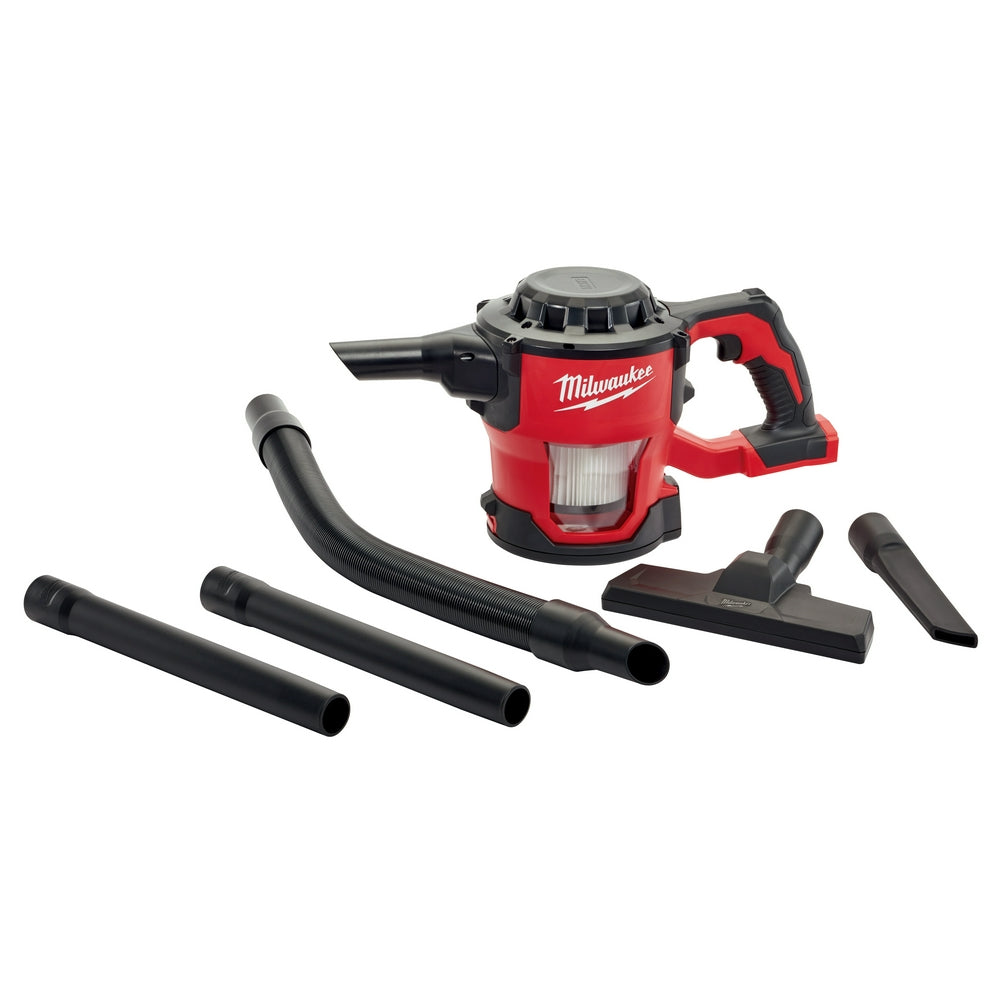
Milwaukee M18 Vacuum HEPA Filter Compatibility: Which Filter Fits Your Model
Not all Milwaukee M18 vacuums share the same HEPA filter compatibility — the compact and wet/dry models use completely different SKUs. Match your model number to the table below before you order anything. That number is on a label on the vacuum body itself, not on the battery and not on the kit box.
| Vacuum Model | OEM Pleated Filter | OEM HEPA Filter | HEPA Available? |
|---|---|---|---|
| M18 FUEL Compact Vacuum (2880-20) | 49-90-1950 | 49-90-2012 | Yes |
| M18 FUEL Wet/Dry Vacuum | 49-90-1978 | 49-90-1900 | Yes |
| M18 Compact Vacuum (legacy 0880-20) | Check milwaukeetool.com | 49-90-1900 | Yes |
Where Is the Model Number on Your Milwaukee M18 Vacuum?
The kit SKU on the box is not the number you need. The model number for filter compatibility is on a label affixed to the vacuum body — typically on the rear of the housing near the motor head or on the bottom. They're not always the same number.
This matters because Milwaukee has changed housing geometry between generations. A filter that seats and seals in a current-gen 2880-20 may not seal correctly in a legacy 0880-20 housing, even if both go by "M18 compact vacuum."
M18 FUEL Compact Vacuum (0882-20 / 2880-20 Series)
These are Milwaukee's current-generation compact M18 vacuums. Both a standard pleated filter and a HEPA-rated upgrade filter are available as separate SKUs — the HEPA filter is a separate purchase and does not ship in the base kit.
If your body label shows a model number not listed in the table above, verify filter compatibility on the Accessories tab at milwaukeetool.com before ordering — filter SKUs can vary between production runs in this series.
M18 FUEL Wet/Dry Vacuum

The M18 wet/dry uses a completely different filter geometry. The housing is larger, and the part numbers do not cross with the compact series at all.
For this series, the OEM pleated filter (49-90-1978) and HEPA filter (49-90-1900) are listed on milwaukeetool.com — confirm your specific body-label model number on the Accessories tab before ordering.
Tank capacity for this model depends on your specific configuration — check the Specifications tab on milwaukeetool.com for exact figures.
Older M18 Compact Models (0880-20 and Earlier)
If you have a first-generation M18 compact vacuum, the housing geometry may have changed enough that the current HEPA filter SKU doesn't seal correctly.
HEPA filter SKU 49-90-1900 (Wet/Dry Vacuum HEPA Replacement Filter) is confirmed compatible with the 0880-20 on the manufacturer product page, giving this legacy model a direct upgrade path to HEPA filtration.
OEM Filter vs. Aftermarket — The Seal Problem
This is the part that matters most when you're vacuuming drywall dust, silica, or anything that can hurt you.
A filter that slides into the bayonet mount is not the same as a filter that seals. The HEPA rating only applies when the filter media creates an airtight gasket contact around its full perimeter. Any gap — even a narrow one — means fine particles bypass the media, pass through the motor, and recirculate back into your breathing zone. The label says HEPA. Your lungs disagree.
How to check an aftermarket filter: Seat it fully, rotate it to lock, then run your fingers around the entire perimeter where the filter meets the housing. No visible gap, no flex, no light. If you can see or feel any bypass at all, that filter is not doing HEPA work.
Aftermarket is acceptable for:
- General construction cleanup — wood chips, coarse debris, loose concrete fragments
- Sawdust from cutting softwood or hardwood (no silica risk)
- Low-dust tasks where the filter's main job is protecting the motor, not your lungs
OEM is non-negotiable for:
- Crystalline silica (concrete grinding, masonry cutting, tile work)
- Drywall joint compound and fine sanding dust
- Lead paint or mold remediation
The price gap between an OEM HEPA filter and a cheap aftermarket one is not worth a lung load of crystalline silica. That's the honest trade-off.
What HEPA Actually Means (and What Milwaukee's Marketing Says)
HEPA is a U.S. EPA-defined filtration standard: 99.97% particle capture at 0.3 microns. That's the threshold where the most penetrating particle size is tested. It's a regulatory term, not a brand label — any filter claiming HEPA has to meet that number.
"Fine dust rated" is different. Milwaukee uses both terms on vacuum accessories. A fine-dust-rated pleated filter is a step up from a basic pleated filter, but it does not meet the HEPA standard. Don't confuse the two.
The other thing that gets missed: HEPA is a system rating, not just a filter rating. The vacuum housing has to form a sealed air path — all intake air must pass through the filter media with no bypass around the gasket or through housing gaps — for the HEPA rating to apply in actual use. An OEM filter in a properly sealed housing achieves that. An aftermarket filter with a questionable gasket does not.
| Filter Type | Rated For | Use When |
|---|---|---|
| Standard pleated | Larger debris, general jobsite dust | Motor protection, coarse cleanup |
| Fine-dust-rated pleated | Finer particles than standard | Light drywall sanding, general dust |
| OEM HEPA | 99.97% at 0.3 microns | Silica, drywall compound, concrete, OSHA-regulated work |
When to Replace Your Milwaukee M18 Vacuum Filter — and How
Signs it's time:
- Suction drops noticeably at a full battery charge — if the vacuum runs sluggish even on a fresh pack, rule out the battery before blaming the filter; see battery troubleshooting
- Pleats are visibly clogged or collapsed
- Tears, holes, or crushed sections in the filter media
Replacement interval: Milwaukee specifies the replacement interval in the user manual for each model — download it from the Documentation tab on milwaukeetool.com and follow the schedule for your specific vacuum.
Tap-cleaning a standard pleated filter: Acceptable field maintenance. Tap the filter firmly against the inside of a trash can — not your leg, not the ground. Knock out the loose material, reseat, and get back to work. It extends the filter's life; it's not a substitute for replacement.
Never tap-clean or wash a HEPA filter. The filtration media is electrostatically charged micro-fiber. Water destroys that charge. Tapping can crack the media and create pinhole bypasses that are invisible to the eye but completely defeat the HEPA rating. A clogged HEPA filter gets replaced — no exceptions.
If the M18 vacuum sees regular HEPA-level work — drywall, concrete, tile — budget for filter replacement as a recurring consumable from the start.
Frequently Asked Questions
What HEPA filter fits the Milwaukee M18 compact vacuum?
The OEM HEPA filter for the Milwaukee M18 compact vacuum is part number 49-90-2012. Confirm the match on the Accessories tab at milwaukeetool.com using your body-label model number before ordering.
Is the Milwaukee M18 vacuum HEPA certified?
Some M18 vacuum models can achieve HEPA-rated filtration when fitted with the correct OEM HEPA filter — but most ship from the factory with a standard pleated filter. Check whether your specific model's Accessories tab lists a genuine HEPA-rated SKU. "HEPA-capable" and "HEPA-certified" are not the same thing.
Can I use an aftermarket HEPA filter in my Milwaukee M18 vacuum?
Many will fit the bayonet mount physically. The risk is the gasket seal — see the section above. For general debris and sawdust, an aftermarket filter is a reasonable call. For silica, drywall compound, or any OSHA-regulated dust environment: use OEM only.
Does the Milwaukee M18 vacuum come with a HEPA filter?
Most M18 vacuum kits include a standard pleated filter. A HEPA filter is a separate purchase — check the "What's in the Box" section on each model's product page at milwaukeetool.com to confirm exactly what ships with your specific kit.
Are Milwaukee M18 vacuum filters interchangeable between compact and wet/dry models?
No. The compact and wet/dry vacuums use different filter geometries and different part numbers. A compact filter will not seat or seal correctly in a wet/dry housing. Always match the part number to your exact model number.
How often should I replace my Milwaukee M18 vacuum HEPA filter?
Milwaukee documents the recommended replacement interval in the user manual for your specific model — download it from the Documentation tab on milwaukeetool.com. As a general field guide: inspect after every 10–15 hours of heavy fine-dust use. Replace when suction drops noticeably on a full battery charge, or when you see any damage to the media.
Can I wash my Milwaukee M18 HEPA filter?
No. Washing destroys the electrostatic micro-fiber media and voids the HEPA rating. Tap-cleaning can crack the media and create bypasses you can't see. Standard pleated filters can be tapped clean in the field — HEPA filters cannot. When it's clogged, replace it.
If you're cutting concrete, grinding masonry, or pulling drywall dust with an M18 vacuum, the OEM HEPA filter is the only correct answer. The sealed gasket design is what makes it HEPA in use — not just on the label. Find your model number on the vacuum body, match it to the table above, and get the right SKU before your next pour.
For more on what the M18 platform designation actually means across tools and accessories, what M18 FUEL means covers the FUEL lineup in detail. For M18 charger compatibility in the same vein, charger compatibility guide runs the same model-matching treatment on the charging side.
Browse the full Milwaukee M18 accessory lineup → Milwaukee M18 accessories