
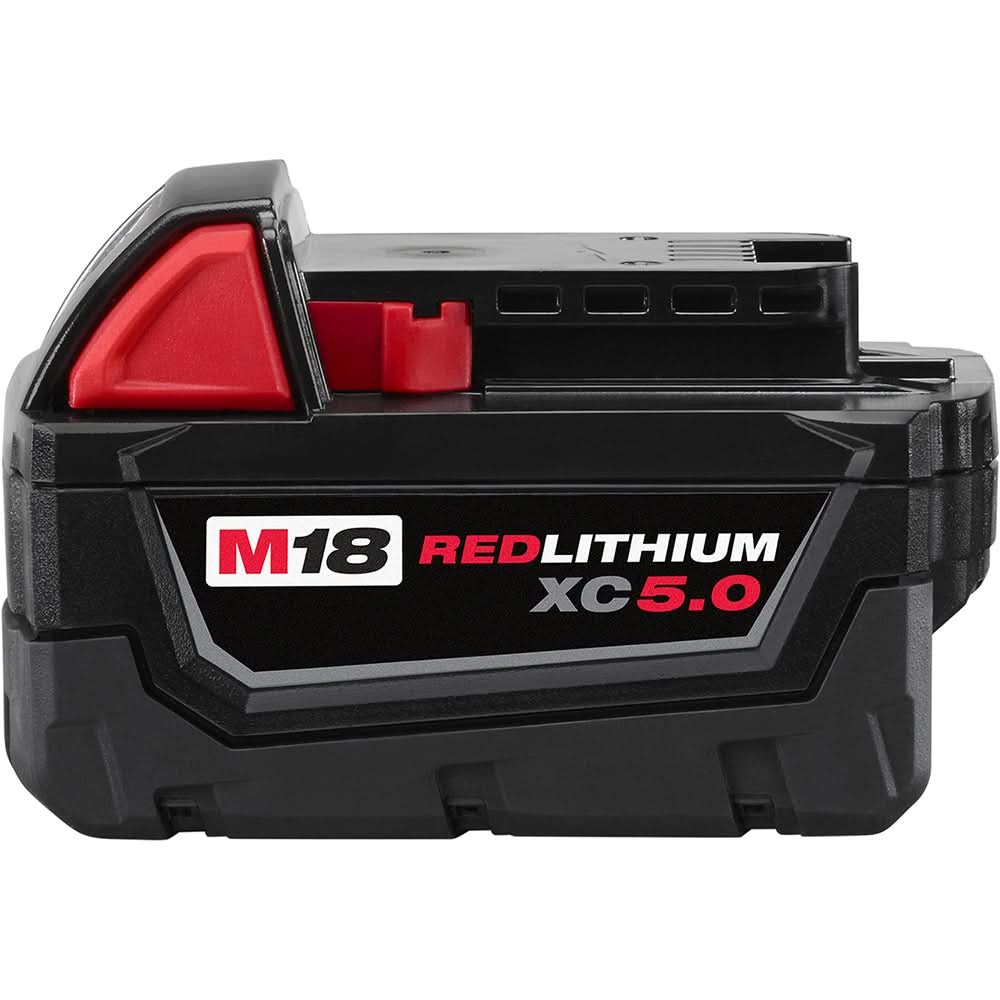
How to Spot a Fake Milwaukee M18 Battery (7 Checks That Actually Work)
Flip the battery over right now. A genuine Milwaukee M18 battery has a QR code that resolves to milwaukeetool.com, a date code molded into the casing itself (not printed on a sticker), and a label where the ink sits flush against the plastic — no peeling edges, no color bleed. Heft it: real M18 packs are dense. If anything feels off before you even run the checklist below, stop. Don't charge it. The seven checks that follow walk through the full inspection in order, from quickest to most definitive.
Why Fake M18 Batteries Are a Bigger Problem Than They Look
It's Not Just a Warranty Issue — It's an Accessory Risk
Most people think a counterfeit battery is a "you bought a dud" problem. It's worse than that.
Every genuine Milwaukee M18 REDLITHIUM pack contains a Battery Management System — the BMS. That circuit is what communicates with your charger and your accessories. It reports voltage, monitors temperature, and prevents overcharge and over-discharge. A quality BMS is why your M18 charger knows when a pack is full versus when a cell has gone bad.
Counterfeit packs often skip the BMS entirely, or install a cheap chip that spoofs the communication signals without actually managing anything. Your charger or accessory sees what looks like a valid pack. Then it draws load. That's when things go sideways.
Sustained-load accessories are especially exposed. A drill pulls current in short bursts. A power inverter or USB charger runs steady, continuous load — they stress a bad BMS harder and longer. The risk isn't that the battery fails slowly over time. The risk is a voltage spike or uncontrolled discharge that damages the accessory while it's in use. Remove the BMS, remove the protection, and anything plugged in is flying without a net.
The 7-Point Physical Inspection (Do These in Order)
1. Check the QR Code
The QR code is on the battery label, usually on the face or side of the pack near the model number. Scan it with your phone.
A genuine M18 battery QR should take you directly to milwaukeetool.com — specifically to a product registration or warranty page. If scanning returns a dead link, redirects to a third-party site, or produces nothing at all, that's a hard red flag.
Some counterfeits skip the QR entirely. Others print a generic-looking square that scans to garbage or a non-Milwaukee domain. Either way: no valid Milwaukee QR, no confidence it's real.
To confirm the destination on a pack you're inspecting, scan it and verify the URL begins with milwaukeetool.com before proceeding to any registration step.
2. Read the Label — Font, Color, and Surface
Run your thumbnail across the label. On a genuine Milwaukee M18 battery, the ink is part of the label substrate — it doesn't catch your nail, doesn't feel raised, doesn't peel at the corners. The label itself is integrated with the casing, not applied as an afterthought.
Look at the Milwaukee wordmark. The lettering is bold and consistent — the weight doesn't vary across the letters, the red is Milwaukee's specific red (not orange-red, not brick red), and the black border is clean with no color bleed at the edge.
Common fake tell: the label is a sticker. You can see the edge of it. Sometimes it's already lifting at a corner. On a genuine pack, that label shouldn't move — ever.
What matters is consistency: real labels look machine-applied and precise; fakes look slightly off in a way that's hard to pin down until you've held a genuine pack.
3. Check the Date Code and Serial Number Format
Turn the battery over. The date code and serial number on a genuine M18 pack are molded or laser-etched into the plastic casing itself — not just printed on the label.
Feel for it. If the only place you see a serial number is on a sticker, that's a problem. Genuine packs have the code in the plastic. Counterfeits skip the molding step because it requires tooling; they print on a sticker instead.
Genuine M18 serial numbers are 13 alphanumeric characters long, and positions 6–9 encode the year and week of manufacture — so you can pinpoint exactly when a real pack was built. If a serial number doesn't follow that format, or only appears on a sticker rather than molded into the casing, treat it as a counterfeit indicator.
4. Weigh the Pack
This one takes a kitchen scale or postal scale, but it's one of the most reliable checks you can do at home.
Genuine Milwaukee M18 REDLITHIUM packs contain real lithium-ion cells at the rated Ah capacity. Real cells have real mass. Counterfeit packs of the same physical size routinely weigh less because they either contain fewer cells, smaller cells, or outright filler.
The 5.0Ah XC (48-11-1850) and the 2.0Ah Compact (48-11-1820) both carry substantial, noticeable weight for their size — the 5.0Ah especially so. A genuine M18 pack always feels solid and dense in the hand. Counterfeit packs of the same claimed capacity regularly fall short of that weight because they lack the full complement of real cells.
If you're at a job site without a scale, heft it against a known-genuine pack of the same SKU. The difference is noticeable — counterfeits feel hollow by comparison.
5. Inspect the Contacts
The battery terminals are gold-plated on genuine M18 packs. Not shiny-silver, not bare copper — gold. The terminal block sits tight, with no flex or rattle when you press on it.
Counterfeit tells to look for:
- Silver or copper-colored contacts (no plating)
- Terminal block that wobbles or feels loose in the housing
- Contacts that look corroded or uneven out of the box
You don't need any tools for this — just look and press lightly. If the terminal block moves, that's not a genuine Milwaukee pack.
6. Test the Fuel Gauge Behavior
M18 REDLITHIUM XC and high-capacity packs have an LED fuel gauge on the side with a push button. Press it: the lights should illuminate immediately, hold for roughly two seconds, then step down and go out.
Counterfeits either omit the fuel gauge entirely on a SKU that should have one, or the LEDs behave strangely — flickering, staying lit indefinitely, or not responding to the button.
The 5.0Ah XC (48-11-1850) and the 8.0Ah (48-11-1828) both have the fuel gauge. The 2.0Ah Compact (48-11-1820) also includes an onboard fuel gauge. If you're looking at a pack that claims to be a 5.0Ah XC and there's no fuel gauge button at all: stop.
7. Plug It Into a Genuine Milwaukee Charger and Watch the Indicator
This is your final confirmation. Seat the battery in a genuine Milwaukee charger — an M18 or M18/M12 multi-voltage charger, not a no-name third-party unit. A real Milwaukee charger runs a diagnostic cycle the moment you seat the pack.
The indicator sequence to watch for on Milwaukee chargers such as the 48-59-1812 and 48-59-1808:
| Indicator | Meaning |
|---|---|
| Continuous Red | Charging in progress |
| Slow Flashing Green | Approaching full charge |
| Continuous Green | Charging complete |
| Fast Flashing Red | Battery or charger too hot or cold |
| Slow Flashing Red | Charge pending (sequential queue) |
| Flashing Red/Green alternating | Damaged or faulty battery or charger |
A counterfeit pack with no real BMS will often trigger the fault sequence immediately, or cause the charger to cycle in and out of fault mode. If you seat a battery and immediately get flashing red/green alternating or fast flashing red, that's the charger telling you something is seriously wrong.
Do not run this test with an off-brand charger. Some third-party chargers don't run diagnostics — they'll just charge whatever you put in them, which defeats the test entirely.
Where Do Fake M18 Batteries Come From?
The short version: third-party marketplace sellers are where most counterfeits enter the supply chain.
On Amazon, the distinction that matters is Sold by versus Fulfilled by. "Fulfilled by Amazon" (FBA) means Amazon warehouses the item, but the seller could be anyone. Look for "Sold by" — if it's not a recognized authorized Milwaukee dealer, be cautious. Authorized dealers have verified storefronts and brand gating agreements; random third-party sellers do not.
The same applies to eBay listings, Facebook Marketplace, and Craigslist. Private sellers and gray-market resellers are where counterfeit stock surfaces most often.
The "too cheap" signal is real. M18 REDLITHIUM batteries at full capacity are not inexpensive — that's the cost of genuine cells and a real BMS. If a deal looks dramatically better than the Home Depot shelf price, ask why. Check current pricing directly at homedepot.com or milwaukeetool.com before buying from any third-party seller; a price that looks significantly lower than the authorized retail price is a warning sign.
Milwaukee's authorized dealer locator is at https://www.milwaukeetool.com/Buy-Now — use it to confirm you're buying from a verified source.
What to Do If You Already Have a Suspected Fake
Step 1: Stop using it now. Don't charge it again, don't run it in a tool.
Step 2: Don't leave it unattended on a charger. If you've already been charging it, watch it. Counterfeit lithium-ion packs without BMS protection carry a higher risk of thermal runaway — especially under charge load.
Step 3: Contact Milwaukee Tool directly. Call 1-800-SAWDUST (1-800-729-3878), Monday–Friday, 7:00 AM – 6:30 PM Central Time, or visit milwaukeetool.com/support or milwaukeetool.com/contact.
Step 4: If you bought it from a retailer, return it with the receipt. If it came from an online marketplace, open a counterfeit/fraud report with that platform — Amazon, eBay, and Facebook all have processes for this.
Step 5: Dispose of it properly. Don't put a suspected counterfeit lithium-ion pack in the trash or recycling bin. Take it to a certified battery recycling facility. Use call2recycle.org to find a drop-off location near you.
Protecting Your M18 Accessories from Counterfeit Battery Damage
Accessories like the M18 power inverter and the Milwaukee M18 USB-C power supply are engineered around real M18 voltage and current specs — what a genuine REDLITHIUM pack actually delivers. That's the environment they're designed to operate in.
A counterfeit pack doesn't deliver those specs reliably. The sustained draw that an inverter or USB charger puts on a pack is exactly where a bad BMS — or no BMS — gets exposed fastest. The accessory is the first thing to take the damage.
Get the battery situation right first. Genuine pack, genuine accessories — that's how the platform is supposed to work. The Milwaukee collection has the accessories we carry for the M18 platform.
FAQ
Can a fake Milwaukee M18 battery damage my tools?
Yes. Counterfeit packs often lack a real Battery Management System. Without BMS regulation, a pack can deliver uncontrolled voltage or current to whatever is plugged in. Motors, electronics, and sustained-load accessories like inverters and USB chargers are all at risk. Stop using a suspected fake immediately.
Does Milwaukee have a way to verify a battery is genuine?
Genuine M18 batteries include a QR code that links to milwaukeetool.com — scan it and confirm the destination. You can also register the battery at https://www.milwaukeetool.com/Support/Registration-and-Warranty; counterfeit packs won't have valid serial numbers in Milwaukee's system.
How much should a genuine Milwaukee M18 battery cost?
If the price looks significantly lower than what Home Depot or Milwaukee's own site charges, that's a warning sign. Check current pricing at homedepot.com or milwaukeetool.com for the M18 5.0Ah (48-11-1850) before purchasing from any third-party seller — authorized retail pricing is the clearest benchmark you have.
Are aftermarket M18 batteries always counterfeits?
No. Aftermarket and counterfeit are different things. A legitimate aftermarket battery is sold honestly as a third-party product — it doesn't pretend to be Milwaukee. A counterfeit mimics Milwaukee branding to pass as genuine. The checks in this article target counterfeits specifically. Aftermarket batteries carry their own quality considerations, but that's a separate question.
What should I do if my Milwaukee charger won't charge a battery?
If a charger triggers a fault light on a battery you suspect is fake, stop immediately. For general battery charging troubleshooting, see the Milwaukee collection.
Can a fake Milwaukee battery catch fire?
Counterfeit lithium-ion packs without proper BMS protection carry a higher risk of thermal runaway — particularly under load or during charging. Do not leave a suspected fake on a charger unattended. Dispose of it at a certified battery recycling facility; use call2recycle.org to find one near you.
Where is the safest place to buy a genuine Milwaukee M18 battery?
Milwaukee's authorized dealers — Home Depot, Lowe's, Acme Tools, and Milwaukee's own store — are the safest options. Buy from a brand-authorized storefront, not a third-party marketplace seller. Milwaukee maintains an up-to-date authorized dealer locator at https://www.milwaukeetool.com/Buy-Now, where you can confirm current authorized sources before you buy.
A genuine M18 battery is a $100+ investment — three minutes of inspection before you plug in is worth it. If you're stocking up on M18 accessories for a genuine pack, the Milwaukee collection has what fits.