
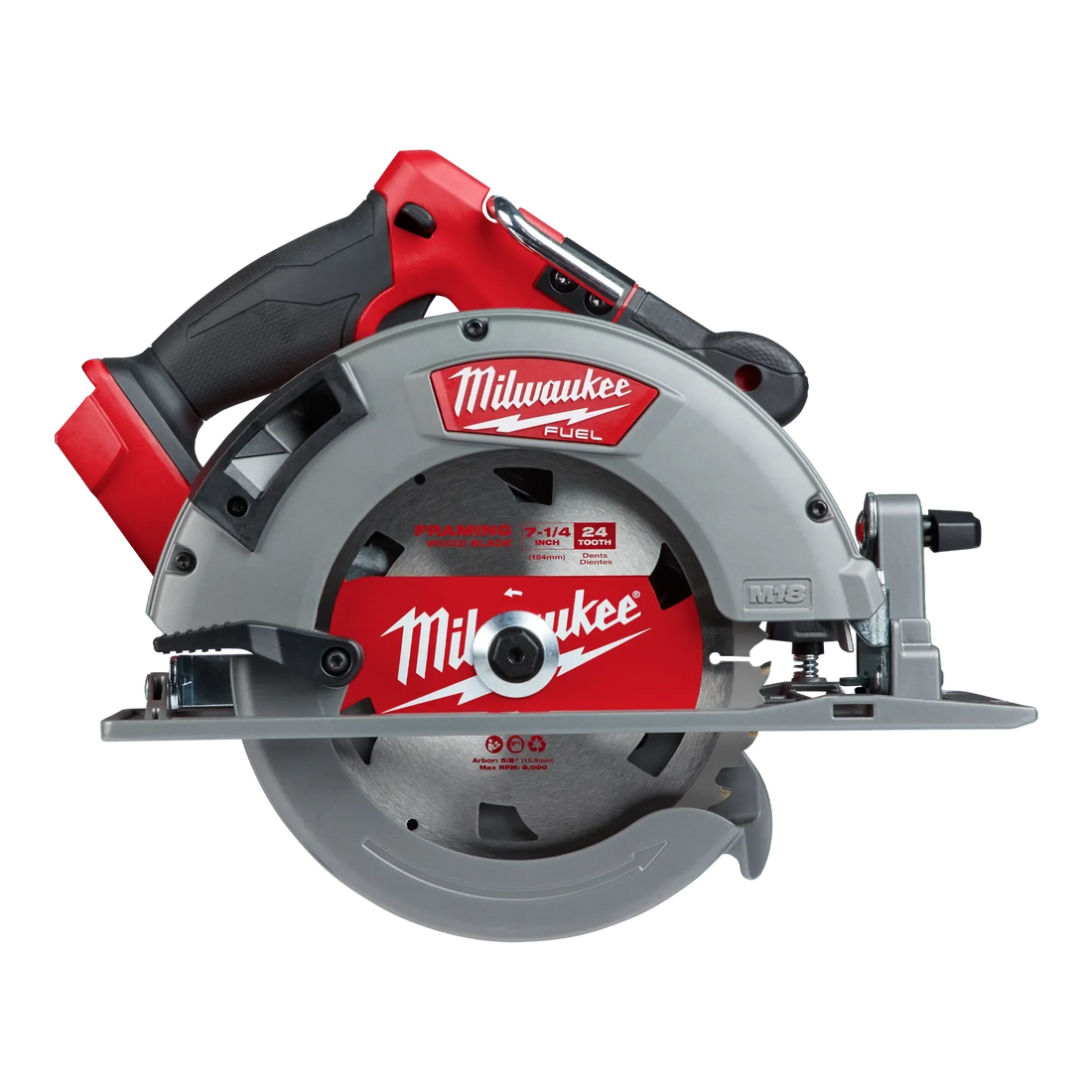
Circular Saw Blade Bolt Won't Loosen? You're Probably Turning It the Wrong Way
On most cordless sidewinder circular saws — including Milwaukee M18 and DeWalt 20V models — the blade bolt (arbor bolt) is reverse (left-hand) threaded. You loosen it by turning clockwise. If you've been cranking counterclockwise for the last ten minutes, you've been tightening it with every turn. Worm-drive saws and left-blade corded saws are the opposite: standard thread, loosen counterclockwise. Confirm your saw type in the table below, then work through the escalating fixes. Most stuck bolts come off in under five minutes once you're turning the right direction.
Which Direction Does Your Circular Saw Blade Bolt Loosen?
Thread direction isn't universal. It follows a mechanical logic: the bolt design prevents the saw's own rotation from unthreading it mid-cut. That means right-blade saws (where the blade mounts to the right of the motor) use reverse thread, and left-blade saws use standard thread.
Right-blade cordless saws (most Milwaukee M18 and DeWalt 20V sidewinders): left-hand thread — loosen clockwise

This covers the majority of modern cordless circular saws. The blade mounts on the right side of the motor housing. The arbor bolt has left-hand (reverse) thread. Turn it clockwise to loosen. The DeWalt DCS565P1 owner's manual confirms this directly: left-hand threads, loosen clockwise, tighten counterclockwise. Milwaukee M18 circular saws follow the same convention — check the blade-change section of your specific model's owner's manual to verify the thread direction for your tool.
Left-blade and worm-drive saws (Skilsaw HD77M, Milwaukee 6390-series, Makita worm drives): standard right-hand thread — loosen counterclockwise
Worm-drive saws mount the blade on the left side of the motor. Standard thread. Turn counterclockwise to loosen — what you'd do for any ordinary bolt.
How to confirm without guessing
Don't rely on memory. Open your owner's manual to the blade-change section — thread direction is always listed there. Some bolt faces have a direction arrow stamped directly on them. If yours reads "LOOSEN →" with a clockwise arrow, that confirms reverse thread.
Thread direction by saw type
| Saw type | Thread | Loosen direction |
|---|---|---|
| Cordless sidewinder, blade right (Milwaukee M18, DeWalt 20V) | Left-hand (reverse) | Clockwise |
| Corded sidewinder, blade right (most standard corded saws) | Left-hand (reverse) | Clockwise |
| Worm-drive saw (Skilsaw HD77M, Makita worm drive) | Standard right-hand | Counterclockwise |
| Left-blade corded saw (Milwaukee 6390-series) | Standard right-hand | Counterclockwise |
Step-by-Step: How to Loosen a Stuck Circular Saw Blade Bolt
Step 1: Pull the battery or unplug the saw. No exceptions. A blade-change is not a "quick job" worth skipping this step.
Step 2: Retract the blade guard fully. Expose the entire bolt head. Trying to wrench on a partially guarded bolt is how you slip.
Step 3: Engage the spindle lock — fully. Press and hold the spindle lock button until you feel it seat positively. A half-engaged lock is the primary reason spindle lock pegs strip. Hold continuous pressure on that button through the entire wrench stroke.
Step 4: Confirm thread direction. Use the table above. One minute now prevents stripped bolt heads later.
Step 5: Apply firm, steady torque in the correct direction. Use the blade wrench that shipped with the saw, or a correctly-sized open-end wrench. Most circular saw arbor bolts are 15 mm or 9/16 in., but the exact size varies by model — your owner's manual's blade-change section lists the correct size for your saw. Smooth, sustained pressure. No jerking — sudden force strips bolt heads fast.
Still Stuck? Escalating Fixes (In Order)
Work through these in sequence. Jump straight to impact wrench and you risk damage that turns a five-minute fix into a shop trip.
More leverage
Fit a longer wrench or a breaker bar onto the bolt head. Slow, steady pressure, not a sharp yank. Do not use an impact driver directly on the spindle — the geometry is wrong and it can shear the spindle lock peg.
Penetrating oil
Apply PB Blaster or WD-40 Specialist Penetrant around the arbor bolt threads. Let it soak 15–30 minutes minimum. Penetrating oil needs time to wick into the threads — five minutes won't cut it. Keep it off the blade teeth and away from rubber components. Retry with the wrench after the soak.
Wood-block method
With the spindle lock engaged, wedge a scrap block of wood firmly between a blade tooth and the saw's shoe/base plate. The block resists blade rotation so the spindle lock doesn't have to do all the work. Turn the bolt wrench in the correct direction. Wear gloves — the tooth contact point is sharp.
Short-burst impact wrench
A cordless impact wrench (not an impact driver) fitted with a correct-size deep socket, one or two short bursts in the verified correct direction. This method works, but carries real risk: if the spindle lock is already stressed or worn, the impact shock can snap it. Treat this as the last mechanical step before you consider professional help. The same principle applies when a lug nut refuses to budge — see how to use impact wrenches on stubborn fasteners for more on impact tool techniques.
When to stop and take it to a shop
Stop immediately if the bolt head starts to round out, if the spindle lock clicks or slips without holding, or if the arbor itself moves in the housing. More force at that point causes damage that costs far more than a blade-change fee. This is a shop repair.
> Important: Do not apply heat to a cordless saw's arbor area. Heat near plastic housings, wiring, or battery contacts can cause permanent damage — or worse.
After the Bolt Comes Off — Set It Up Right
Getting the blade off is half the job. A correct reinstall means you won't be back here next time.
Blade teeth direction: Teeth should point forward and downward in the direction of cut. Get this wrong and the saw will kick, bind, and cut badly. For a full breakdown of blade orientation and selection, see our blade compatibility guide.
Correct tightening: Snug the bolt by hand, then 1/8 turn more with the wrench. That's it. The reverse-thread design means the saw's own cutting action continues tightening the bolt while it works. Gorilla-tight on installation equals a stuck bolt on the next blade change — guaranteed.
Now that the old blade is off, it's a good time to upgrade. A fresh blade makes a visible difference in cut quality and motor load. Start by considering which tooth count suits your material, then evaluate whether thin-kerf blades fit your cordless saw — they matter more than most people realize. Platform options are available for both Milwaukee M18 and DeWalt 20V circular saws.
FAQ
Is a circular saw blade bolt reverse threaded? On most cordless sidewinder saws — blade mounted to the right of the motor housing — yes. The arbor bolt is left-hand threaded. Turn clockwise to loosen. Worm-drive and left-blade saws use standard thread; loosen counterclockwise. Your owner's manual's blade-change section always specifies the direction.
What direction do you turn a circular saw blade nut to loosen it? Clockwise on most cordless right-blade saws. Counterclockwise on worm drives and left-blade saws. The rule of thumb "righty-tighty, lefty-loosey" only applies to standard thread — reverse-thread bolts are the opposite. The manual tells you which one you have.
What size wrench fits a circular saw blade bolt? Most commonly 15 mm or 9/16 in., but it varies by model and manufacturer. Check your owner's manual's blade-change section for the exact size before you start. Using a close-but-wrong size is a reliable way to round the bolt head.
Can I use an impact wrench to loosen a stuck circular saw blade bolt? A cordless impact wrench with a correct-size deep socket can work — one or two short bursts in the verified correct direction. Do not use an impact driver; wrong tool geometry for this application. Key risk: if the spindle lock is already worn, the impact shock can snap it. Use this as a last resort, not a first step.
Why does my circular saw blade bolt keep getting stuck? The reverse-thread design means the saw tightens the bolt during every cut — that's the intended function. The problem happens when the previous blade install was over-torqued. Each cut makes it tighter. Snug plus 1/8 turn on install is all the thread needs; the saw does the rest.
How tight should a circular saw blade bolt be? Firmly snug by hand, then 1/8 turn with the wrench. Most arbor bolt specifications stop at "firmly tighten" rather than a precise torque figure — check the blade-change section of your own manual to see if a specific value is listed for your model. The reverse-thread design means over-tightening is the more common problem, not under-tightening.
Ready to install a fresh blade? Browse Milwaukee circular saw accessories or DeWalt 20V blade options.