
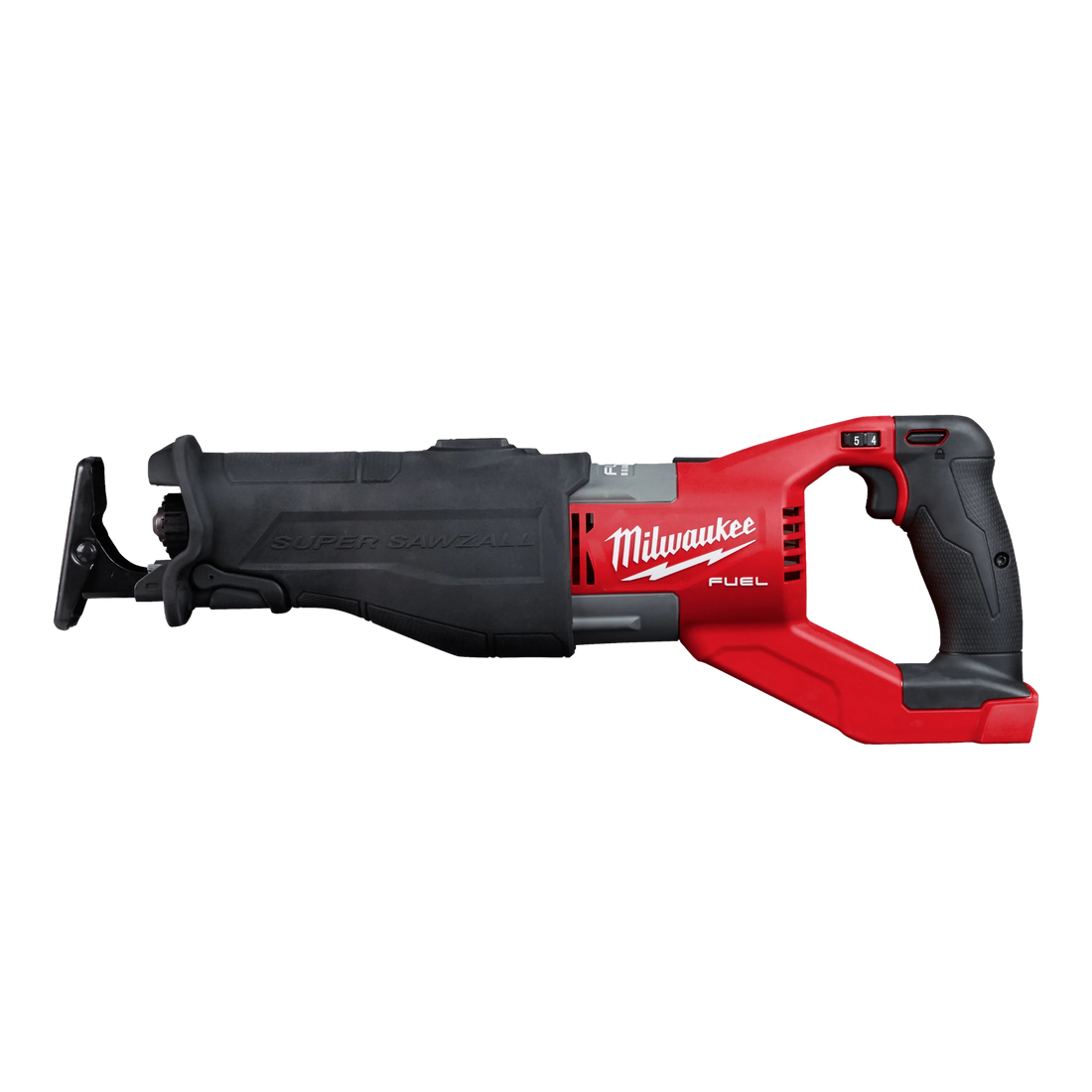
Milwaukee Sawzall Blade Stuck and Won't Release? Here's the Fix
If your Milwaukee Sawzall blade is stuck and won't release, start here: push the QUIK-LOK collar all the way forward — toward the blade tip — hold it there, then pull the blade straight rearward. That's the correct sequence. If it still won't budge, stop. Don't force it. One of three things is going wrong: you're not fully actuating the collar, the blade is bent and the shank is binding inside the jaw, or the clamp spring is broken and the jaws aren't actually opening. The fix is different for each. Sixty seconds of diagnosis beats five minutes of frustration.
> Inverse problem? If the blade keeps *falling out* instead of sticking in, that's a different fix — see this guide on preventing blade drop-out.
Quick diagnostic — pick your symptom:
| Symptom | Likely cause | Go to |
|---|---|---|
| Collar won't push forward or doesn't hold | Technique or collar binding | Step 1 |
| Collar opens fine, blade still won't pull out | Blade deformation | Step 2 |
| Collar moves but feels vague; blade rattles during cuts | Broken clamp spring | Step 3 |
Step 1 — Make Sure the QUIK-LOK Collar Is Fully Open
This is where most stuck-blade calls start and end.
How the QUIK-LOK actually works
The QUIK-LOK collar is a spring-loaded ring around the blade clamp. Pushing it forward cams the jaws open. Release it and the spring snaps the jaws shut. Simple — but it only works if you push it *all the way* forward and *hold it there* before pulling.
What's the correct release sequence?
Wrong: grabbing the blade and pushing the collar at the same time while wiggling everything.
Right: two hands. One pushes the collar fully forward and holds it — don't let it drift back. The other pulls the blade straight rearward. No twisting, no side-load. Collar first, then pull.
If the collar feels stiff or won't push fully forward, skip to Step 3.
Which Milwaukee SAWZALL models use QUIK-LOK vs. the older keyed clamp?
QUIK-LOK is standard on current M18 and M12 cordless SAWZALL models, including the Milwaukee 2821-20 M18 FUEL SAWZALL (2821-20), 2722-21HD, 2621-20, 2625-20, 2420-20, and 2520-20.
Older corded SAWZALL models used a keyed clamp — a hex key or built-in wrench releases a set screw rather than a collar. Milwaukee's keyed-vs.-QUIK-LOK split runs across multiple M18 lines: the M18 FUEL HOLE HAWG Gen 1 (2014) offered the 2707 (keyed) and 2708 (QUIK-LOK); the current Gen 2 is the 2807 (keyed) and 2808 (QUIK-LOK); and the M18 FUEL SUPER HAWG currently ships as the 2809 (keyed) or 2811 (QUIK-LOK). If there's no collar to push on your saw, look for the hex key location near the blade chuck.
Step 2 — Deal with a Blade That's Deformed

If the collar pushes forward fine but the blade won't pull out, the blade itself is the problem. There are two types — and they need different fixes.
Body-bent blade
The shank seats fine, but the blade body is bowed or kinked. Pulling rearward, the bent body hits the opening and won't pass through.
Fix: With the collar held fully forward, grip the blade body close to the clamp with locking pliers. Rotate the blade 10–15 degrees while pulling. That small rotation gives the bent body the clearance to clear the opening.
Shank-bent blade
The T-shank itself is deformed — flattened, bent, or the locking notch is mangled. The jaw opens but the shank won't slide free.
Mild case: With the collar held open, work a flat-blade screwdriver or thin wedge behind the jaw face to lever it open slightly more, then pull while levering.
Severe case: If the shank won't move at all, cut the blade body off close to the clamp with a bolt cutter or angle grinder. Now you have a grip on just the shank stub with locking pliers — much more control. It sounds aggressive; it's the right call after you've already burned five minutes on everything else.
How do you tell a bent blade from a broken clamp?
With the saw off, try wiggling the blade side-to-side. If the clamp feels solid but the blade won't pull out — deformed blade. If the clamp itself feels sloppy, or the blade rattles at idle — move to Step 3.
Step 3 — When the Clamp Mechanism Itself Is Broken
A healthy QUIK-LOK spring holds the jaws firmly closed. A broken spring means the collar may move but the jaws don't open with real force, or the whole assembly feels vague.
Signs of a failed QUIK-LOK spring
- Collar pushes forward but blade won't release
- Blade rattles or has play during a cut
- Clamp feels noticeably looser than when the saw was new
- You can move the shank by hand without pushing the collar
Is the Milwaukee QUIK-LOK blade clamp user-replaceable?
Yes — the QUIK-LOK blade clamp assembly is a user-replaceable part on the 2821-20. Order it under part number 42-68-0026 from Milwaukee or an authorized service dealer.
What's the Milwaukee warranty and service path?
Milwaukee covers M18 power tools under a 5-year limited warranty. For a broken QUIK-LOK clamp on an in-warranty saw, call Milwaukee at 1-800-729-3878 before paying for anything out of pocket. A mechanical failure isn't a user error — don't let a service center treat it like one.
How to Prevent a Stuck Sawzall Blade
Clear the clamp with compressed air. Drywall dust and plaster pack the blade clamp area over time and make the collar stiff. A quick blast after any demolition or masonry cut keeps it moving freely.
Don't side-load the blade. Keep the shoe flat against the material and let the saw track the cut. Angling the saw and wrist-steering bends blades at the shank — that's the root cause of most stuck-shank situations. Not a saw problem; a technique problem.
Swap blades before they're completely dead. Dull blades flex harder under load and bend at the shank faster. This blade selection guide covers when to pull a blade before it becomes a stuck-blade situation.
For blade compatibility across brands, compatible blade standards covers what fits the QUIK-LOK. And if you're deciding between Milwaukee and Diablo for the next load, Milwaukee vs. Diablo blades has the head-to-head.
Frequently Asked Questions
Q: How do I release a blade from a Milwaukee Sawzall? Push the QUIK-LOK collar fully forward — toward the blade tip — and hold it there. Then pull the blade straight rearward. Both steps matter. Releasing the collar mid-pull closes the jaws back on the shank.
Q: Why won't my Sawzall blade release even when I push the collar? Two likely causes: the blade shank is bent and binding inside the jaw despite the clamp being open, or the clamp spring is failed and the jaws aren't actually opening with enough force. If the clamp feels loose in normal use, the spring is the likely culprit.
Q: Can I use pliers to pull out a stuck Sawzall blade? Yes — but only after confirming the QUIK-LOK collar is fully held forward. Yanking against a closed clamp damages the jaw. With the collar held open, locking pliers on the blade body close to the clamp is the right move for a bent-body blade.
Q: Is the Milwaukee QUIK-LOK blade clamp replaceable? Yes — the QUIK-LOK assembly on the 2821-20 is a user-replaceable part, available as part number 42-68-0026. For an in-warranty saw with a broken clamp, call Milwaukee at 1-800-729-3878 before paying anything.
Q: Why does my Milwaukee Sawzall blade keep bending? Side-loading — angling the saw rather than running it straight through the cut. Keep the shoe flat against the material. Dull blades make it worse; they flex harder under load. Swap earlier.
Q: What blades fit the Milwaukee Sawzall QUIK-LOK? The QUIK-LOK accepts T-shank (universal shank) reciprocating saw blades — the standard profile used across major blade brands. Milwaukee, Diablo, Bosch, and DeWalt T-shank blades all fit.
Once the blade is out, it's worth checking your stock. For demolition cuts — nails, wood, mixed material — the Milwaukee Demolition Blade Set covers the heavy work. For metal, load the Milwaukee Metal Cutting Blade Set. Both are in the Milwaukee collection.